Laboratoire ECIPSY - EA 4047, Université de Versailles Saint Quentin en Yvelines Versailles, France ; Grupo de Investigación en Neurociencias (NeURos), Facultad de Ciencias de la Salud, Universidad del Rosario Bogotá, Colombia ; Grupo de Investiga, Laboratorio de Psicología Experimental, Facultad de Psicología, Universidad El Bosque Bogotá, Colombia.
Laboratoire ECIPSY - EA 4047, Université de Versailles Saint Quentin en Yvelines Versailles, France ; Child and Adolescent Psychiatry Department, Centre Hospitalier de Versailles Versailles, France.
Front Hum Neurosci. 2014 May 12;8:257. doi: 10.3389/fnhum.2014.00257. eCollection 2014.
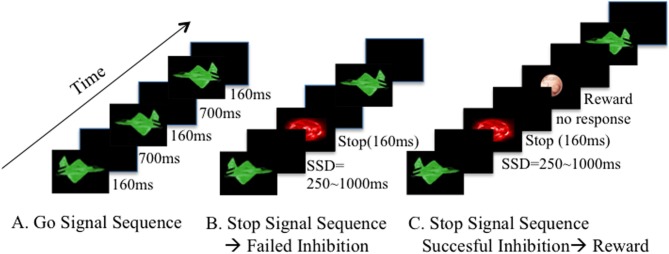
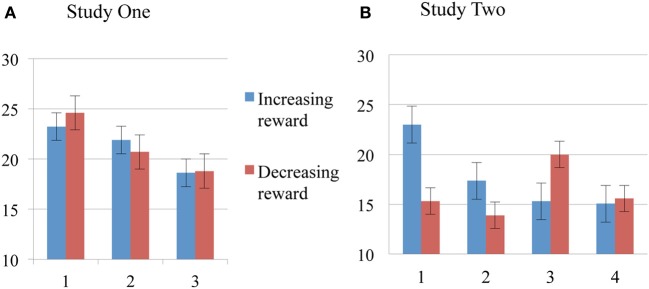
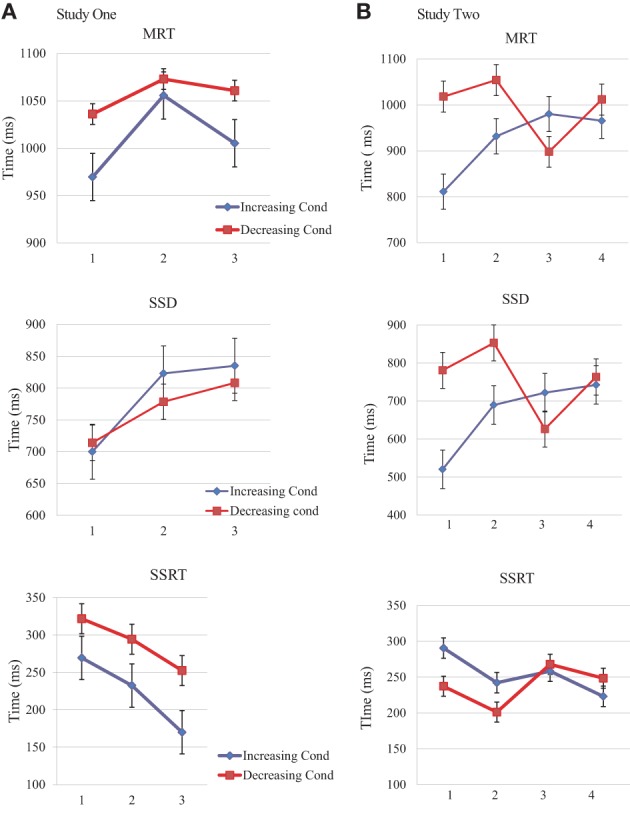
The ability to override a dominant response, often referred to as behavioral inhibition, is considered a key element of executive cognition. Poor behavioral inhibition is a defining characteristic of several neurological and psychiatric populations. Recently, there has been increasing interest in the motivational dimension of behavioral inhibition, with some experiments incorporating emotional contingencies in classical inhibitory paradigms such as the Go/NoGo and Stop Signal Tasks (SSTs). Several studies have reported a positive modulatory effect of reward on performance in pathological conditions such as substance abuse, pathological gambling, and Attention Deficit Hyperactive Disorder (ADHD). However, experiments that directly investigate the modulatory effects of reward magnitudes on the performance of inhibitory tasks are scarce and little is known about the finer grained relationship between motivation and inhibitory control. Here we probed the effect of reward magnitude and context on behavioral inhibition with three modified versions of the widely used SST. The pilot study compared inhibition performance during six blocks alternating neutral feedback, low, medium, and high monetary rewards. Study One compared increasing vs. decreasing rewards, with low, high rewards, and neutral feedback; whilst Study Two compared low and high reward magnitudes alone also in an increasing and decreasing reward design. The reward magnitude effect was not demonstrated in the pilot study, probably due to a learning effect induced by practice in this lengthy task. The reward effect per se was weak but the context (order of reward) was clearly suggested in Study One, and was particularly strongly confirmed in study two. In addition, these findings revealed a "kick start effect" over global performance measures. Specifically, there was a long lasting improvement in performance throughout the task when participants received the highest reward magnitudes at the beginning of the protocol. These results demonstrate a dynamical behavioral inhibition capacity in humans, as illustrated by the reward magnitude modulation and initial reward history effects.
抑制优势反应的能力,通常被称为行为抑制,被认为是执行认知的关键要素。行为抑制能力差是几种神经和精神疾病人群的一个显著特征。最近,人们对行为抑制的动机维度越来越感兴趣,一些实验在经典的抑制范式(如 Go/NoGo 和停止信号任务(SST))中加入了情绪关联。几项研究报告称,奖励对物质滥用、病态赌博和注意力缺陷多动障碍(ADHD)等病理条件下的表现有积极的调节作用。然而,直接调查奖励幅度对抑制任务表现的调节作用的实验很少,关于动机和抑制控制之间更精细的关系知之甚少。在这里,我们用广泛使用的 SST 的三个修改版本来探测奖励幅度和情境对行为抑制的影响。初步研究比较了在六个块之间交替中性反馈、低、中、高金钱奖励时的抑制性能。研究一比较了递增和递减奖励与低、高奖励和中性反馈的情况;而研究二则单独比较了低和高奖励幅度,同时也在递增和递减奖励设计中进行了比较。初步研究中没有显示出奖励幅度的效果,可能是由于这个冗长任务中的练习导致了学习效应。奖励本身的效果很弱,但在研究一中,情境(奖励顺序)很明显,在研究二中得到了特别强烈的证实。此外,这些发现揭示了对全局性能测量的“启动效应”。具体来说,当参与者在协议开始时收到最高奖励幅度时,整个任务的表现会有持久的提高。这些结果表明人类具有动态的行为抑制能力,这可以通过奖励幅度的调节和初始奖励历史的影响来体现。