Minkov Momchil, Savona Vincenzo
Institute of Theoretical Physics, Ecole Polytechnique Fédérale de Lausanne EPFL, CH-1015 Lausanne, Switzerland.
Sci Rep. 2014 May 30;4:5124. doi: 10.1038/srep05124.
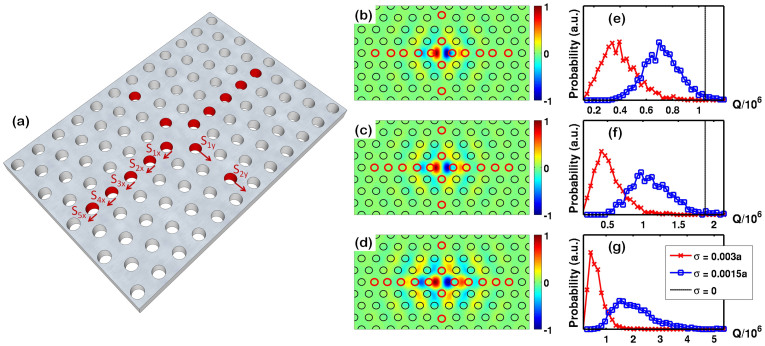
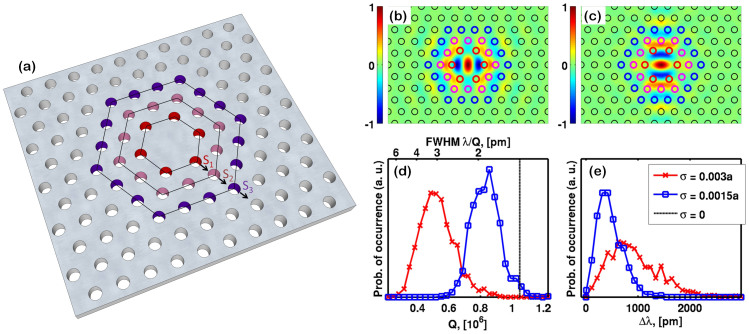
Thanks to their high quality factor, combined to the smallest modal volume, defect-cavities in photonic crystal slabs represent a promising, versatile tool for fundamental studies and applications in photonics. In paricular, the L3, H0, and H1 defects are the most popular and widespread cavity designs, due to their compactness, simplicity, and small mode volume. For these cavities, the current best optimal designs still result in Q-values of a few times 10(5) only, namely one order of magnitude below the bound set by fabrication imperfections and material absorption in silicon. Here, we use a genetic algorithm to find a global maximum of the quality factor of these designs, by varying the positions of few neighbouring holes. We consistently find Q-values above one million - one order of magnitude higher than previous designs. Furthermore, we study the effect of disorder on the optimal designs and conclude that a similar improvement is also expected experimentally in state-of-the-art systems.
由于其高品质因数,再加上最小的模态体积,光子晶体平板中的缺陷腔是用于光子学基础研究和应用的一种很有前景的通用工具。特别是,L3、H0和H1缺陷是最流行且应用广泛的腔设计,这得益于它们的紧凑性、简单性以及小模式体积。对于这些腔来说,目前最佳的优化设计的品质因数仍仅为10的5次方的几倍,即比硅中的制造缺陷和材料吸收所设定的界限低一个数量级。在此,我们通过改变少数相邻孔的位置,使用遗传算法来找到这些设计的品质因数的全局最大值。我们始终发现品质因数高于一百万——比之前的设计高一个数量级。此外,我们研究了无序对优化设计的影响,并得出结论,在最先进的系统中,实验上也有望实现类似的改进。