Biomass and Waste Energy Laboratory, Korea Institute of Energy Research, 152 Gajeong-ro, Daejeon, Yuseong-gu 305-343, Republic of Korea.
Department of Civil Engineering, Kyung Hee University, 1732 Deokyoungdaero, Yongin, Giheung, Gyeonggi-do 446-701, Republic of Korea.
Biotechnol Biofuels. 2014 May 27;7:79. doi: 10.1186/1754-6834-7-79. eCollection 2014.
Biological fermentation routes can provide an environmentally friendly way of producing H2 since they use renewable biomass as feedstock and proceed under ambient temperature and pressure. In particular, photo-fermentation has superior properties in terms of achieving high H2 yield through complete degradation of substrates. However, long-term H2 production data with stable performance is limited, and this data is essential for practical applications. In the present work, continuous photo-fermentative H2 production from lactate was attempted using the purple non-sulfur bacterium, Rhodobacter sphaeroides KD131. As a gradual drop in H2 production was observed, we attempted to add ethanol (0.2% v/v) to the medium.
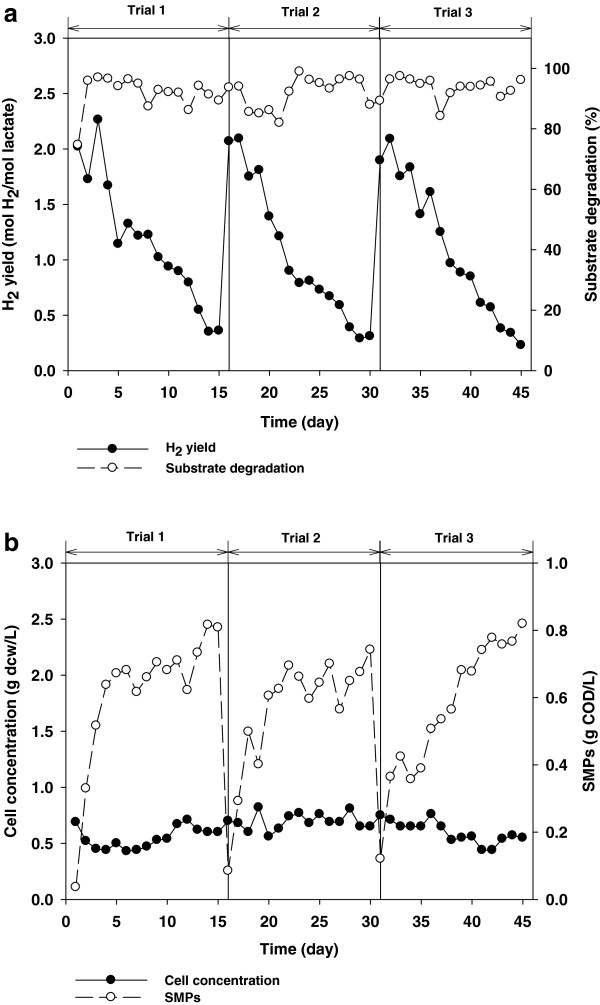
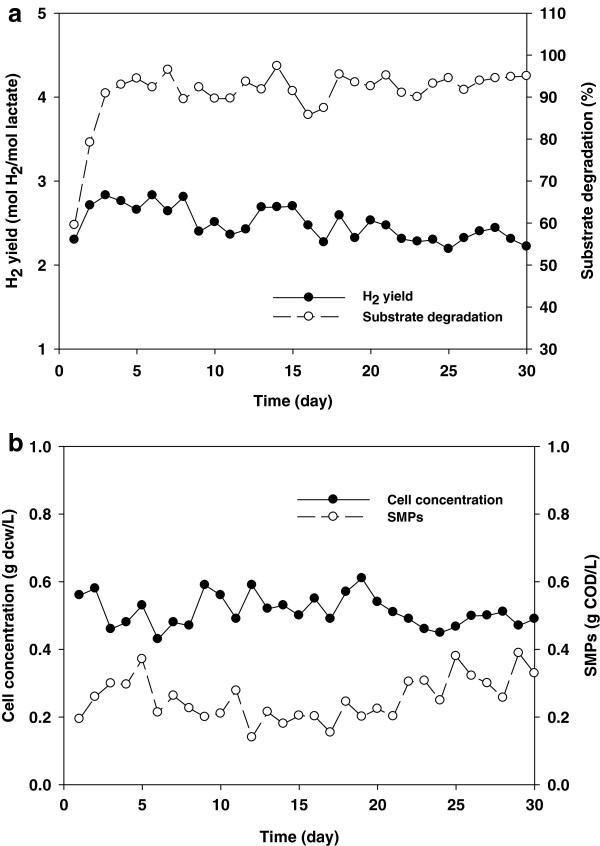
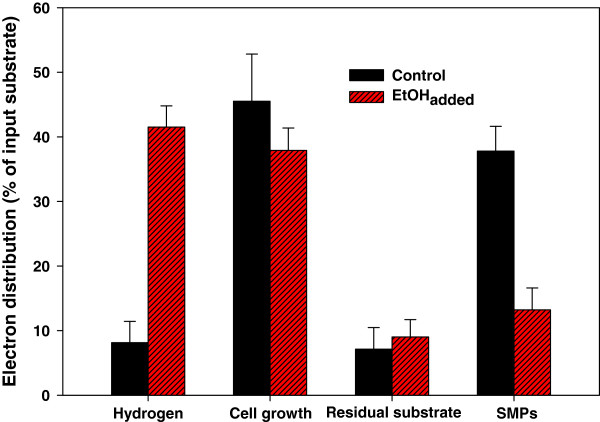
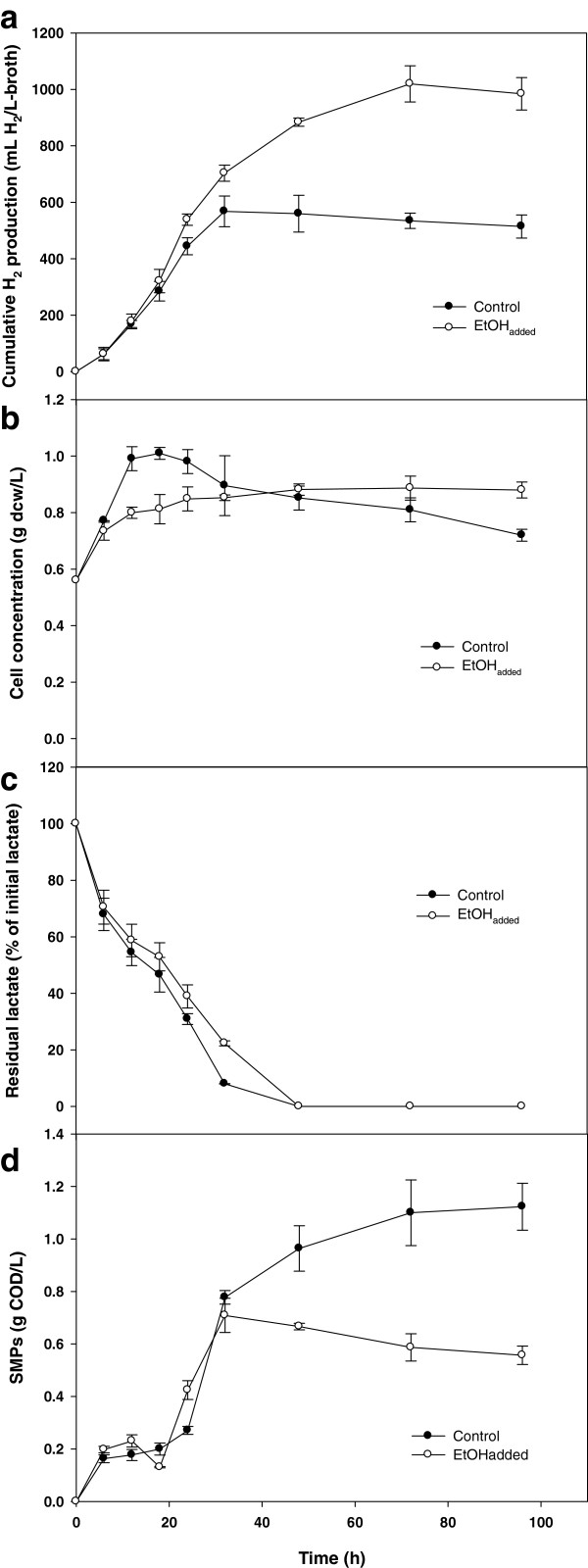
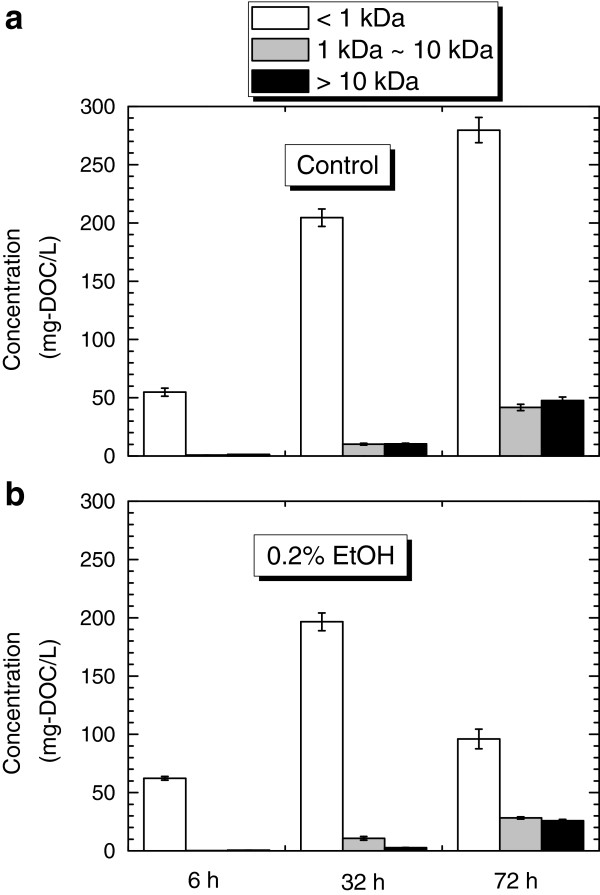
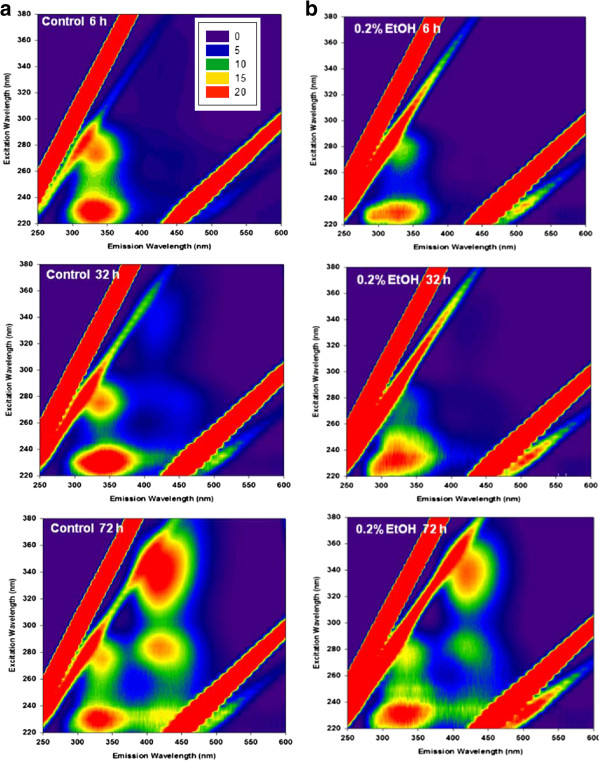
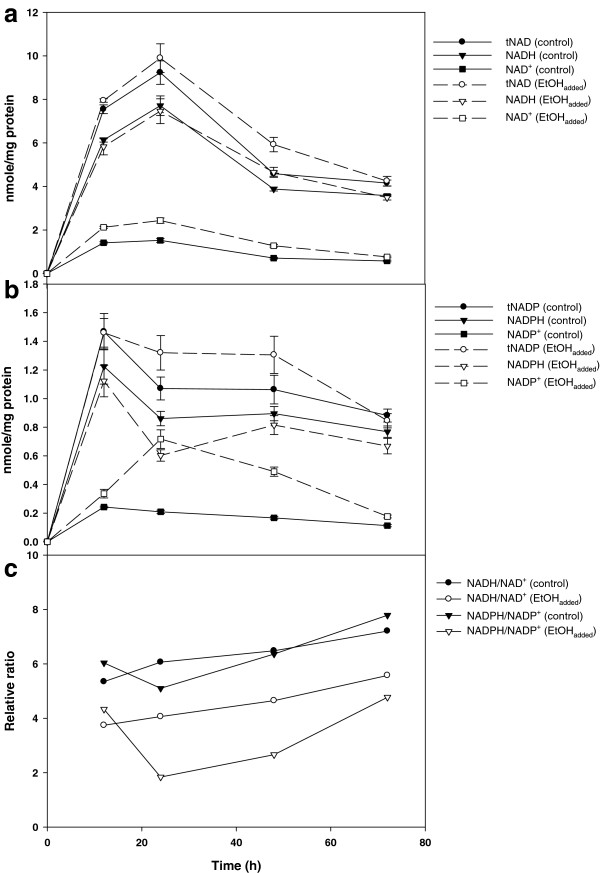
As continuous operation went on, H2 production was not sustained and showed a negligible H2 yield (< 0.5 mol H2/mol lactateadded) within two weeks. Electron balance analysis showed that the reason for the gradual drop in H2 production was ascribed to the increase in production of soluble microbial products (SMPs). To see the possible effect of ethanol addition, a batch test was first conducted. The presence of ethanol significantly increased the H2 yield from 1.15 to 2.20 mol H2/mol lactateadded, by suppressing the production of SMPs. The analysis of SMPs by size exclusion chromatography showed that, in the later period of fermentation, more than half of the low molecular weight SMPs (< 1 kDa) were consumed and used for H2 production when ethanol had been added, while the concentration of SMPs continuously increased in the absence of ethanol. It was found that the addition of ethanol facilitated the utilization of reducing power, resulting in an increase in the cellular levels of NAD(+) and NADP(+). In continuous operation, ethanol addition was effective, such that stable H2 production was attained with an H2 yield of 2.5 mol H2/mol lactateadded. Less than 15% of substrate electrons were used for SMP production, whereas 35% were used in the control.
We have found that SMPs are the key factor in photo-fermentative H2 production, and their production can be suppressed by ethanol addition. However, since external addition of ethanol to the medium represents an extra economic burden, ethanol should be prepared in a cost-effective way.
生物发酵途径可以提供一种环保的生产氢气的方式,因为它们使用可再生生物质作为原料,并在环境温度和压力下进行。特别是,光发酵在通过完全降解基质来获得高氢气产量方面具有优越的性质。然而,具有稳定性能的长期氢气生产数据是有限的,而这些数据对于实际应用是必不可少的。在本工作中,尝试使用紫色非硫细菌 Rhodobacter sphaeroides KD131 从乳酸盐连续进行光发酵生产氢气。由于观察到氢气产量逐渐下降,我们尝试向培养基中添加乙醇(0.2%v/v)。
随着连续操作的进行,氢气生产不能维持,并且在两周内表现出可忽略不计的氢气产率(<0.5molH2/mol乳酸盐添加)。电子平衡分析表明,氢气产量逐渐下降的原因归因于可溶微生物产物(SMP)产量的增加。为了观察添加乙醇的可能效果,首先进行了分批试验。当添加乙醇时,通过抑制 SMP 的产生,乙醇的存在显著将氢气产率从 1.15molH2/mol乳酸盐添加提高到 2.20molH2/mol乳酸盐添加。通过尺寸排阻色谱对 SMP 进行分析表明,在发酵后期,当添加乙醇时,超过一半的低分子量 SMP(<1kDa)被消耗并用于氢气生产,而在没有乙醇的情况下,SMP 的浓度持续增加。发现添加乙醇有利于还原力的利用,从而增加了细胞内 NAD(+)和 NADP(+)的水平。在连续操作中,添加乙醇是有效的,使得稳定的氢气产率达到 2.5molH2/mol乳酸盐添加。不到 15%的基质电子用于 SMP 生产,而在对照中则有 35%用于 SMP 生产。
我们发现 SMP 是光发酵生产氢气的关键因素,并且可以通过添加乙醇来抑制 SMP 的产生。然而,由于向培养基中添加乙醇会带来额外的经济负担,因此应该以具有成本效益的方式制备乙醇。