
用于检测狐狸(赤狐)粪便中低水平多房棘球绦虫卵的灵敏分子工具的实验室评估。
Laboratory assessment of sensitive molecular tools for detection of low levels of Echinococcus multilocularis-eggs in fox (Vulpes vulpes) faeces.
作者信息
Øines Øivind, Isaksson Mats, Hagström Åsa, Tavornpanich Saraya, Davidson Rebecca K
机构信息
Norwegian Veterinary Institute, Post boks 750 Sentrum, 0106, Oslo, Norway.
出版信息
Parasit Vectors. 2014 May 28;7:246. doi: 10.1186/1756-3305-7-246.
BACKGROUND
In endemic areas with very low infection prevalence, the frequency and intensity of Echinococcus multilocularis can be extremely low. This necessitates efficient, specific and sensitive molecular tools. We wanted to compare the existing molecular tools, used in the Norwegian national surveillance programme, and compare these with new techniques for detection of this zoonotic pathogen in fox faeces. Here we present the results of screening samples containing a known level of E. multilocularis eggs with two highly sensitive DNA isolation and extraction methods combined with one conventional PCR and three real-time PCR methods for detection.
METHODS
We performed a comparison of two extraction protocols; one based on sieving of faecal material and one using targeted DNA sampling. Four methods of molecular detection were tested on E. multilocularis-egg spiked fox faeces.
RESULTS
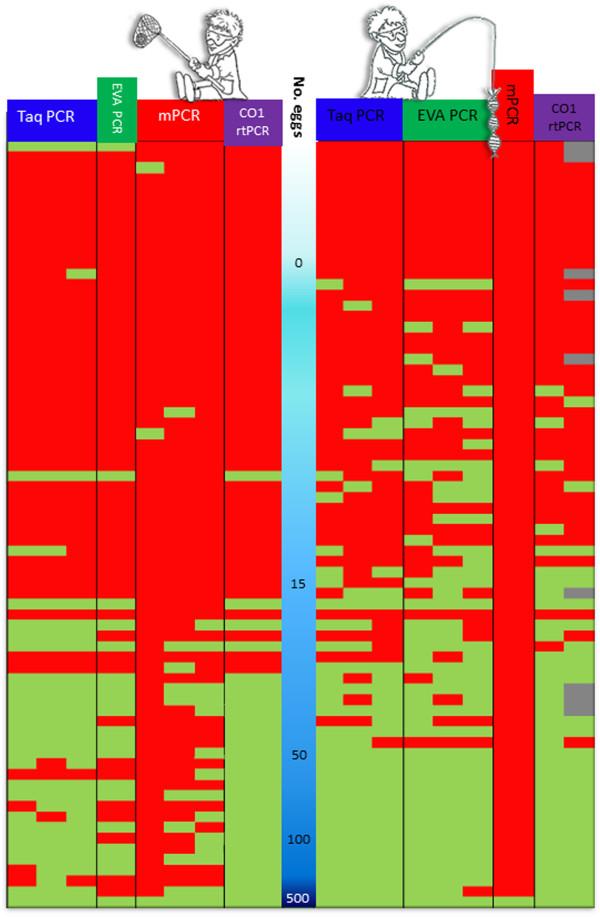
There were significant differences between the multiplex PCR/egg sieving DNA extraction methods compared to the new DNA fishing method and the three real-time PCR assays. Results also indicate that replicates of the PCR-reactions improve detection sensitivity when egg numbers are low.
CONCLUSIONS
The results indicate that the use of real-time PCR combined with targeted DNA extraction, improves the sensitivity of E. multilocularis detection in faecal samples containing low numbers of E. multilocularis eggs. Results also indicate the importance of replicates of the PCR-reactions when pathogen levels are low.
背景
在感染率极低的流行地区,多房棘球绦虫的感染频率和强度可能极低。这就需要高效、特异且灵敏的分子检测工具。我们希望比较挪威国家监测项目中使用的现有分子检测工具,并将其与检测狐狸粪便中这种人畜共患病原体的新技术进行比较。在此,我们展示了用两种高灵敏度DNA分离提取方法,结合一种常规PCR和三种实时PCR方法检测含有已知水平多房棘球绦虫虫卵的样本的筛查结果。
方法
我们对两种提取方案进行了比较;一种基于粪便材料的筛分,另一种采用靶向DNA采样。在接种了多房棘球绦虫虫卵的狐狸粪便上测试了四种分子检测方法。
结果
多重PCR/虫卵筛分DNA提取方法与新的DNA捕捞方法及三种实时PCR检测方法之间存在显著差异。结果还表明,当虫卵数量较少时,PCR反应的重复操作可提高检测灵敏度。
结论
结果表明,实时PCR与靶向DNA提取相结合,可提高在含有少量多房棘球绦虫虫卵的粪便样本中检测该病原体的灵敏度。结果还表明,当病原体水平较低时,PCR反应重复操作的重要性。




 Zotero 插件