Brücher Björn Ldm, Jamall Ijaz S
Theodor-Billroth-Academy®, Munich, Germany.
BMC Cancer. 2014 May 10;14:331. doi: 10.1186/1471-2407-14-331.
Carcinogenesis is widely thought to originate from somatic mutations and an inhibition of growth suppressors, followed by cell proliferation, tissue invasion, and risk of metastasis. Fewer than 10% of all cancers are hereditary; the ratio in gastric (1%), colorectal (3-5%) and breast (8%) cancers is even less. Cancers caused by infection are thought to constitute some 15% of the non-hereditary cancers. Those remaining, 70 to 80%, are called "sporadic," because they are essentially of unknown etiology. We propose a new paradigm for the origin of the majority of cancers.
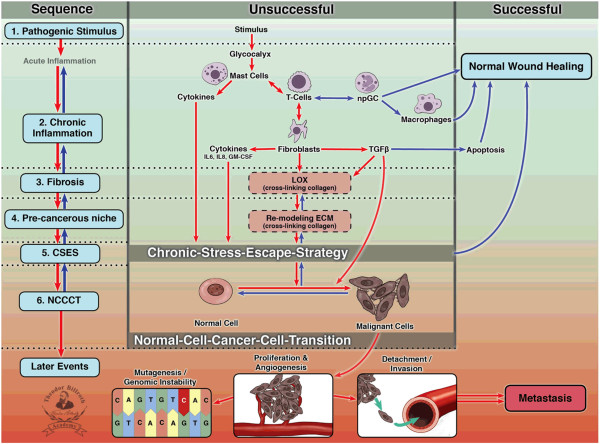
Our paradigm postulates that cancer originates following a sequence of events that include (1) a pathogenic stimulus (biological or chemical) followed by (2) chronic inflammation, from which develops (3) fibrosis with associated changes in the cellular microenvironment. From these changes a (4) pre-cancerous niche develops, which triggers the deployment of (5) a chronic stress escape strategy, and when this fails to resolve, (6) a transition of a normal cell to a cancer cell occurs. If we are correct, this paradigm would suggest that the majority of the findings in cancer genetics so far reported are either late events or are epiphenomena that occur after the appearance of the pre-cancerous niche.
If, based on experimental and clinical findings presented here, this hypothesis is plausible, then the majority of findings in the genetics of cancer so far reported in the literature are late events or epiphenomena that could have occurred after the development of a PCN. Our model would make clear the need to establish preventive measures long before a cancer becomes clinically apparent. Future research should focus on the intermediate steps of our proposed sequence of events, which will enhance our understanding of the nature of carcinogenesis. Findings on inflammation and fibrosis would be given their warranted importance, with research in anticancer therapies focusing on suppressing the PCN state with very early intervention to detect and quantify any subclinical inflammatory change and to treat all levels of chronic inflammation and prevent fibrotic changes, and so avoid the transition from a normal cell to a cancer cell.
The paradigm proposed here, if proven, spells out a sequence of steps, one or more of which could be interdicted or modulated early in carcinogenesis to prevent or, at a minimum, slow down the progression of many cancers.
人们普遍认为,癌症的发生源于体细胞突变和生长抑制因子的抑制,随后是细胞增殖、组织侵袭和转移风险。所有癌症中遗传性癌症不到10%;胃癌(1%)、结直肠癌(3 - 5%)和乳腺癌(8%)的这一比例更低。由感染引起的癌症被认为约占非遗传性癌症的15%。其余70%至80%的癌症被称为“散发性”,因为它们的病因基本上不明。我们提出了一种关于大多数癌症起源的新范式。
我们的范式假定癌症起源于一系列事件,这些事件包括:(1)致病性刺激(生物性或化学性),接着是(2)慢性炎症,由此发展出(3)伴有细胞微环境相关变化的纤维化。从这些变化中形成(4)癌前生态位,它触发(5)慢性应激逃避策略的部署,当这种策略无法解决问题时,(6)正常细胞就会转变为癌细胞。如果我们是正确的,那么这个范式表明,到目前为止报道的癌症遗传学中的大多数发现要么是晚期事件,要么是在癌前生态位出现后发生的附带现象。
如果基于此处呈现的实验和临床发现,这个假说看似合理,那么到目前为止文献中报道的癌症遗传学中的大多数发现都是晚期事件或附带现象,这些现象可能在癌前生态位形成之后才出现。我们的模型将明确表明,在癌症临床显现之前很久就需要建立预防措施。未来的研究应聚焦于我们提出的事件序列中的中间步骤,这将增进我们对致癌作用本质的理解。炎症和纤维化方面的发现将得到应有的重视,抗癌治疗的研究将集中在通过非常早期的干预来抑制癌前生态位状态,以检测和量化任何亚临床炎症变化,并治疗所有程度的慢性炎症,预防纤维化变化,从而避免正常细胞向癌细胞的转变。
此处提出的范式如果得到证实,将阐明一系列步骤,其中一个或多个步骤可以在致癌作用的早期被阻断或调节,以预防或至少减缓许多癌症的进展。