Marth Katharina, Wollmann Eva, Gallerano Daniela, Ndlovu Portia, Makupe Ian, Valenta Rudolf, Sibanda Elopy
Division of Immunopathology, Department of Pathophysiology and Allergy Research, Center of Pathophysiology, Infectiology and Immunology, Medical University of Vienna, Vienna, Austria; Christian Doppler Laboratory for Allergy Research, Division of Immunopathology, Department of Pathophysiology and Allergy Research, Center of Pathophysiology, Infectiology and Immunology, Medical University of Vienna, Vienna, Austria.
Division of Immunopathology, Department of Pathophysiology and Allergy Research, Center of Pathophysiology, Infectiology and Immunology, Medical University of Vienna, Vienna, Austria.
PLoS One. 2014 Jun 4;9(6):e97893. doi: 10.1371/journal.pone.0097893. eCollection 2014.
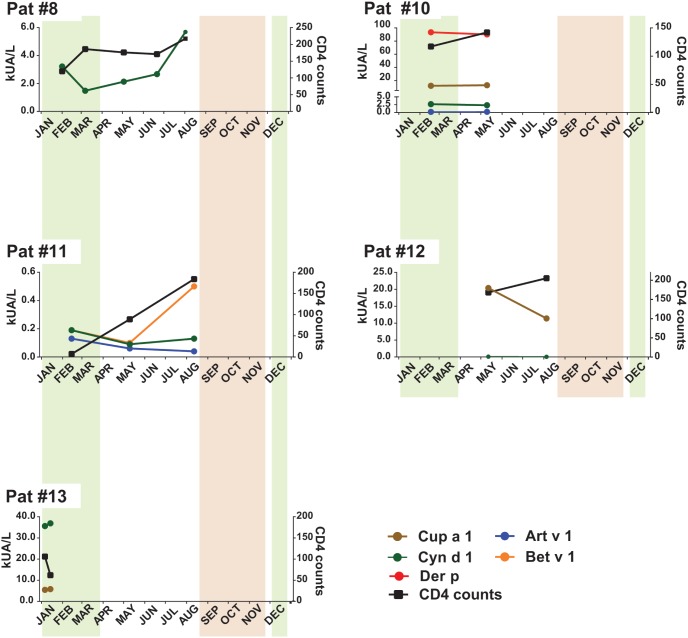
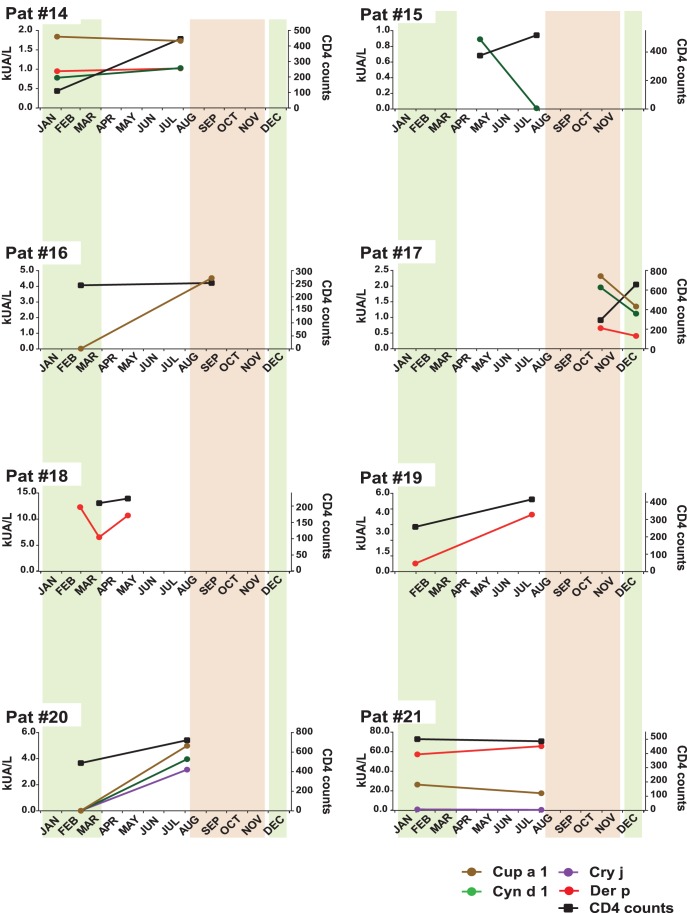
The infection of CD4+ cells by HIV leads to the progressive destruction of CD4+ T lymphocytes and, after a severe reduction of CD4+ cells, to AIDS. The aim of the study was to investigate whether HIV-infected patients with CD4 cell counts <200 cells/µl can suffer from symptoms of IgE-mediated allergy, produce allergen-specific IgE antibody responses and show boosts of allergen-specific IgE production. HIV-infected patients with CD4 counts ≤ 200 cells/µl suffering from AIDS and from IgE-mediated allergy were studied. Allergy was diagnosed according to case history, physical examination, skin prick testing (SPT), and serological analyses including allergen microarrays. HIV infection was confirmed serologically and the disease was staged clinically. The predominant allergic symptoms in the studied patients were acute allergic rhinitis (73%) followed by asthma (27%) due to IgE-mediated mast cell activation whereas no late phase allergic symptoms such as atopic dermatitis, a mainly T cell-mediated skin manifestation, were found in patients suffering from AIDS. According to IgE serology allergies to house dust mites and grass pollen were most common besides IgE sensitizations to various food allergens. Interestingly, pollen allergen-specific IgE antibody levels in the patients with AIDS and in additional ten IgE-sensitized patients with HIV infections and low CD4 counts appeared to be boosted by seasonal allergen exposure and were not associated with CD4 counts. Our results indicate that secondary allergen-specific IgE production and IgE-mediated allergic inflammation do not require a fully functional CD4+ T lymphocyte repertoire.
HIV对CD4+细胞的感染会导致CD4+ T淋巴细胞的逐渐破坏,在CD4+细胞严重减少后会引发艾滋病。本研究的目的是调查CD4细胞计数<200个细胞/微升的HIV感染患者是否会出现IgE介导的过敏症状、产生过敏原特异性IgE抗体反应以及是否会出现过敏原特异性IgE产生的增强。对CD4计数≤200个细胞/微升且患有艾滋病和IgE介导的过敏的HIV感染患者进行了研究。根据病史、体格检查、皮肤点刺试验(SPT)以及包括过敏原微阵列在内的血清学分析来诊断过敏。通过血清学确认HIV感染,并对疾病进行临床分期。研究患者中主要的过敏症状是急性过敏性鼻炎(73%),其次是由于IgE介导的肥大细胞活化引起的哮喘(27%),而在患有艾滋病的患者中未发现迟发性过敏症状,如特应性皮炎(一种主要由T细胞介导的皮肤表现)。根据IgE血清学,除了对各种食物过敏原的IgE致敏外,对屋尘螨和草花粉的过敏最为常见。有趣的是,艾滋病患者以及另外10名IgE致敏的低CD4计数HIV感染患者的花粉过敏原特异性IgE抗体水平似乎因季节性过敏原暴露而升高,且与CD4计数无关。我们的结果表明,继发性过敏原特异性IgE产生和IgE介导的过敏性炎症并不需要完整功能的CD4+ T淋巴细胞库。