Ethiopian Institute of Agricultural Research, Forestry Research Center, P,O, Box 58532, Addis Ababa, Ethiopia.
J Ethnobiol Ethnomed. 2014 Jun 4;10:46. doi: 10.1186/1746-4269-10-46.
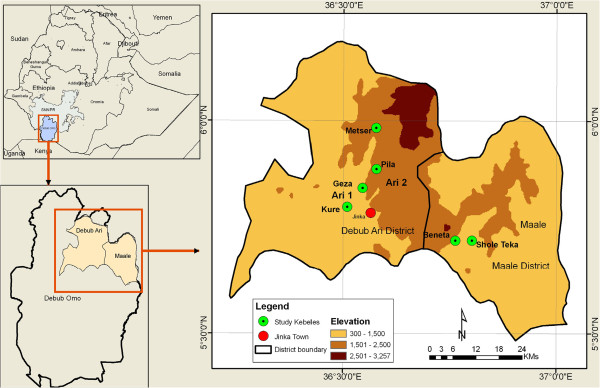
Around 80% of the people of Ethiopia are estimated to be relying on medicinal plants for the treatment of different types of human health problems. The purpose of this study was to describe and analyse the use and management of medicinal plants used for the treatment of human health problems by the Maale and Ari communities in southern Ethiopia.
Quantitative and qualitative ethnobotanical field inquiries and analytical methods including individual and focus group discussions (18), observations, individual interviews (n = 74), preference ranking and paired comparison were used. Data were collected in three study sites and from two markets; the latter surveyed every 15 days from February 2011 to February 2012.
A total of 128 medicinal plant species, belonging to 111 genera and 49 families, used as herbal medicine by Maale and Ari communities were documented. Predominantly harvested plant parts were leaves, which are known to have relatively low impact on medicinal plant resources. Species with high familiarity indices included Solanum dasyphyllum, Indigofera spicata, Ruta chalepensis, Plumbago zeylanica and Meyna tetraphylla. Low Jaccards similarity indices (≤ 0.33) indicated little correspondence in medicinal plant use among sites and between ethnic communities. The dominant ways of medicinal plant knowledge acquisition and transfer is vertical: from parents to children through oral means. Gender and site significantly influenced the number of human medicinal plants known currently in the study sites. Age was only a factor of significance in Maale. Marketing of medicinal plants harvested from wild and semi-wild stands is not common. Expansion of agricultural land and lack of cultivation efforts by local communities are mentioned by locals to affect the availability of medicinal plant resources.
S. dasyphyllum, I. spicata, P. zeylanica, M. tetraphylla, and Oxalis radicosa need to be considered for phytochemical and pharmacological testing to verify their efficacy and determine their dosages. Land use planning and development initiatives in the area and beyond need to sharply focus on strategies that could alleviate the major threats affecting medicinal plant resources in the landscape and encourage their cultivation to enhance their availability and complement ex-and in-situ conservation.
据估计,埃塞俄比亚约有 80%的人依赖药用植物来治疗各种人类健康问题。本研究旨在描述和分析 Maale 和 Ari 社区在埃塞俄比亚南部地区用于治疗人类健康问题的药用植物的使用和管理情况。
采用定量和定性的民族植物学实地调查和分析方法,包括个人和焦点小组讨论(18 次)、观察、个人访谈(n=74)、偏好排序和配对比较。数据于三个研究地点收集,并从两个市场收集;后者于 2011 年 2 月至 2012 年 2 月期间每 15 天调查一次。
共记录了 Maale 和 Ari 社区用作草药的 128 种药用植物,隶属于 111 属和 49 科。最常被采摘的植物部位是叶子,因为它们对药用植物资源的影响相对较小。熟悉指数较高的物种包括 S. dasyphyllum、I. spicata、R. chalepensis、P. zeylanica 和 M. tetraphylla。较低的杰卡德相似性指数(≤0.33)表明,各地点和不同民族社区之间的药用植物使用方式没有太多相似之处。药用植物知识获取和传承的主要方式是垂直的:通过父母以口头方式传授给子女。性别和地点对研究地点目前已知的人类药用植物数量有显著影响。年龄仅在 Maale 是一个重要因素。从野生和半野生状态下采集的药用植物的销售并不常见。当地人提到,农业用地的扩张和当地社区缺乏种植努力,是影响药用植物资源供应的因素。
S. dasyphyllum、I. spicata、P. zeylanica、M. tetraphylla 和 O. radicosa 需要进行植物化学和药理学测试,以验证其疗效并确定其剂量。该地区及其他地区的土地利用规划和发展倡议需要重点关注能够缓解影响景观药用植物资源的主要威胁的策略,并鼓励对其进行种植,以增加其可用性并补充就地和原地保护。