Wang Linqi, Tian Xiuyun, Gyawali Rachana, Upadhyay Srijana, Foyle Dylan, Wang Gang, Cai James J, Lin Xiaorong
Department of Biology, Texas A&M University, College Station, Texas, United States of America.
Department of Veterinary Integrative Biosciences, Texas A&M University, College Station, Texas, United States of America.
PLoS Pathog. 2014 Jun 5;10(6):e1004185. doi: 10.1371/journal.ppat.1004185. eCollection 2014 Jun.
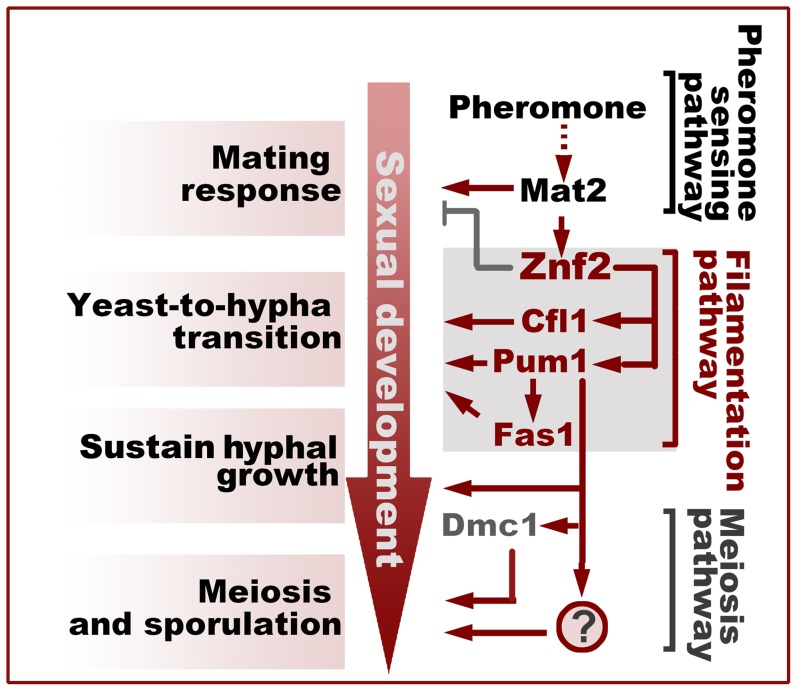
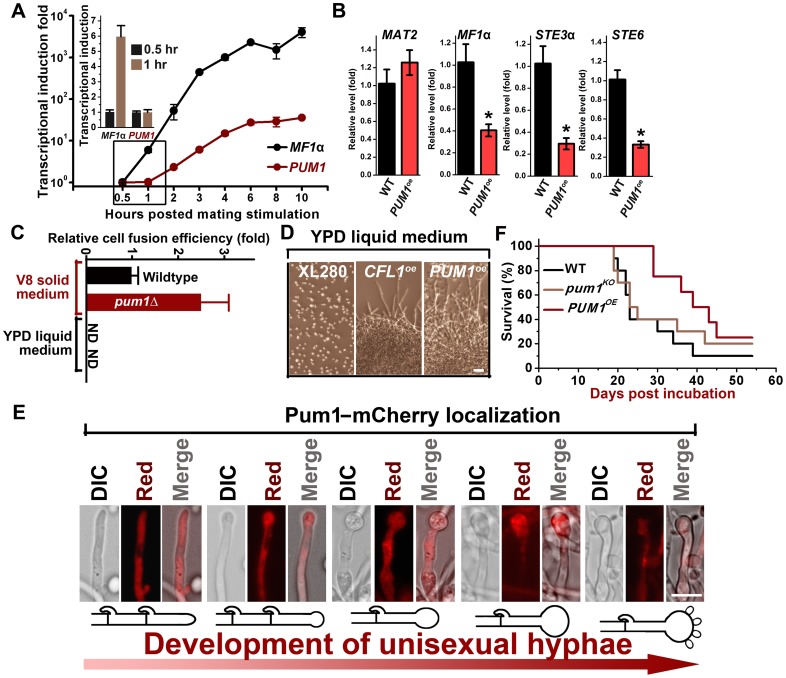
Sexual reproduction in an environmental pathogen helps maximize its lineage fitness to changing environment and the host. For the fungal pathogen Cryptococcus neoformans, sexual reproduction is proposed to have yielded hyper virulent and drug resistant variants. The life cycle of this pathogen commences with mating, followed by the yeast-hypha transition and hyphal growth, and it concludes with fruiting body differentiation and sporulation. How these sequential differentiation events are orchestrated to ensure developmental continuality is enigmatic. Here we revealed the genetic network of the yeast-to-hypha transition in Cryptococcus by analyzing transcriptomes of populations with a homogeneous morphotype generated by an engineered strain. Among this network, we found that a Pumilio-family protein Pum1 and the matricellular signal Cfl1 represent two major parallel circuits directing the yeast-hypha transition. Interestingly, only Pum1 coordinates the sequential morphogenesis events during a-α bisexual and α unisexual reproduction. Pum1 initiates the yeast-to-hypha transition, partially through a novel filament-specific secretory protein Fas1; Pum1 is also required to sustain hyphal growth after the morphological switch. Furthermore, Pum1 directs subsequent differentiation of aerial hyphae into fruiting bodies in both laboratory and clinical isolates. Pum1 exerts its control on sexual reproduction partly through regulating the temporal expression of Dmc1, the meiosis-specific recombinase. Therefore, Pum1 serves a pivotal role in bridging post-mating morphological differentiation events with sexual reproduction in Cryptococcus. Our findings in Cryptococcus illustrate how an environmental pathogen can ensure the completion of its life cycle to safeguard its long-term lineage success.
环境病原体中的有性繁殖有助于使其谱系适应性在不断变化的环境和宿主中最大化。对于真菌病原体新型隐球菌而言,有性繁殖被认为产生了高毒力和耐药性变体。这种病原体的生命周期始于交配,随后是酵母-菌丝转变和菌丝生长,最后以子实体分化和孢子形成为结束。这些连续的分化事件是如何被精心编排以确保发育连续性的,仍是个谜。在这里,我们通过分析由工程菌株产生的具有均匀形态型的群体的转录组,揭示了新型隐球菌中酵母到菌丝转变的遗传网络。在这个网络中,我们发现一个Pumilio家族蛋白Pum1和基质细胞信号Cfl1代表了指导酵母-菌丝转变的两个主要平行回路。有趣的是,只有Pum1在a-α两性和α单性繁殖过程中协调连续的形态发生事件。Pum1部分通过一种新型的丝状特异性分泌蛋白Fas1启动酵母到菌丝的转变;形态转换后维持菌丝生长也需要Pum1。此外,在实验室和临床分离株中,Pum1指导气生菌丝随后分化为子实体。Pum1部分通过调节减数分裂特异性重组酶Dmc1的时间表达来控制有性繁殖。因此,Pum1在新型隐球菌中连接交配后形态分化事件与有性繁殖方面起着关键作用。我们在新型隐球菌中的发现说明了一种环境病原体如何确保其生命周期的完成以保障其长期谱系的成功。