Scribbans Trisha D, Edgett Brittany A, Vorobej Kira, Mitchell Andrew S, Joanisse Sophie D, Matusiak Jennifer B L, Parise Gianni, Quadrilatero Joe, Gurd Brendon J
School of Kinesiology and Health Studies, Queen's University, Kingston, Ontario, Canada.
Department of Kinesiology, University of Waterloo, Waterloo, Ontario, Canada.
PLoS One. 2014 Jun 5;9(6):e98119. doi: 10.1371/journal.pone.0098119. eCollection 2014.
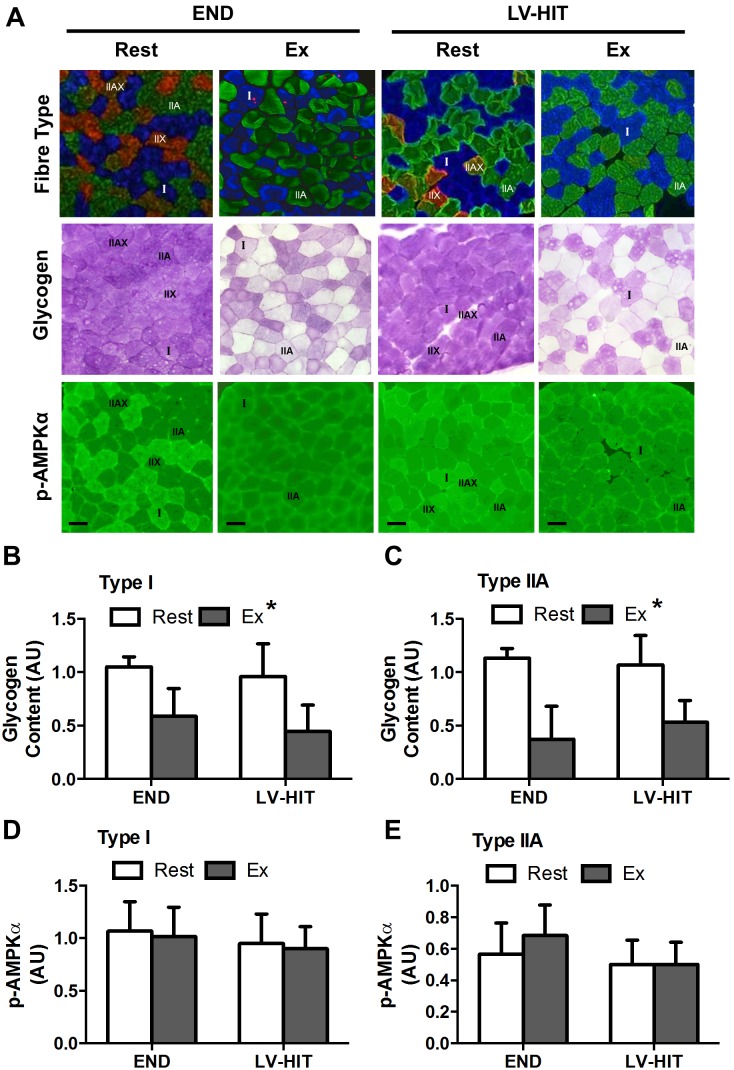
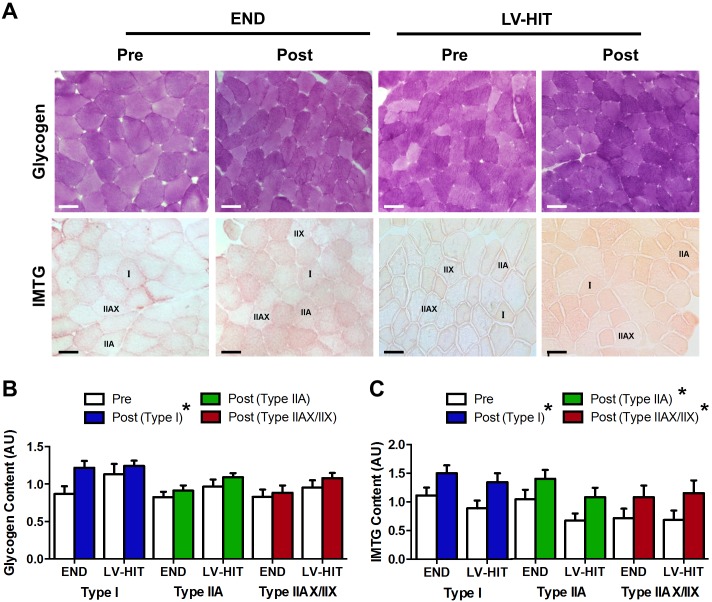
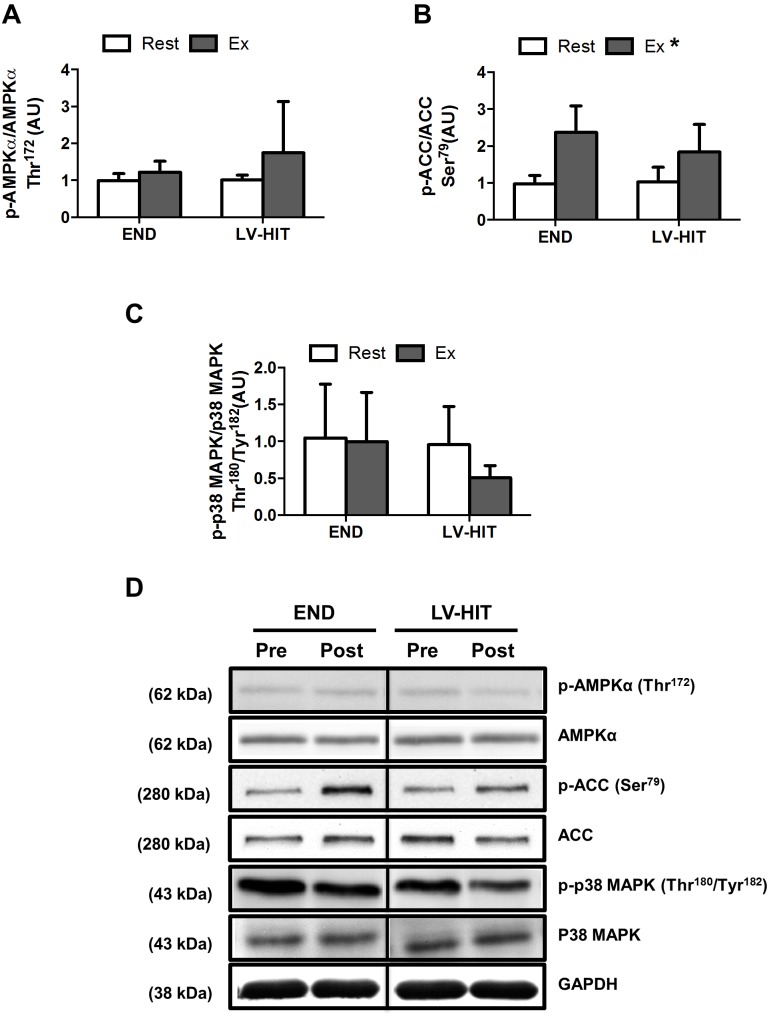
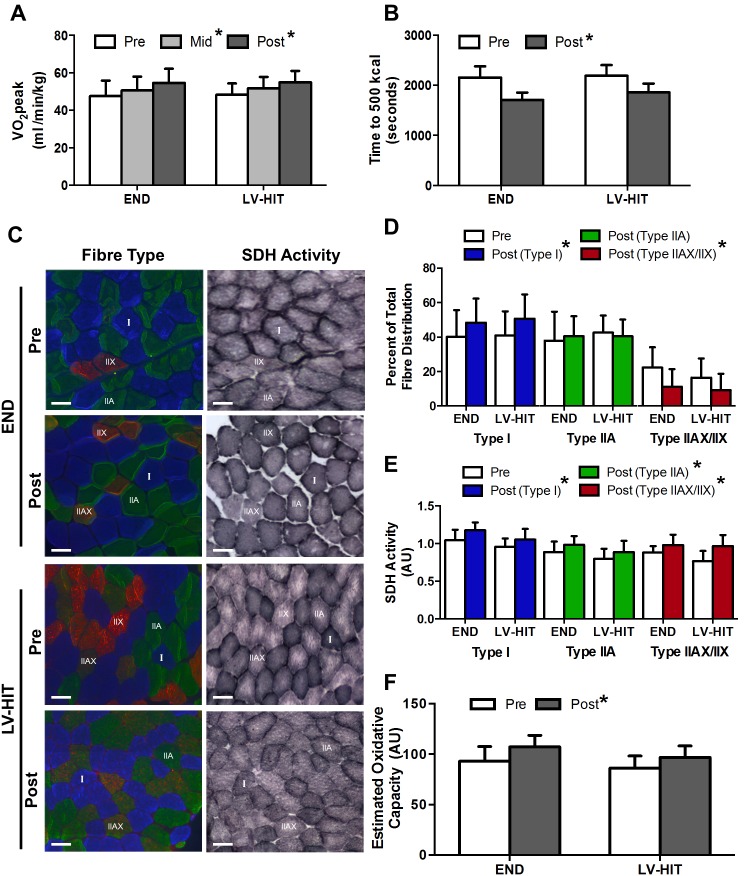
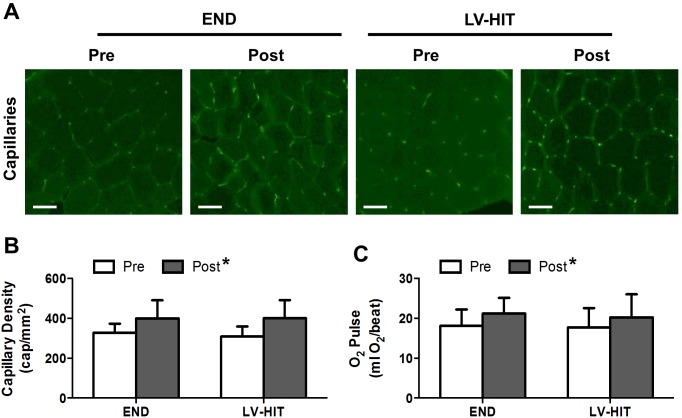
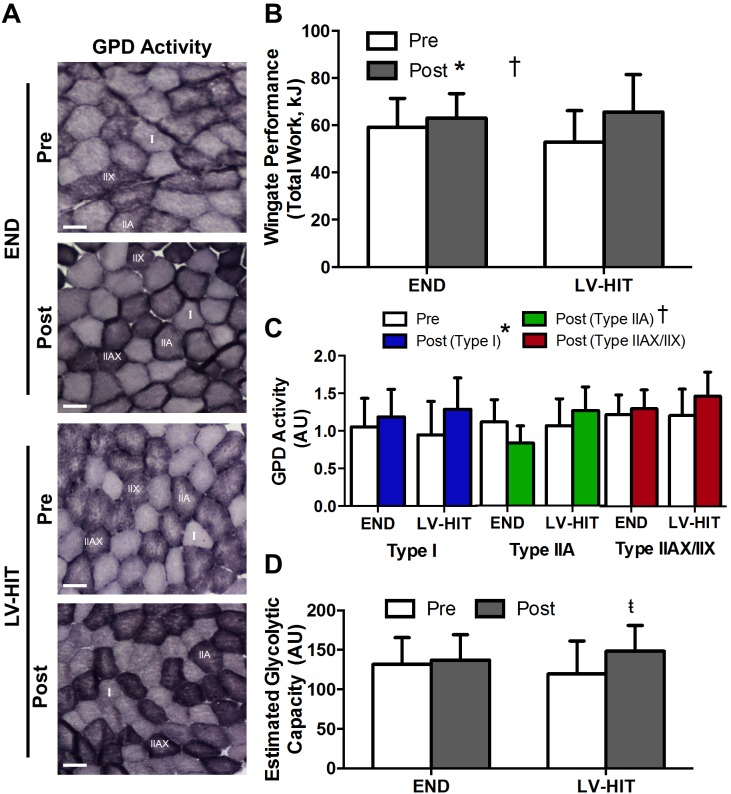
The current study involved the completion of two distinct experiments. Experiment 1 compared fibre specific and whole muscle responses to acute bouts of either low-volume high-intensity interval training (LV-HIT) or moderate-intensity continuous endurance exercise (END) in a randomized crossover design. Experiment 2 examined the impact of a six-week training intervention (END or LV-HIT; 4 days/week), on whole body and skeletal muscle fibre specific markers of aerobic and anaerobic capacity. Six recreationally active men (Age: 20.7 ± 3.8 yrs; VO2peak: 51.9 ± 5.1 mL/kg/min) reported to the lab on two separate occasions for experiment 1. Following a muscle biopsy taken in a fasted state, participants completed an acute bout of each exercise protocol (LV-HIT: 8, 20-second intervals at ∼ 170% of VO2peak separated by 10 seconds of rest; END: 30 minutes at ∼ 65% of VO2peak), immediately followed by a muscle biopsy. Glycogen content of type I and IIA fibres was significantly (p<0.05) reduced, while p-ACC was significantly increased (p<0.05) following both protocols. Nineteen recreationally active males (n = 16) and females (n = 3) were VO2peak-matched and assigned to either the LV-HIT (n = 10; 21 ± 2 yrs) or END (n = 9; 20.7 ± 3.8 yrs) group for experiment 2. After 6 weeks, both training protocols induced comparable increases in aerobic capacity (END: Pre: 48.3 ± 6.0, Mid: 51.8 ± 6.0, Post: 55.0 ± 6.3 mL/kg/min LV-HIT: Pre: 47.9 ± 8.1, Mid: 50.4 ± 7.4, Post: 54.7 ± 7.6 mL/kg/min), fibre-type specific oxidative and glycolytic capacity, glycogen and IMTG stores, and whole-muscle capillary density. Interestingly, only LV-HIT induced greater improvements in anaerobic performance and estimated whole-muscle glycolytic capacity. These results suggest that 30 minutes of END exercise at ∼ 65% VO2peak or 4 minutes of LV-HIT at ∼ 170% VO2peak induce comparable changes in the intra-myocellular environment (glycogen content and signaling activation); correspondingly, training-induced adaptations resulting for these protocols, and other HIT and END protocols are strikingly similar.
当前的研究包括完成两个不同的实验。实验1采用随机交叉设计,比较了低容量高强度间歇训练(LV-HIT)或中等强度持续耐力运动(END)的急性发作对纤维特异性和全肌肉反应的影响。实验2研究了为期六周的训练干预(END或LV-HIT;每周4天)对全身和骨骼肌纤维特异性有氧和无氧能力标志物的影响。六名有运动习惯的男性(年龄:20.7±3.8岁;峰值摄氧量:51.9±5.1毫升/千克/分钟)分两次到实验室进行实验1。在空腹状态下进行肌肉活检后,参与者完成每种运动方案的急性发作(LV-HIT:8次,20秒间歇,强度约为峰值摄氧量的170%,间歇10秒休息;END:30分钟,强度约为峰值摄氧量的65%),随后立即进行肌肉活检。两种方案后,I型和IIA型纤维的糖原含量显著降低(p<0.05),而p-ACC显著增加(p<0.05)。19名有运动习惯的男性(n = 16)和女性(n = 3)根据峰值摄氧量进行匹配,并被分配到LV-HIT组(n = 10;21±2岁)或END组(n = 9;20.7±3.8岁)进行实验2。6周后,两种训练方案均使有氧能力得到了相当程度的提高(END:训练前:48.3±6.0,训练中期:51.8±6.0,训练后:55.0±6.3毫升/千克/分钟;LV-HIT:训练前:47.9±8.1,训练中期:50.4±7.4,训练后:54.7±7.6毫升/千克/分钟),纤维类型特异性氧化和糖酵解能力、糖原和IMTG储备以及全肌肉毛细血管密度也得到了提高。有趣的是,只有LV-HIT在无氧性能和估计的全肌肉糖酵解能力方面带来了更大的改善。这些结果表明,在约65%峰值摄氧量下进行30分钟的END运动或在约170%峰值摄氧量下进行4分钟的LV-HIT运动,会在肌细胞内环境(糖原含量和信号激活)中引起相当的变化;相应地,这些方案以及其他HIT和END方案所导致的训练适应性变化非常相似。