Darking Mary, Anson Rachel, Bravo Ferdinand, Davis Julie, Flowers Steve, Gillingham Emma, Goldberg Lawrence, Helliwell Paul, Henwood Flis, Hudson Claire, Latimer Simon, Lowes Paul, Stirling Ian
School of Applied Social Science, Faculty of Health, University of Brighton, Mayfield House, Falmer BN1 9PH, UK.
BMC Health Serv Res. 2014 Jun 5;14:243. doi: 10.1186/1472-6963-14-243.
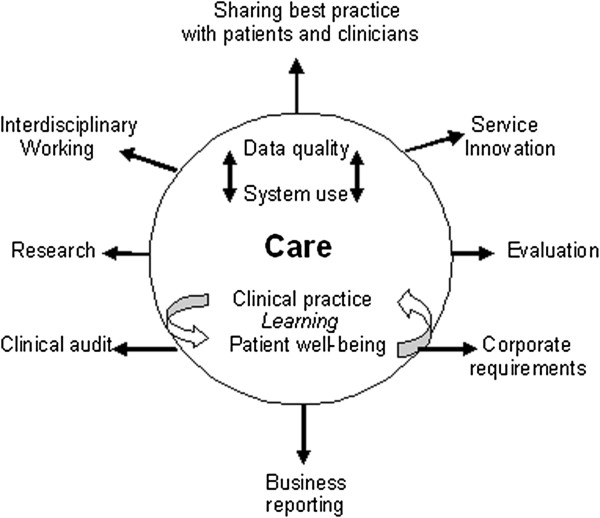
Our contribution, drawn from our experience of the case study provided, is a protocol for practice-centred, participative evaluation of technology in the clinical setting that privileges care. In this context 'practice-centred' evaluation acts as a scalable, coordinating framework for evaluation that recognises health information technology supported care as an achievement that is contingent and ongoing. We argue that if complex programmes of technology-enabled service innovation are understood in terms of their contribution to patient care and supported by participative, capability-building evaluation methodologies, conditions are created for practitioners and patients to realise the potential of technologies and make substantive contributions to the evidence base underpinning health innovation programmes.
Electronic Patient Records (EPRs) and telemedicine are positioned by policymakers as health information technologies that are integral to achieving improved clinical outcomes and efficiency savings. However, evaluating the extent to which these aims are met poses distinct evaluation challenges, particularly where clinical and cost outcomes form the sole focus of evaluation design. We propose that a practice-centred approach to evaluation - in which those whose day-to-day care practice is altered (or not) by the introduction of new technologies are placed at the centre of evaluation efforts - can complement and in some instances offer advantages over, outcome-centric evaluation models.
We carried out a regional programme of innovation in renal services where a participative approach was taken to the introduction of new technologies, including: a regional EPR system and a system to support video clinics. An 'action learning' approach was taken to procurement, pre-implementation planning, implementation, ongoing development and evaluation. Participants included clinicians, technology specialists, patients and external academic researchers. Whilst undergoing these activities we asked: how can a practice-centred approach be embedded into evaluation of health information technologies?
Organising EPR and telemedicine evaluation around predetermined outcome measures alone can be impractical given the complex and contingent nature of such projects. It also limits the extent to which unforeseen outcomes and new capabilities are recognised. Such evaluations often fail to improve understanding of 'when' and 'under what conditions' technology-enabled service improvements are realised, and crucially, how such innovation improves care.
Our contribution, drawn from our experience of the case study provided, is a protocol for practice-centred, participative evaluation of technology in the clinical setting that privileges care. In this context 'practice-centred' evaluation acts as a scalable, coordinating framework for evaluation that recognises health information technology supported care as an achievement that is contingent and ongoing. We argue that if complex programmes of technology-enabled service innovation are understood in terms of their contribution to patient care and supported by participative, capability-building evaluation methodologies, conditions are created for practitioners and patients to realise the potential of technologies and make substantive contributions to the evidence base underpinning health innovation programmes.
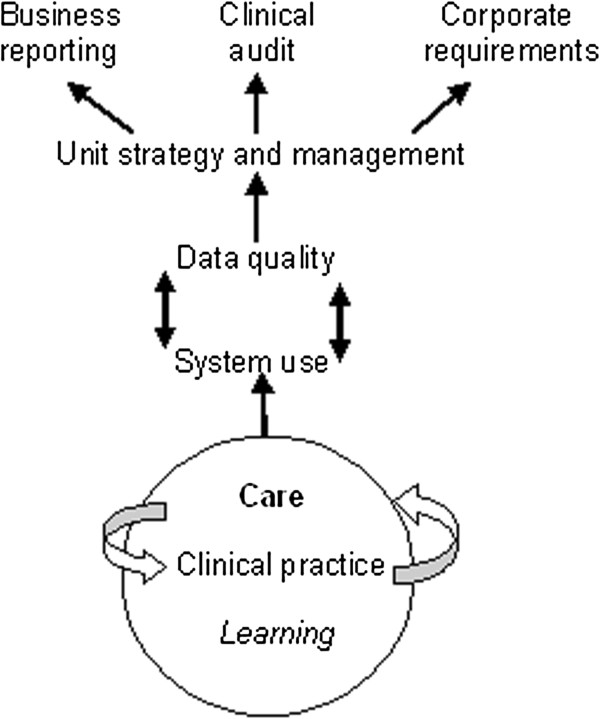
我们基于所提供的案例研究经验,贡献了一种以实践为中心、参与式的临床环境技术评估方案,该方案优先考虑护理。在此背景下,“以实践为中心”的评估作为一种可扩展的协调评估框架,将健康信息技术支持的护理视为一种偶然且持续的成果。我们认为,如果能从其对患者护理的贡献角度理解复杂的技术驱动型服务创新项目,并通过参与式、能力建设评估方法予以支持,就能为从业者和患者创造条件,使其发挥技术潜力,并为支撑健康创新项目的证据基础做出实质性贡献。
政策制定者将电子病历(EPR)和远程医疗定位为对改善临床结果和节省效率至关重要的健康信息技术。然而,评估这些目标的实现程度带来了独特的评估挑战,尤其是在临床和成本结果成为评估设计的唯一重点时。我们提出,一种以实践为中心的评估方法——将那些日常护理实践因新技术引入而改变(或未改变)的人置于评估工作的中心——可以补充并在某些情况下优于以结果为中心的评估模型。
我们开展了一项肾脏服务区域创新计划,在引入新技术时采用了参与式方法,包括:一个区域电子病历系统和一个支持视频诊所的系统。在采购、实施前规划、实施、持续开发和评估过程中采用了“行动学习”方法。参与者包括临床医生、技术专家、患者和外部学术研究人员。在进行这些活动时,我们问:如何将以实践为中心的方法融入健康信息技术的评估中?
仅围绕预定结果指标来组织电子病历和远程医疗评估,鉴于此类项目的复杂性和偶然性,可能不切实际。这也限制了对意外结果和新能力的识别程度。此类评估往往无法增进对“何时”以及“在何种条件下”实现技术驱动型服务改进的理解,至关重要的是,无法理解此类创新如何改善护理。
我们基于所提供的案例研究经验,贡献了一种以实践为中心、参与式的临床环境技术评估方案,该方案优先考虑护理。在此背景下,“以实践为中心”的评估作为一种可扩展的协调评估框架,将健康信息技术支持的护理视为一种偶然且持续的成果。我们认为,如果能从其对患者护理的贡献角度理解复杂的技术驱动型服务创新项目,并通过参与式、能力建设评估方法予以支持,就能为从业者和患者创造条件,使其发挥技术潜力,并为支撑健康创新项目的证据基础做出实质性贡献。