Bögels Sara, Barr Dale J, Garrod Simon, Kessler Klaus
Max Planck Institute for Psycholinguistics, Nijmegen, The Netherlands Institute of Neuroscience and Psychology, University of Glasgow, Glasgow, UK.
Institute of Neuroscience and Psychology, University of Glasgow, Glasgow, UK.
Cereb Cortex. 2015 Sep;25(9):3219-34. doi: 10.1093/cercor/bhu116. Epub 2014 Jun 5.
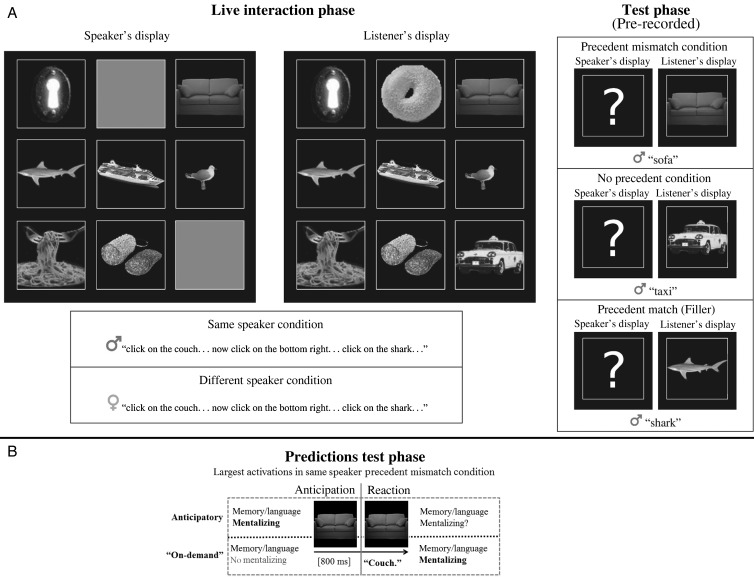
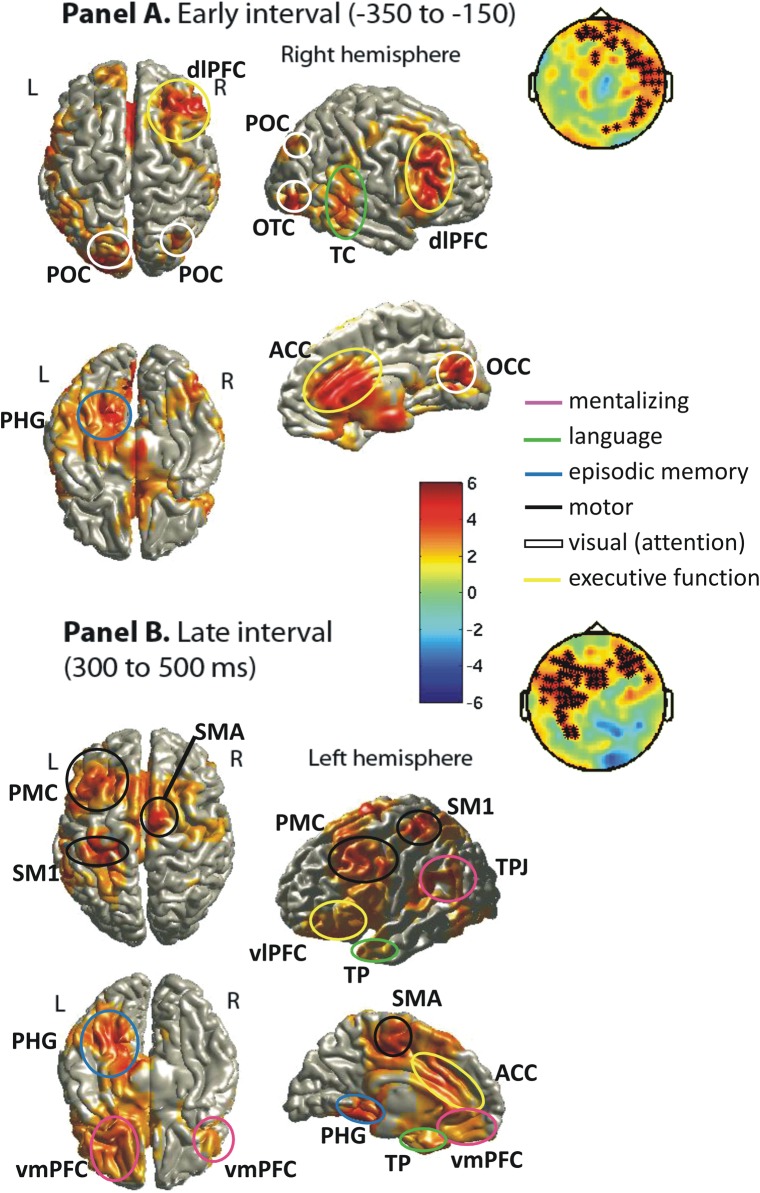
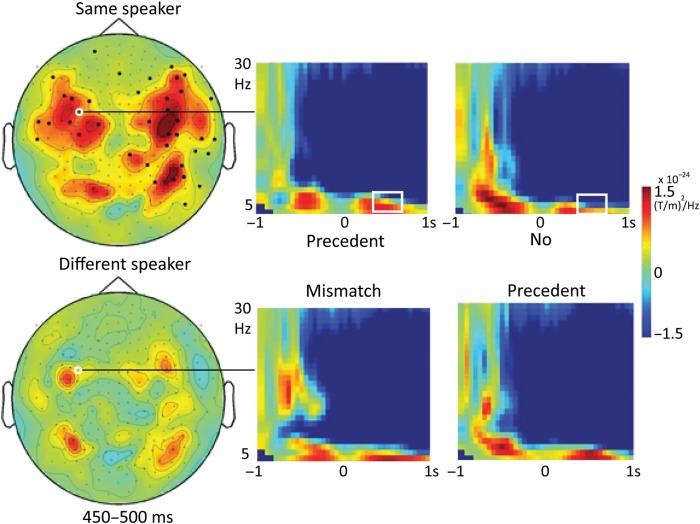
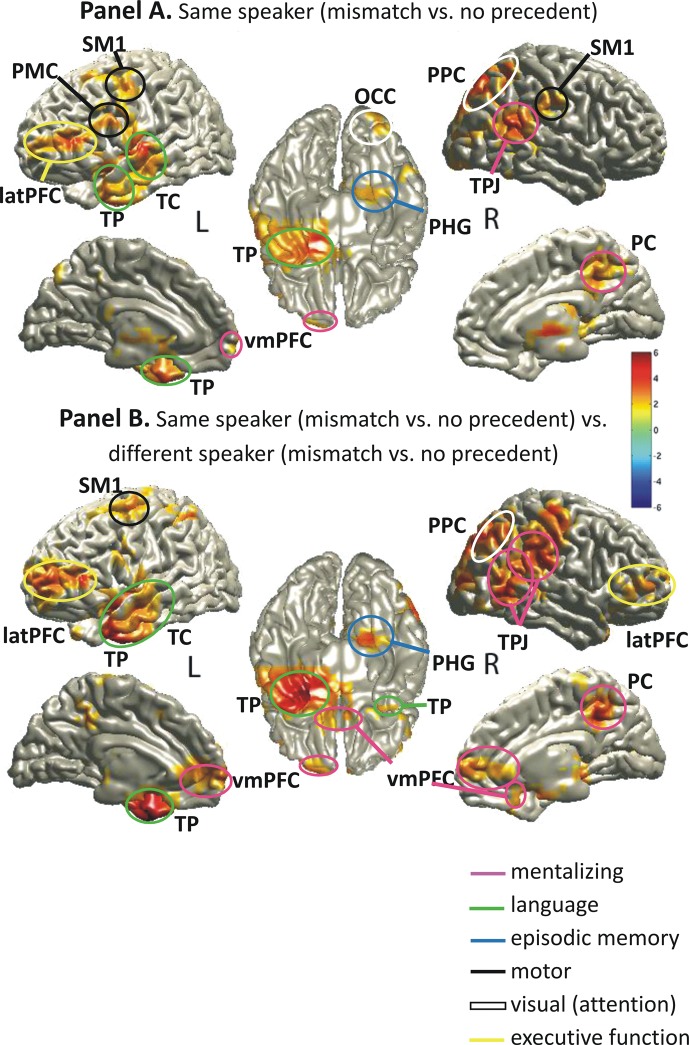
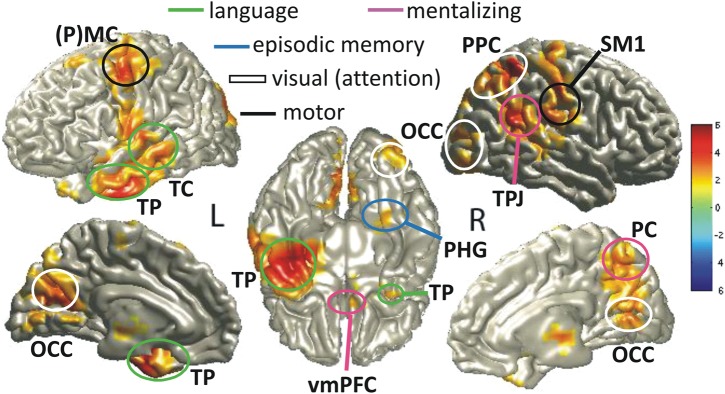
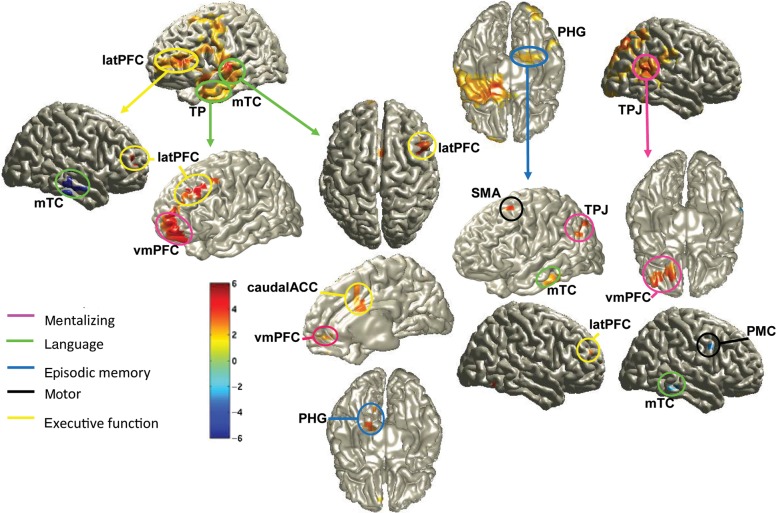
Humans are especially good at taking another's perspective-representing what others might be thinking or experiencing. This "mentalizing" capacity is apparent in everyday human interactions and conversations. We investigated its neural basis using magnetoencephalography. We focused on whether mentalizing was engaged spontaneously and routinely to understand an utterance's meaning or largely on-demand, to restore "common ground" when expectations were violated. Participants conversed with 1 of 2 confederate speakers and established tacit agreements about objects' names. In a subsequent "test" phase, some of these agreements were violated by either the same or a different speaker. Our analysis of the neural processing of test phase utterances revealed recruitment of neural circuits associated with language (temporal cortex), episodic memory (e.g., medial temporal lobe), and mentalizing (temporo-parietal junction and ventromedial prefrontal cortex). Theta oscillations (3-7 Hz) were modulated most prominently, and we observed phase coupling between functionally distinct neural circuits. The episodic memory and language circuits were recruited in anticipation of upcoming referring expressions, suggesting that context-sensitive predictions were spontaneously generated. In contrast, the mentalizing areas were recruited on-demand, as a means for detecting and resolving perceived pragmatic anomalies, with little evidence they were activated to make partner-specific predictions about upcoming linguistic utterances.
人类尤其擅长从他人的角度出发——呈现他人可能在思考或经历的事情。这种“心理化”能力在日常人际互动和对话中很明显。我们使用脑磁图研究了其神经基础。我们关注的是,心理化是自发且常规地用于理解话语的含义,还是主要在需要时,即在期望被违背时用于恢复“共同基础”。参与者与两名同谋者之一进行对话,并就物体的名称达成默契。在随后的“测试”阶段,其中一些默契被同一名或另一名说话者打破。我们对测试阶段话语的神经处理分析表明,与语言相关的神经回路(颞叶皮层)、情景记忆(如内侧颞叶)和心理化(颞顶联合区和腹内侧前额叶皮层)被激活。θ振荡(3 - 7赫兹)受到的调制最为显著,并且我们观察到功能不同的神经回路之间存在相位耦合。情景记忆和语言回路在预期即将出现的指代表达时被激活,这表明会自发产生上下文敏感的预测。相比之下,心理化区域是在需要时被激活,作为检测和解决感知到的语用异常的一种方式,几乎没有证据表明它们被激活是为了对即将出现的语言话语做出针对伙伴的预测。