Yang Guang, Lai Cora Sau Wan, Cichon Joseph, Ma Lei, Li Wei, Gan Wen-Biao
Skirball Institute, Department of Neuroscience and Physiology, New York University School of Medicine, New York, NY 10016, USA. Department of Anesthesiology, New York University School of Medicine, New York, NY 10016, USA.
Skirball Institute, Department of Neuroscience and Physiology, New York University School of Medicine, New York, NY 10016, USA.
Science. 2014 Jun 6;344(6188):1173-8. doi: 10.1126/science.1249098.
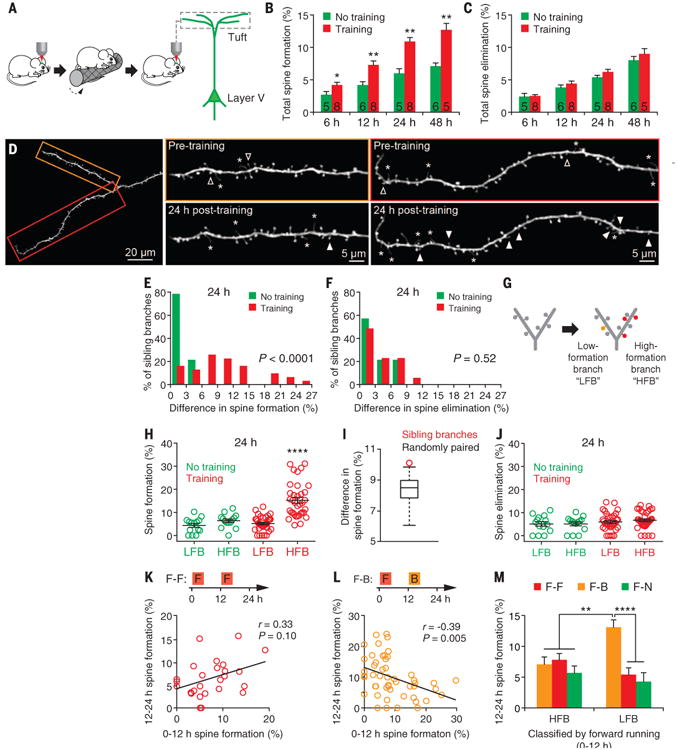
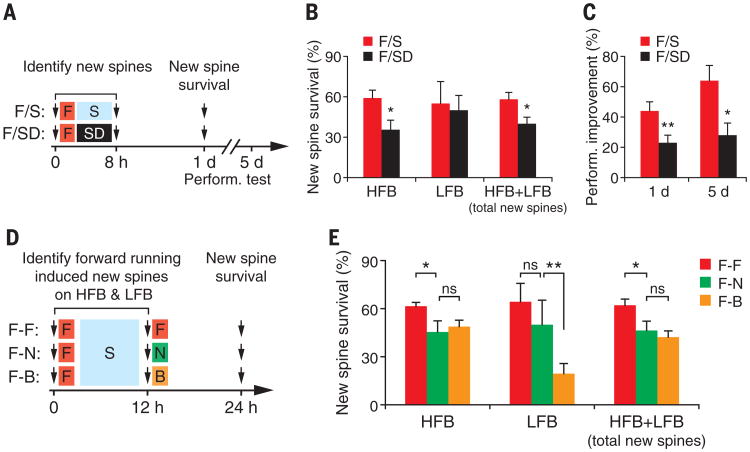
How sleep helps learning and memory remains unknown. We report in mouse motor cortex that sleep after motor learning promotes the formation of postsynaptic dendritic spines on a subset of branches of individual layer V pyramidal neurons. New spines are formed on different sets of dendritic branches in response to different learning tasks and are protected from being eliminated when multiple tasks are learned. Neurons activated during learning of a motor task are reactivated during subsequent non-rapid eye movement sleep, and disrupting this neuronal reactivation prevents branch-specific spine formation. These findings indicate that sleep has a key role in promoting learning-dependent synapse formation and maintenance on selected dendritic branches, which contribute to memory storage.
睡眠如何助力学习和记忆仍是未知之谜。我们在小鼠运动皮层中发现,运动学习后的睡眠会促进单个第五层锥体神经元的部分分支上突触后树突棘的形成。针对不同的学习任务,新的树突棘会在不同的树突分支上形成,并且当学习多个任务时,这些新形成的树突棘会受到保护而不被消除。在一项运动任务学习过程中被激活的神经元,在随后的非快速眼动睡眠期间会再次被激活,而干扰这种神经元的再次激活会阻止特定分支的树突棘形成。这些发现表明,睡眠在促进特定树突分支上依赖于学习的突触形成和维持方面起着关键作用,而这有助于记忆存储。