Ellaway Peter H, Vásquez Natalia, Craggs Michael
The London Spinal Cord Injury Centre, Royal National Orthopaedic Hospital Stanmore, UK ; Division of Brain Sciences, Centre for Clinical Neuroscience, Imperial College London London, UK.
The London Spinal Cord Injury Centre, Royal National Orthopaedic Hospital Stanmore, UK.
Front Integr Neurosci. 2014 May 20;8:42. doi: 10.3389/fnint.2014.00042. eCollection 2014.
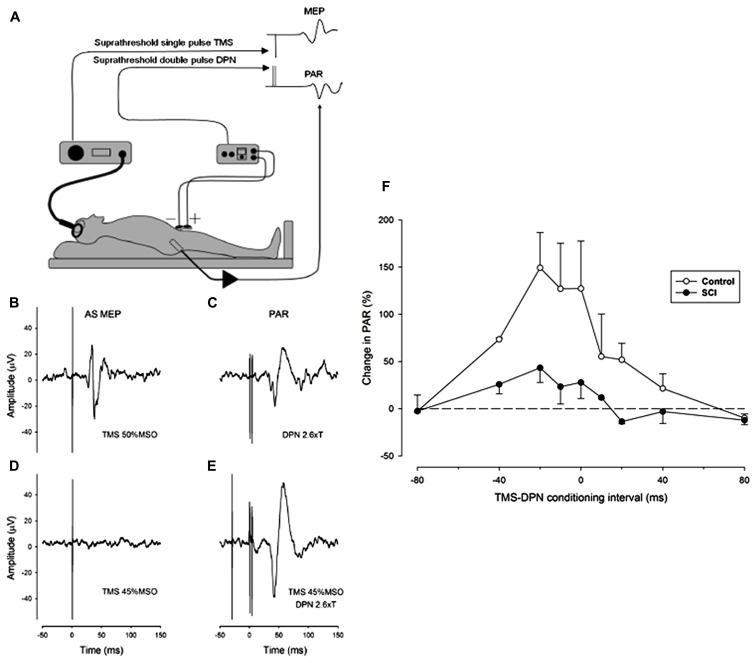
Cortical and spinal cord plasticity may be induced with non-invasive transcranial magnetic stimulation to encourage long term potentiation or depression of neuronal circuits. Such plasticity inducing stimulation provides an attractive approach to promote changes in sensorimotor circuits that have been degraded by spinal cord injury (SCI). If residual corticospinal circuits can be conditioned appropriately there should be the possibility that the changes are accompanied by functional recovery. This article reviews the attempts that have been made to restore sensorimotor function and to obtain functional benefits from the application of repetitive transcranial magnetic stimulation (rTMS) of the cortex following incomplete spinal cord injury. The confounding issues that arise with the application of rTMS, specifically in SCI, are enumerated. Finally, consideration is given to the potential for rTMS to be used in the restoration of bladder and bowel sphincter function and consequent functional recovery of the guarding reflex.
非侵入性经颅磁刺激可诱导皮质和脊髓可塑性,以促进神经回路的长期增强或抑制。这种可塑性诱导刺激为促进因脊髓损伤(SCI)而退化的感觉运动回路的变化提供了一种有吸引力的方法。如果残余的皮质脊髓回路能够得到适当的调节,那么就有可能伴随功能恢复而发生变化。本文综述了在不完全性脊髓损伤后,为恢复感觉运动功能以及通过应用皮质重复经颅磁刺激(rTMS)获得功能益处所做的尝试。列举了rTMS应用中出现的混杂问题,特别是在SCI中的问题。最后,探讨了rTMS用于恢复膀胱和肠道括约肌功能以及随之而来的保护反射功能恢复的潜力。