Department of Biomedical Engineering, University of Rochester , Rochester, NY , USA.
Department of Neurology, University of Rochester , Rochester, NY , USA ; Department of Neurobiology and Anatomy, University of Rochester , Rochester, NY , USA.
Front Neurol. 2014 May 19;5:70. doi: 10.3389/fneur.2014.00070. eCollection 2014.
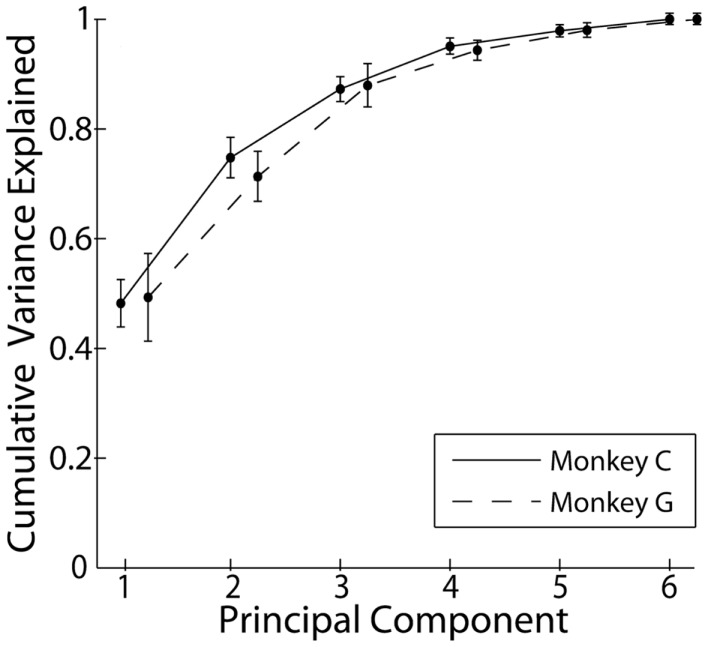
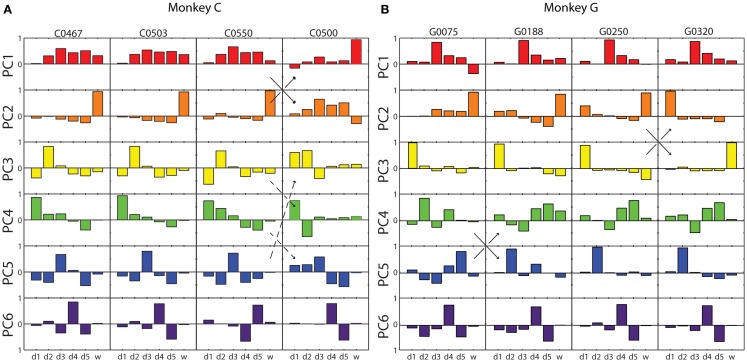
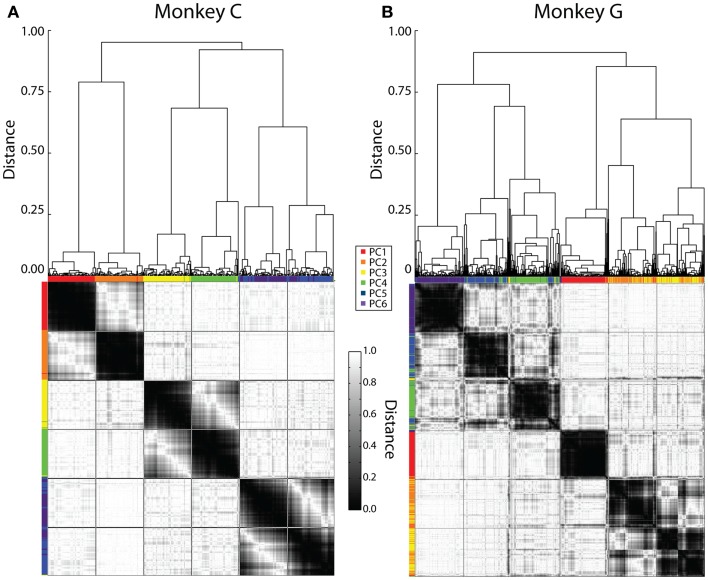
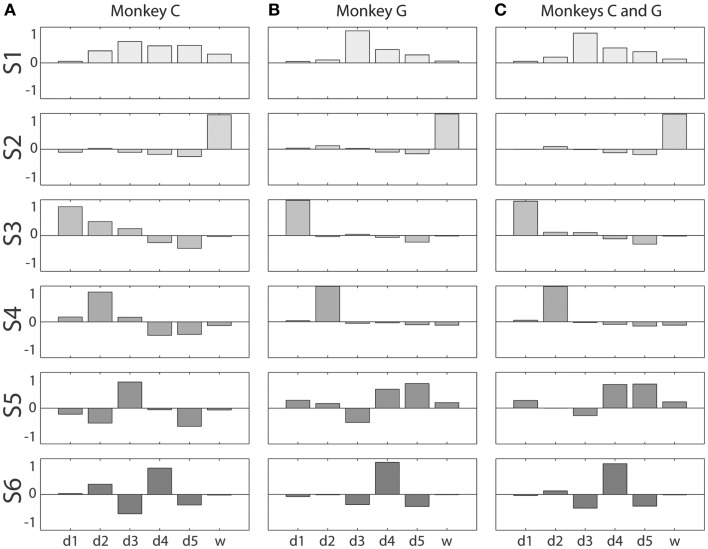
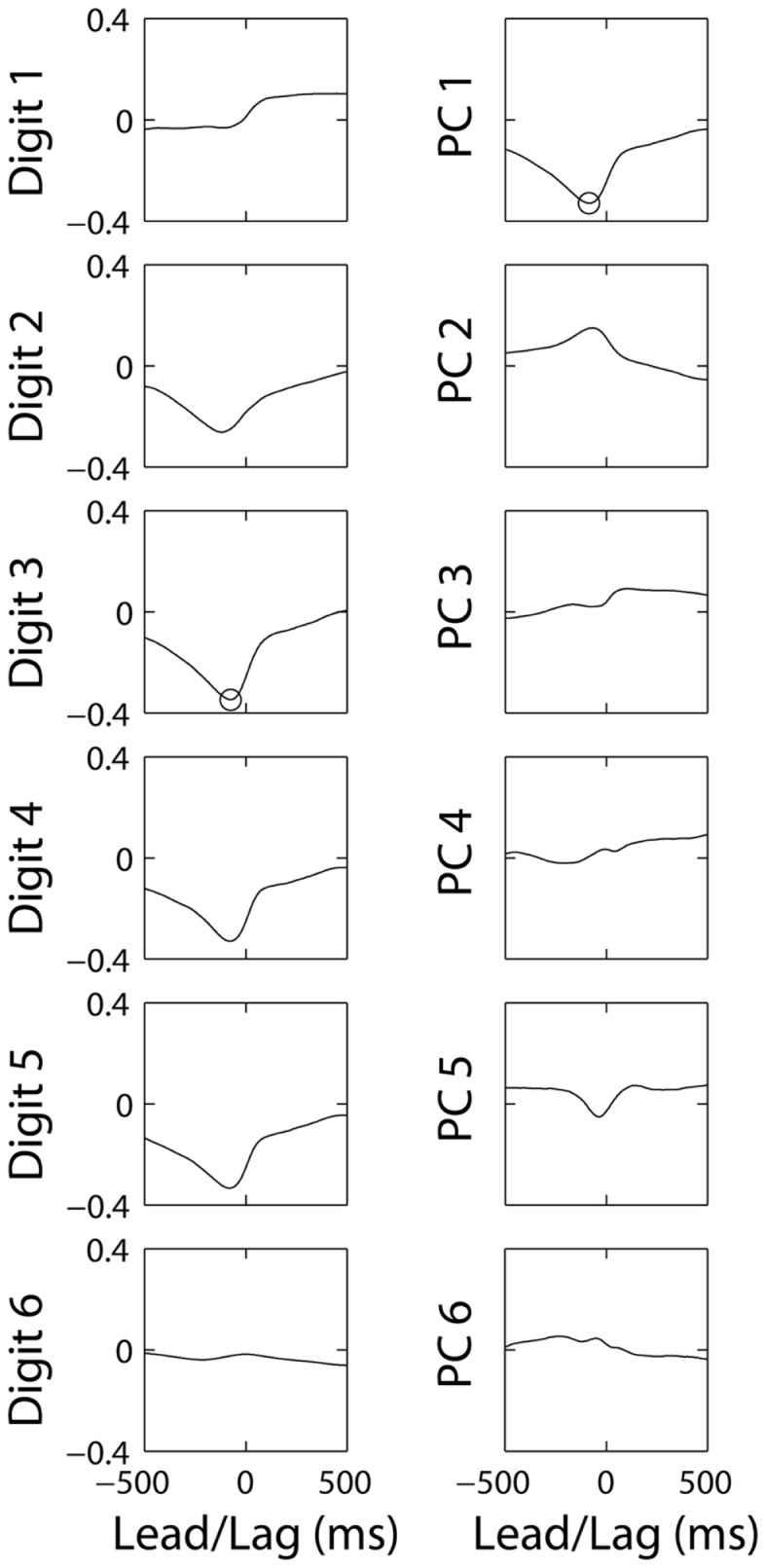
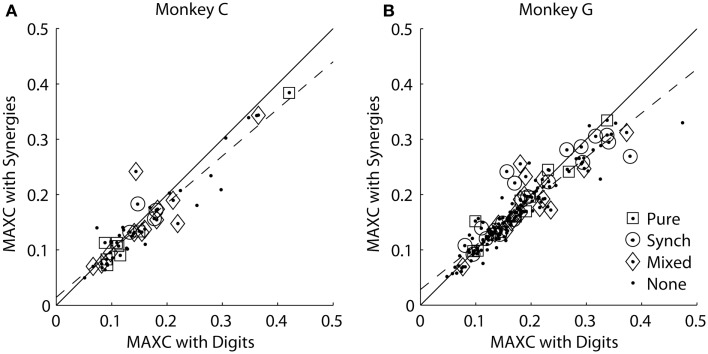
The joints of the hand provide 24 mechanical degrees of freedom. Yet 2-7 principal components (PCs) account for 80-95% of the variance in hand joint motion during tasks that vary from grasping to finger spelling. Such findings have led to the hypothesis that the brain may simplify operation of the hand by preferentially controlling PCs. We tested this hypothesis using data recorded from the primary motor cortex (M1) during individuated finger and wrist movements. Principal component analysis (PCA) of the simultaneous position of the five digits and the wrist showed relatively consistent kinematic synergies across recording sessions in two monkeys. The first three PCs typically accounted for 85% of the variance. Cross-correlations then were calculated between the firing rate of single neurons and the simultaneous flexion/extension motion of each of the five digits and the wrist, as well as with each of their six PCs. For each neuron, we then compared the maximal absolute value of the cross-correlations (MAXC) achieved with the motion of any digit or the wrist to the MAXC achieved with motion along any PC axis. The MAXC with a digit and the MAXC with a PC were themselves highly correlated across neurons. A minority of neurons correlated more strongly with a PC than with any digit. But for the populations of neurons sampled from each of two subjects, MAXCs with digits were slightly but significantly higher than those with PCs. We therefore reject the hypothesis that M1 neurons preferentially control PCs of hand motion. We cannot exclude the possibility that M1 neurons might control kinematic synergies identified using linear or non-linear methods other than PCA. We consider it more likely, however, that neurons in other centers of the motor system - such as the pontomedullary reticular formation and the spinal gray matter - drive synergies of movement and/or muscles, which M1 neurons act to fractionate in producing individuated finger and wrist movements.
手部关节提供了 24 个机械自由度。然而,在从抓握到手指拼写等各种任务中,手关节运动的 2-7 个主要成分(PC)占 80-95%的方差。这些发现导致了这样一种假设,即大脑可能通过优先控制 PC 来简化手部操作。我们使用从两只猴子的初级运动皮层(M1)记录的数据来测试这一假设。对五个手指和手腕的同时位置进行主成分分析(PCA),在两个猴子的多个记录会话中显示出相对一致的运动协同作用。前三个 PC 通常占方差的 85%。然后计算了单个神经元的放电率与五个手指和手腕的同时弯曲/伸展运动以及它们的六个 PC 中的每一个之间的交叉相关。对于每个神经元,我们将与任何一个手指或手腕的运动相关的神经元的放电率的最大绝对值(MAXC)与沿任何 PC 轴运动的 MAXC 进行比较。在神经元之间,MAXC 与手指的相关性和 MAXC 与 PC 的相关性高度相关。少数神经元与 PC 的相关性强于与任何手指的相关性。但是,对于从两个被试者中的每一个采样的神经元群体,与手指的 MAXC 略高于与 PC 的 MAXC。因此,我们拒绝 M1 神经元优先控制手部运动 PC 的假设。我们不能排除 M1 神经元可能通过除 PCA 之外的线性或非线性方法来控制运动协同作用的可能性。然而,我们认为更有可能的是,运动系统的其他中心的神经元 - 如桥脑被盖网状结构和脊髓灰质 - 驱动运动和/或肌肉的协同作用,而 M1 神经元则将其分解为产生个体化的手指和手腕运动。