Parasoglou Prodromos, Xia Ding, Chang Gregory, Regatte Ravinder R
Quantitative Multinuclear Musculoskeletal Imaging Group (QMMIG), Department of Radiology, Center for Biomedical Imaging, New York University Langone Medical Center, New York, NY, USA.
Sci Rep. 2014 Jun 9;4:5219. doi: 10.1038/srep05219.
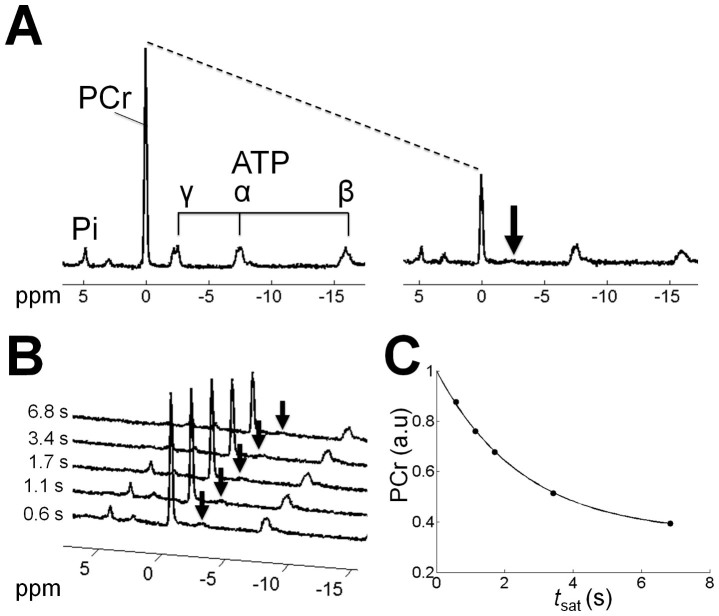
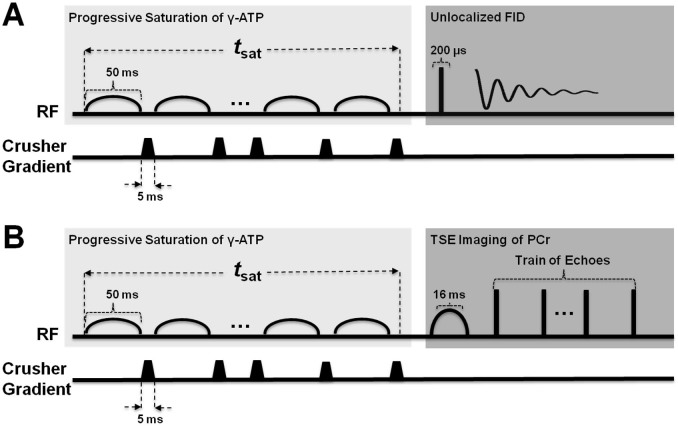
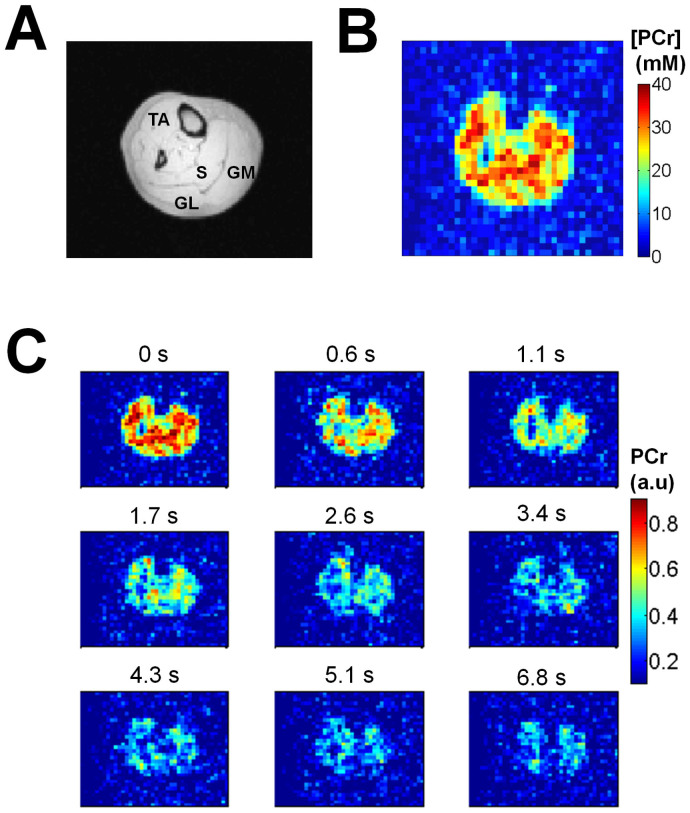
The creatine kinase (CK) reaction plays a critical role in skeletal muscle function, and can be studied non-invasively using phosphorus ((31)P) saturation transfer (ST) techniques. However, due to the low MR sensitivity of the (31)P nucleus, most studies on clinically approved magnetic fields (≤3.0 T) have been performed with coarse resolution and limited tissue coverage. However, such methods are not able to detect spatially resolved metabolic heterogeneities, which may be important in diseases of the skeletal muscle. In this study, our aim was to develop and implement a (31)P-MRI method for mapping the kinetics of the CK reaction, and the unidirectional phosphocreatine (PCr) to adenosine triphosphate (ATP) metabolic fluxes in muscles of the lower leg on a clinical 3.0 T MR scanner. We imaged the lower leg muscles of ten healthy volunteers (total experimental time: 40 min, nominal voxel sizes 0.5 mL), and found statistically significant differences between the kinetics of the CK reaction among muscle groups. Our developed technique may allow in the future the early detection of focal metabolic abnormalities in diseases that affect the function of the skeletal muscle.
肌酸激酶(CK)反应在骨骼肌功能中起着关键作用,并且可以使用磷(³¹P)饱和转移(ST)技术进行无创研究。然而,由于³¹P原子核的磁共振灵敏度较低,大多数针对临床批准磁场(≤3.0 T)的研究都是以低分辨率和有限的组织覆盖范围进行的。然而,此类方法无法检测到空间分辨的代谢异质性,而这在骨骼肌疾病中可能很重要。在本研究中,我们的目的是开发并实施一种³¹P - 磁共振成像(MRI)方法,用于在临床3.0 T MR扫描仪上绘制小腿肌肉中CK反应的动力学以及磷酸肌酸(PCr)到三磷酸腺苷(ATP)的单向代谢通量。我们对十名健康志愿者的小腿肌肉进行了成像(总实验时间:40分钟,标称体素大小0.5 mL),并发现不同肌肉群之间CK反应的动力学存在统计学上的显著差异。我们开发的技术未来可能有助于早期检测影响骨骼肌功能的疾病中的局灶性代谢异常。