Division of Molecular and Cellular Biology, Toronto General Research Institute, Toronto, Canada ; Department of Laboratory Medicine & Pathobiology, University of Toronto, 172 St George St, Toronto, ON M5R 0A3, Canada.
Institute of Hematology and Blood Disease Hospital, Chinese Academy of Medical Sciences and Peking Union Medical College, Tianjin, China.
Biomark Res. 2014 May 30;2:10. doi: 10.1186/2050-7771-2-10. eCollection 2014.
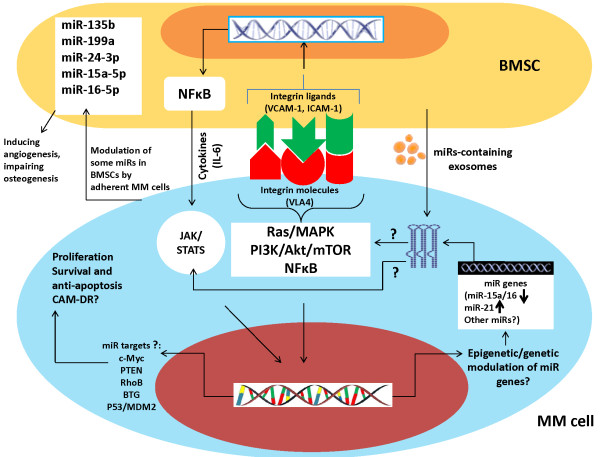
The established interaction between multiple myeloma cells and bone marrow microenvironment components provides malignant cells with various survival, growth and drug resistance signals. As a new concept, identification of miRNAs and their related gene/protein targets, signaling molecules and pathways in the context of bone marrow microenvironment will help understanding more deeply the pathogenesis of the disease and possible mechanisms underlying environment-induced drug resistance. Recent studies suggest that bone marrow stromal cells can modulate some miRNAs (miR-21, miR-15a/16) in multiple myeloma cells through direct adhesion, cytokine secretion or transfer of miRNA-containing exosomes, however; the specific miRNA targets are not clear. In spite of a remarkable progress in understanding myeloma biology and therapy, the disease persists to be hard to treat. This review will discuss the most recent findings on miRNAs expression and function in the context of bone marrow microenvironment highlighting the miRNAs as potential therapeutic targets in multiple myeloma.
多发性骨髓瘤细胞与骨髓微环境成分之间已确立的相互作用为恶性细胞提供了各种生存、生长和耐药信号。作为一个新概念,在骨髓微环境背景下鉴定 miRNA 及其相关基因/蛋白靶标、信号分子和途径,将有助于更深入地了解疾病的发病机制以及环境诱导耐药的可能机制。最近的研究表明,骨髓基质细胞可以通过直接黏附、细胞因子分泌或转移含有 miRNA 的外泌体来调节多发性骨髓瘤细胞中的某些 miRNA(miR-21、miR-15a/16),但是,特定的 miRNA 靶标尚不清楚。尽管对骨髓瘤生物学和治疗的认识取得了显著进展,但该疾病仍然难以治疗。这篇综述将讨论在骨髓微环境背景下 miRNA 表达和功能的最新发现,强调 miRNA 作为多发性骨髓瘤潜在治疗靶点的重要性。