Kitazoe Yasuhiro, Tanaka Masashi
Center of Medical Information Science, Kochi Medical School, Nankoku, Kochi, Japan.
Department of Genomics for Longevity and Health, Tokyo Metropolitan Institute of Gerontology, Tokyo, Japan.
PLoS One. 2014 Jun 9;9(6):e98188. doi: 10.1371/journal.pone.0098188. eCollection 2014.
Basal metabolic rate (BMR) has a very strong body-mass (M) dependence in an individual animal group, and BMR per unit mass (msBMR) converges on a markedly narrow range even across major taxonomic groups. However, it is here a basic question in metazoan biology how much BMR per unit mitochondrion (mtBMR) changes, and then whether mtBMR can be related to the original molecular mechanism of action of mt-encoded membrane proteins (MMPs) playing a central role in cellular energy production.
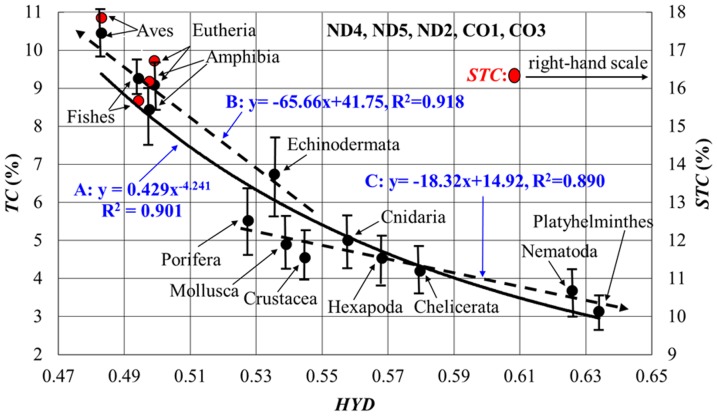
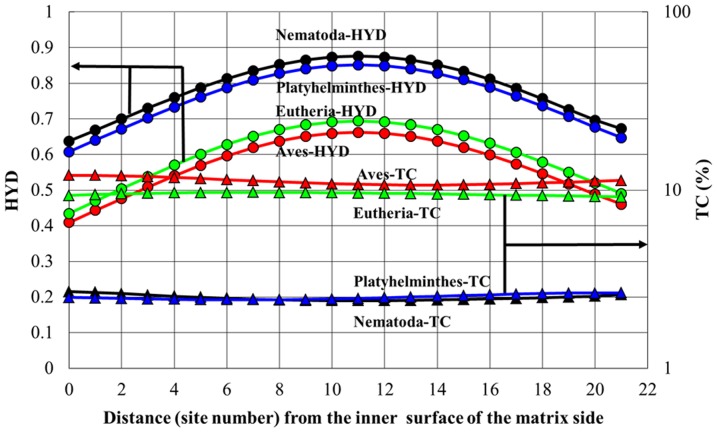
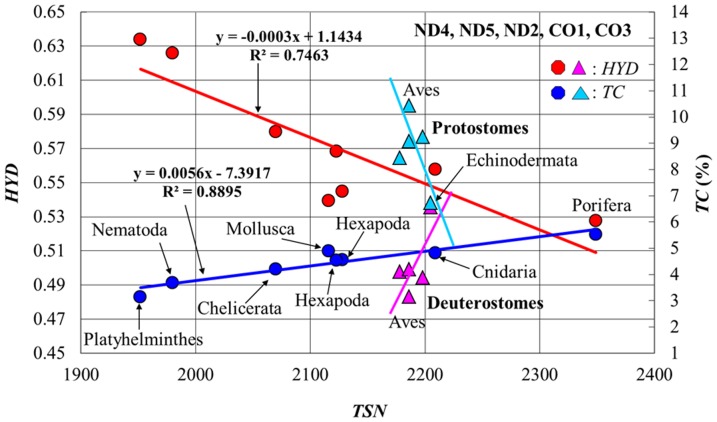
METHODOLOGY/PRINCIPAL FINDINGS: Analyzing variations of amino-acid compositions of MMPs across 13 metazoan animal groups, incorporating 2022 sequences, we found a strong inverse correlation between Ser/Thr composition (STC) and hydrophobicity (HYD). A majority of animal groups showed an evolutionary pathway of a gradual increase in HYD and decrease in STC, whereas only the deuterostome lineage revealed a rapid decrease in HYD and increase in STC. The strongest correlations appeared in 5 large subunits (ND4, ND5, ND2, CO1, and CO3) undergoing dynamic conformational changes for the proton-pumping function. The pathway of the majority groups is well understood as reflecting natural selection to reduce mtBMR, since simply raising HYD in MMPs (surrounded by the lipid bilayer) weakens their mobility and strengthens their stability. On the other hand, the marked decrease in HYD of the deuterostome elevates mtBMR, but is accompanied with their instability heightening a turnover rate of mitochondria and then cells. Interestingly, cooperative networks of interhelical hydrogen-bonds between motifs involving Ser and Thr residues can enhance MMP stability.
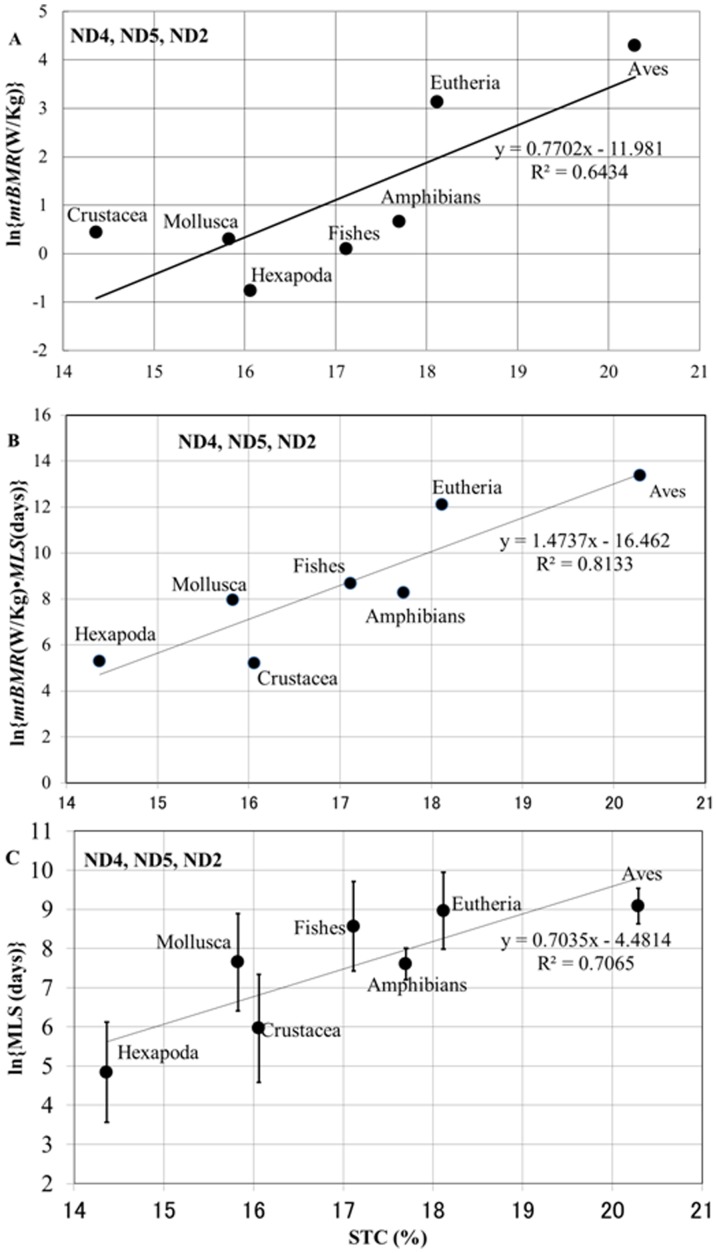
CONCLUSION/SIGNIFICANCE: This stability enhancement lowers turnover rates of mitochondria/cells and may prolong even longevity, and was indeed founded by strong positive correlations of STC with both mtBMR and longevity. The lowest HYD and highest STC in Aves and Mammals are congruent with their very high mtBMR and long longevity.
基础代谢率(BMR)在单个动物群体中对体重(M)有很强的依赖性,即使在主要分类群中,单位质量的基础代谢率(msBMR)也会收敛到一个明显狭窄的范围内。然而,后生动物生物学中的一个基本问题是,单位线粒体的基础代谢率(mtBMR)会发生多大变化,以及mtBMR是否与在细胞能量产生中起核心作用的线粒体编码膜蛋白(MMPs)的原始分子作用机制有关。
方法/主要发现:分析了13个后生动物群体中2022个MMPs氨基酸组成的变化,我们发现丝氨酸/苏氨酸组成(STC)与疏水性(HYD)之间存在很强的负相关。大多数动物群体显示出HYD逐渐增加和STC逐渐减少的进化途径,而只有后口动物谱系显示出HYD迅速减少和STC增加。最强的相关性出现在5个大亚基(ND4、ND5、ND2、CO1和CO3)中,这些亚基为质子泵功能经历动态构象变化。大多数群体的途径被很好地理解为反映了降低mtBMR的自然选择,因为简单地提高MMPs(被脂质双层包围)中的HYD会削弱它们的流动性并增强它们的稳定性。另一方面,后口动物HYD的显著降低提高了mtBMR,但伴随着它们的不稳定性增加,线粒体和细胞的周转率提高。有趣的是,涉及丝氨酸和苏氨酸残基的基序之间的螺旋间氢键协同网络可以增强MMP的稳定性。
结论/意义:这种稳定性增强降低了线粒体/细胞的周转率,甚至可能延长寿命,并且确实通过STC与mtBMR和寿命的强正相关得以证实。鸟类和哺乳动物中最低的HYD和最高的STC与它们非常高的mtBMR和长寿相一致。