Gajendragadkar Parag R, Hubsch Annette, Mäki-Petäjä Kaisa M, Serg Martin, Wilkinson Ian B, Cheriyan Joseph
Clinical Pharmacology Unit, University of Cambridge, Cambridge, United Kingdom.
Clinical Pharmacology Unit, University of Cambridge, Cambridge, United Kingdom; Department of Cardiology, University of Tartu, Tartu, Estonia.
PLoS One. 2014 Jun 9;9(6):e99070. doi: 10.1371/journal.pone.0099070. eCollection 2014.
The mechanisms by which a 'Mediterranean diet' reduces cardiovascular disease (CVD) burden remain poorly understood. Lycopene is a potent antioxidant found in such diets with evidence suggesting beneficial effects. We wished to investigate the effects of lycopene on the vasculature in CVD patients and separately, in healthy volunteers (HV).
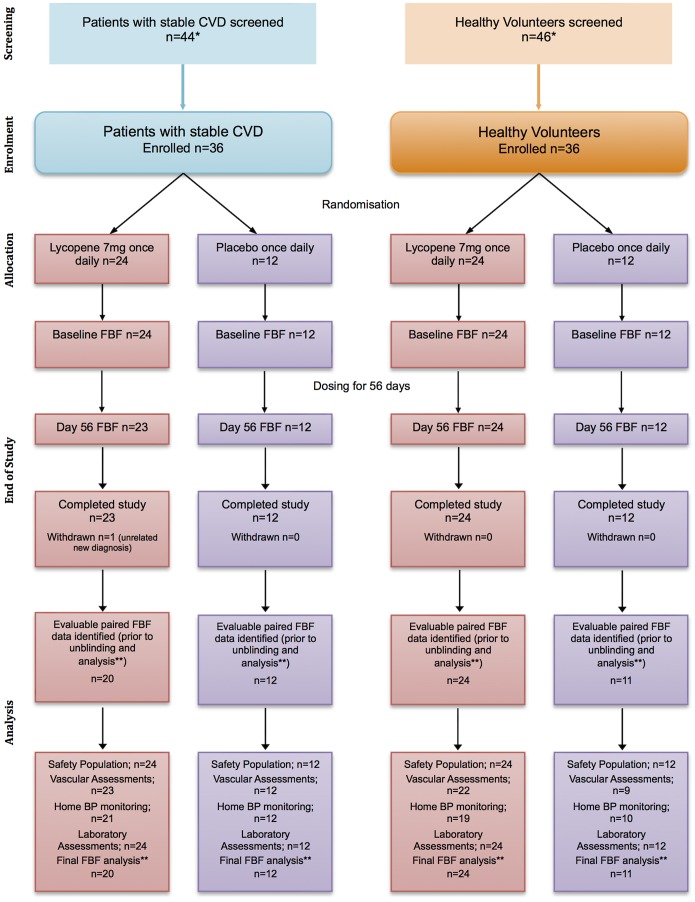
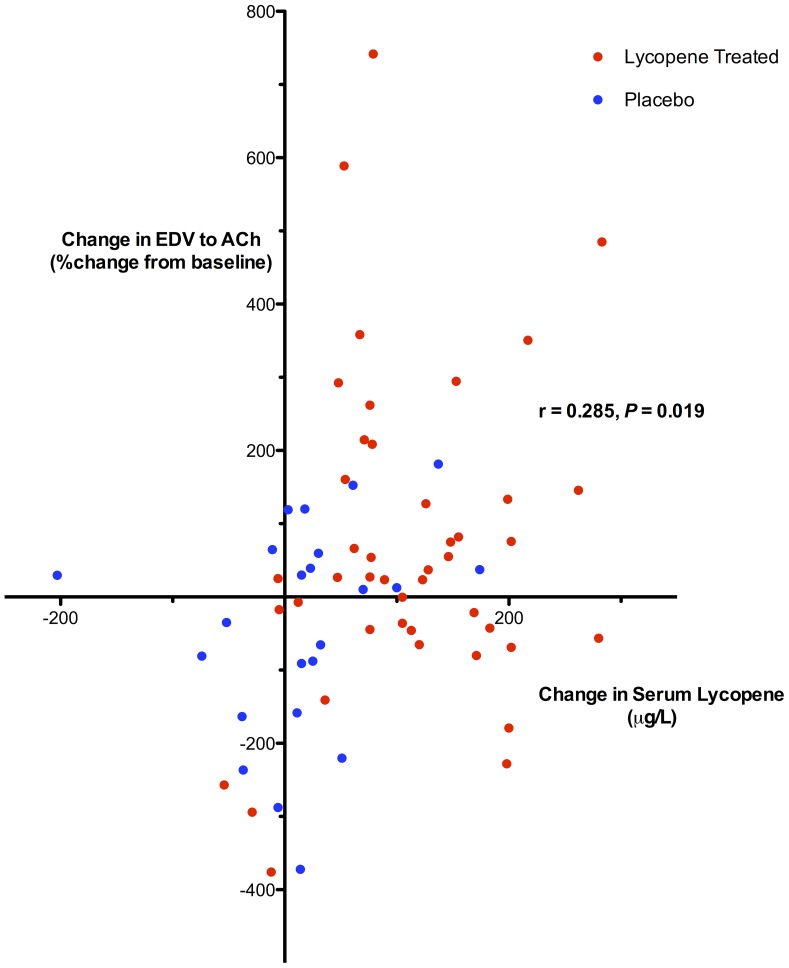
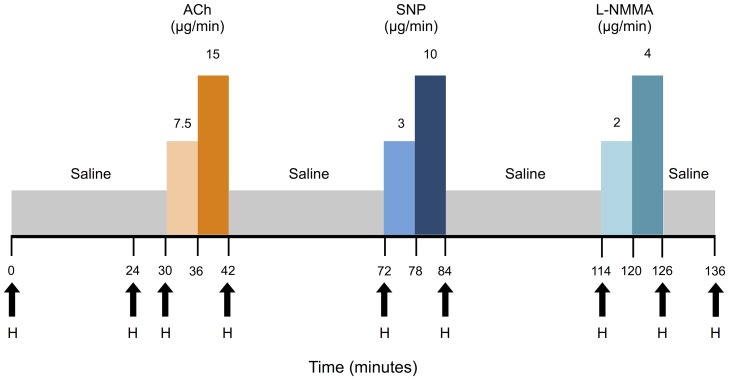
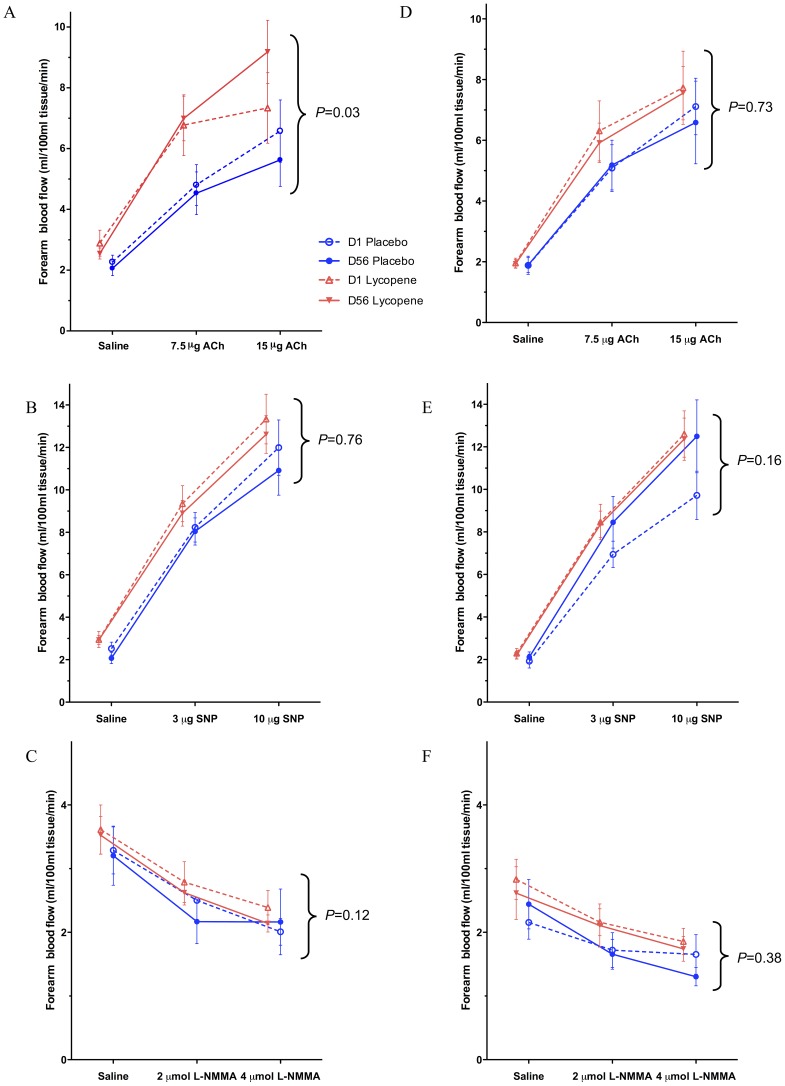
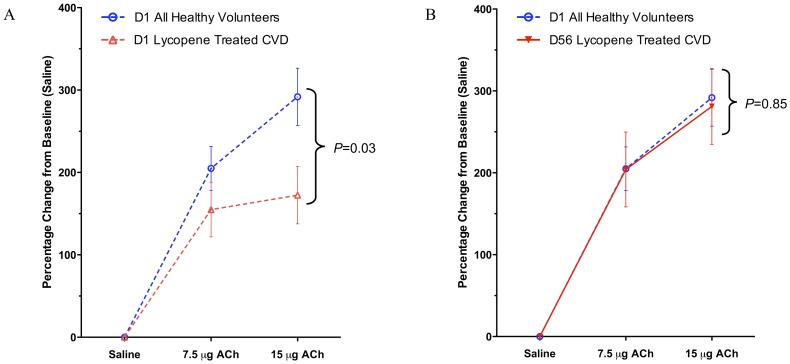
We randomised 36 statin treated CVD patients and 36 healthy volunteers in a 2∶1 treatment allocation ratio to either 7 mg lycopene or placebo daily for 2 months in a double-blind trial. Forearm responses to intra-arterial infusions of acetylcholine (endothelium-dependent vasodilatation; EDV), sodium nitroprusside (endothelium-independent vasodilatation; EIDV), and NG-monomethyl-L-arginine (basal nitric oxide (NO) synthase activity) were measured using venous plethysmography. A range of vascular and biochemical secondary endpoints were also explored. EDV in CVD patients post-lycopene improved by 53% (95% CI: +9% to +93%, P = 0.03 vs. placebo) without changes to EIDV, or basal NO responses. HVs did not show changes in EDV after lycopene treatment. Blood pressure, arterial stiffness, lipids and hsCRP levels were unchanged for lycopene vs. placebo treatment groups in the CVD arm as well as the HV arm. At baseline, CVD patients had impaired EDV compared with HV (30% lower; 95% CI: -45% to -10%, P = 0.008), despite lower LDL cholesterol (1.2 mmol/L lower, 95% CI: -1.6 to -0.9 mmol/L, P<0.001). Post-therapy EDV responses for lycopene-treated CVD patients were similar to HVs at baseline (2% lower, 95% CI: -30% to +30%, P = 0.85), also suggesting lycopene improved endothelial function.
Lycopene supplementation improves endothelial function in CVD patients on optimal secondary prevention, but not in HVs.
ClinicalTrials.gov NCT01100385.
“地中海饮食”降低心血管疾病(CVD)负担的机制仍未完全明确。番茄红素是这种饮食中含有的一种强效抗氧化剂,有证据表明其具有有益作用。我们希望研究番茄红素对CVD患者血管系统的影响,并分别研究其对健康志愿者(HV)血管系统的影响。
在一项双盲试验中,我们以2∶1的治疗分配比例将36名接受他汀类药物治疗的CVD患者和36名健康志愿者随机分为两组,分别每日服用7毫克番茄红素或安慰剂,持续2个月。使用静脉体积描记法测量前臂对动脉内注射乙酰胆碱(内皮依赖性血管舒张;EDV)、硝普钠(非内皮依赖性血管舒张;EIDV)和NG-单甲基-L-精氨酸(基础一氧化氮(NO)合酶活性)的反应。还探索了一系列血管和生化次要终点。番茄红素治疗后,CVD患者的EDV改善了53%(95%CI:+9%至+93%,与安慰剂相比P=0.03),而EIDV或基础NO反应没有变化。番茄红素治疗后,HV的EDV没有变化。在CVD组和HV组中,番茄红素治疗组与安慰剂治疗组的血压、动脉僵硬度、血脂和hsCRP水平均无变化。在基线时,尽管CVD患者的低密度脂蛋白胆固醇较低(低1.2 mmol/L,95%CI:-1.6至-0.9 mmol/L,P<0.001),但其EDV仍比HV受损(低30%;95%CI:-45%至-10%,P=0.008)。番茄红素治疗的CVD患者治疗后的EDV反应与基线时的HV相似(低2%,95%CI:-30%至+30%,P=0.85),这也表明番茄红素改善了内皮功能。
补充番茄红素可改善接受最佳二级预防的CVD患者的内皮功能,但对HV无效。
ClinicalTrials.gov NCT01100385。