Finsterbusch Michaela, Voisin Mathieu-Benoit, Beyrau Martina, Williams Timothy John, Nourshargh Sussan
William Harvey Research Institute, Barts and the London School of Medicine and Dentistry, Queen Mary University of London, London E1 4NS, England, UK.
William Harvey Research Institute, Barts and the London School of Medicine and Dentistry, Queen Mary University of London, London E1 4NS, England, UK National Heart and Lung Institute, Faculty of Medicine, Imperial College London, London SW7 2AZ, England, UK.
J Exp Med. 2014 Jun 30;211(7):1307-14. doi: 10.1084/jem.20132413. Epub 2014 Jun 9.
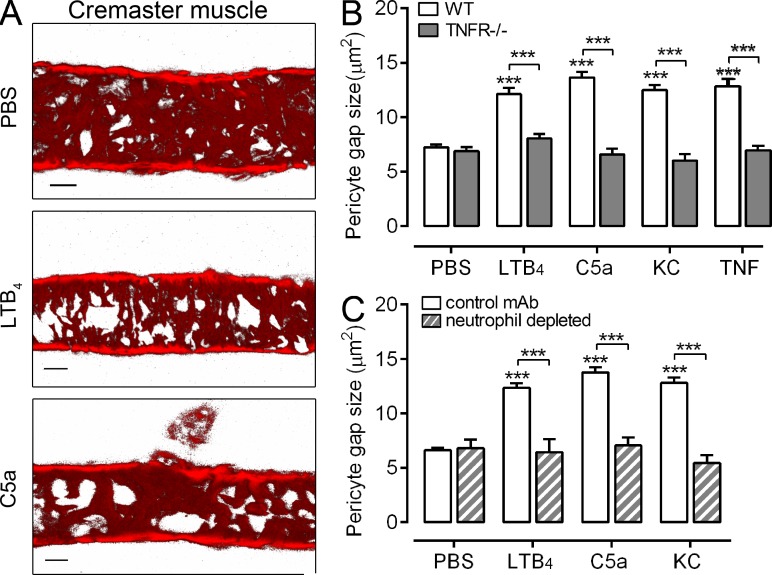
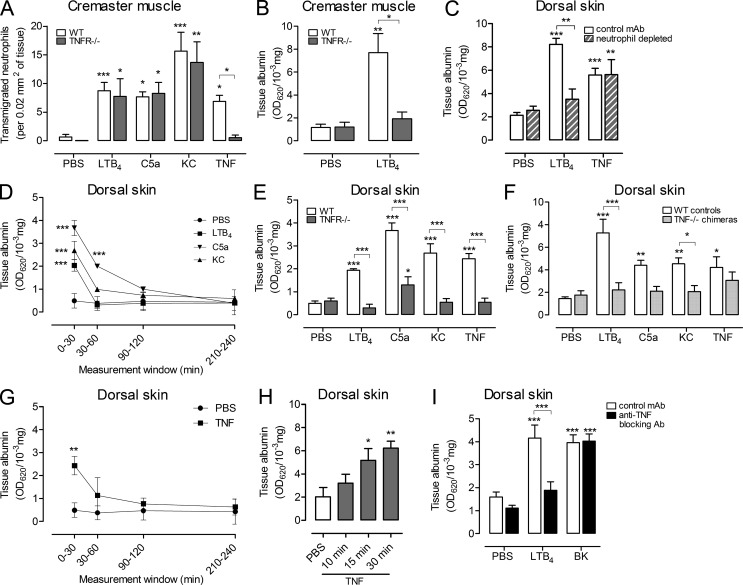
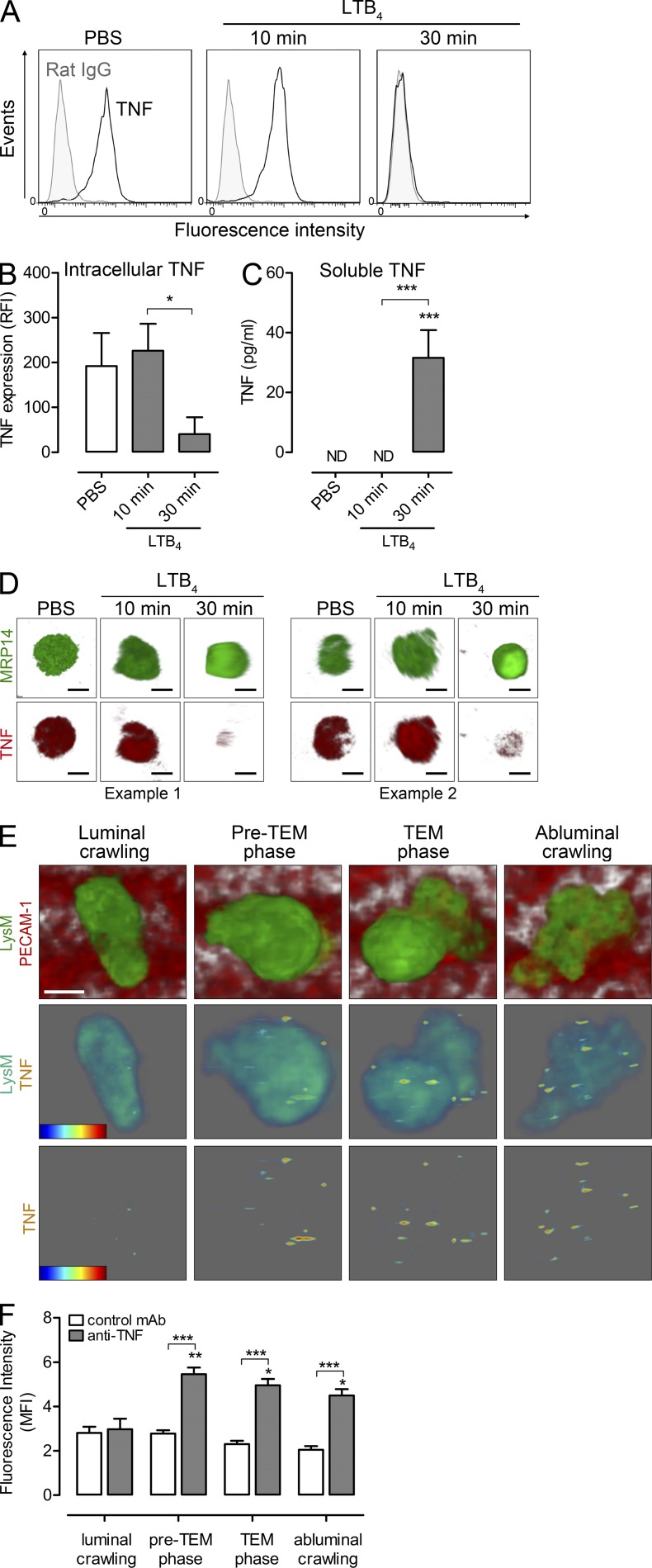
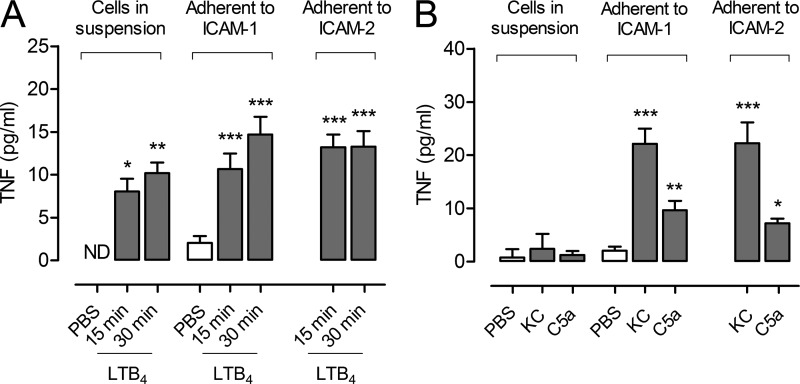
Microvascular plasma protein leakage is an essential component of the inflammatory response and serves an important function in local host defense and tissue repair. Mediators such as histamine and bradykinin act directly on venules to increase the permeability of endothelial cell (EC) junctions. Neutrophil chemoattractants also induce leakage, a response that is dependent on neutrophil adhesion to ECs, but the underlying mechanism has proved elusive. Through application of confocal intravital microscopy to the mouse cremaster muscle, we show that neutrophils responding to chemoattractants release TNF when in close proximity of EC junctions. In vitro, neutrophils adherent to ICAM-1 or ICAM-2 rapidly released TNF in response to LTB4, C5a, and KC. Further, in TNFR(-/-) mice, neutrophils accumulated normally in response to chemoattractants administered to the cremaster muscle or dorsal skin, but neutrophil-dependent plasma protein leakage was abolished. Similar results were obtained in chimeric mice deficient in leukocyte TNF. A locally injected TNF blocking antibody was also able to inhibit neutrophil-dependent plasma leakage, but had no effect on the response induced by bradykinin. The results suggest that TNF mediates neutrophil-dependent microvascular leakage. This mechanism may contribute to the effects of TNF inhibitors in inflammatory diseases and indicates possible applications in life-threatening acute edema.
微血管血浆蛋白渗漏是炎症反应的重要组成部分,在局部宿主防御和组织修复中发挥重要作用。组胺和缓激肽等介质直接作用于微静脉,增加内皮细胞(EC)连接的通透性。中性粒细胞趋化因子也会诱导渗漏,这种反应依赖于中性粒细胞与内皮细胞的黏附,但潜在机制一直难以捉摸。通过将共聚焦活体显微镜应用于小鼠提睾肌,我们发现对趋化因子作出反应的中性粒细胞在靠近内皮细胞连接时会释放肿瘤坏死因子(TNF)。在体外,黏附于细胞间黏附分子-1(ICAM-1)或细胞间黏附分子-2(ICAM-2)的中性粒细胞在受到白三烯B4(LTB4)、C5a和趋化因子KC刺激后会迅速释放TNF。此外,在肿瘤坏死因子受体基因敲除(TNFR(-/-))小鼠中,中性粒细胞在对注射到提睾肌或背部皮肤的趋化因子作出反应时正常聚集,但中性粒细胞依赖性血浆蛋白渗漏被消除。在缺乏白细胞TNF的嵌合小鼠中也得到了类似的结果。局部注射TNF阻断抗体也能够抑制中性粒细胞依赖性血浆渗漏,但对缓激肽诱导的反应没有影响。这些结果表明,TNF介导中性粒细胞依赖性微血管渗漏。这种机制可能有助于解释TNF抑制剂在炎症性疾病中的作用,并提示其在危及生命的急性水肿中的可能应用。