Everatt Kristoffer T, Andresen Leah, Somers Michael J
Centre for Wildlife Management, University of Pretoria, Pretoria, South Africa.
Centre for Wildlife Management, University of Pretoria, Pretoria, South Africa; Centre for Invasion Biology, University of Pretoria, Pretoria, South Africa.
PLoS One. 2014 Jun 10;9(6):e99389. doi: 10.1371/journal.pone.0099389. eCollection 2014.
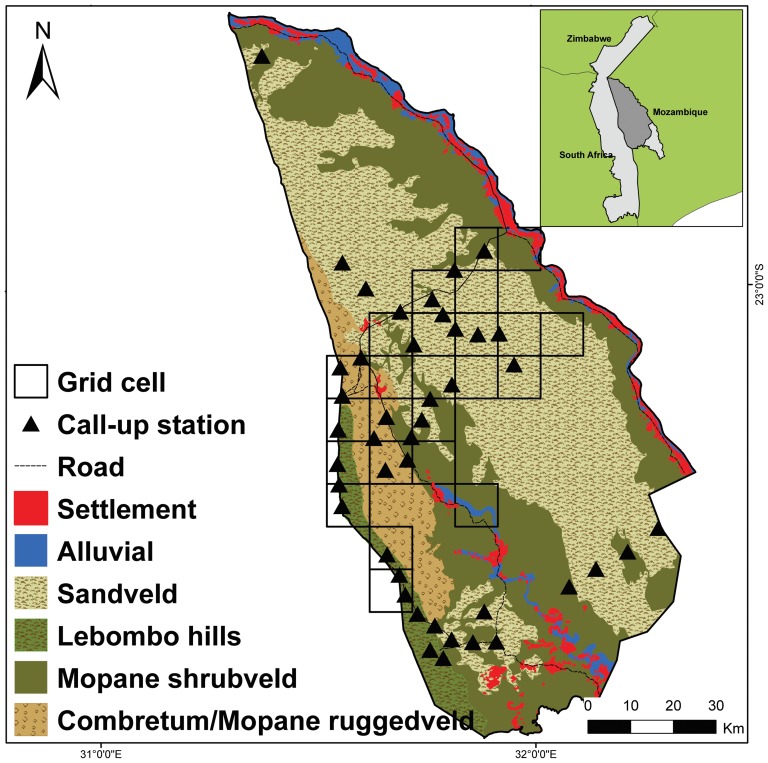
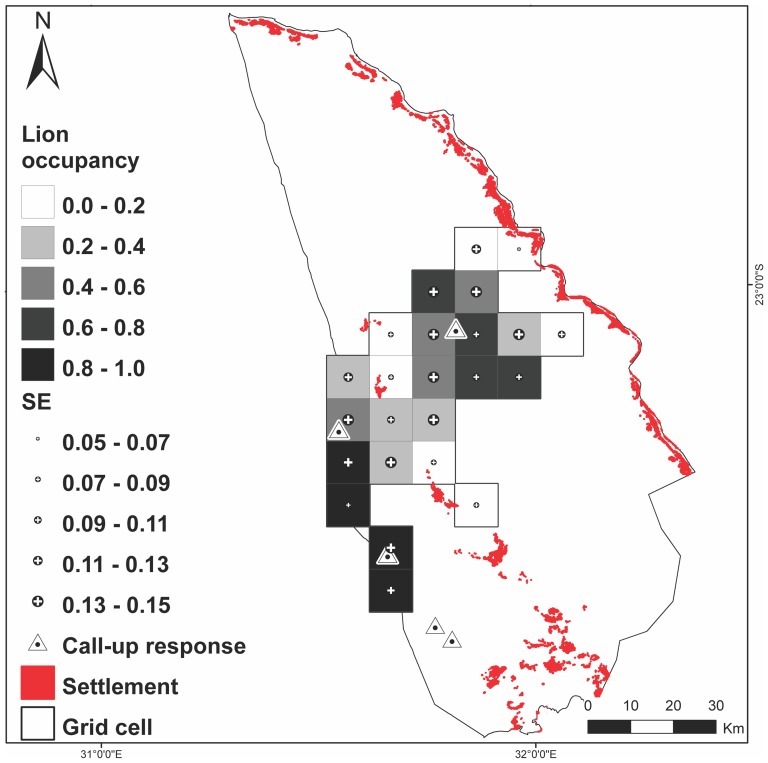
The African lion (Panthera Leo) has suffered drastic population and range declines over the last few decades and is listed by the IUCN as vulnerable to extinction. Conservation management requires reliable population estimates, however these data are lacking for many of the continent's remaining populations. It is possible to estimate lion abundance using a trophic scaling approach. However, such inferences assume that a predator population is subject only to bottom-up regulation, and are thus likely to produce biased estimates in systems experiencing top-down anthropogenic pressures. Here we provide baseline data on the status of lions in a developing National Park in Mozambique that is impacted by humans and livestock. We compare a direct density estimate with an estimate derived from trophic scaling. We then use replicated detection/non-detection surveys to estimate the proportion of area occupied by lions, and hierarchical ranking of covariates to provide inferences on the relative contribution of prey resources and anthropogenic factors influencing lion occurrence. The direct density estimate was less than 1/3 of the estimate derived from prey resources (0.99 lions/100 km² vs. 3.05 lions/100 km²). The proportion of area occupied by lions was Ψ = 0.439 (SE = 0.121), or approximately 44% of a 2,400 km2 sample of potential habitat. Although lions were strongly predicted by a greater probability of encountering prey resources, the greatest contributing factor to lion occurrence was a strong negative association with settlements. Finally, our empirical abundance estimate is approximately 1/3 of a published abundance estimate derived from opinion surveys. Altogether, our results describe a lion population held below resource-based carrying capacity by anthropogenic factors and highlight the limitations of trophic scaling and opinion surveys for estimating predator populations exposed to anthropogenic pressures. Our study provides the first empirical quantification of a population that future change can be measured against.
在过去几十年里,非洲狮(Panthera Leo)的种群数量和活动范围急剧减少,被国际自然保护联盟列为易危物种。保护管理需要可靠的种群数量估计,但非洲大陆许多剩余种群缺乏这些数据。可以使用营养级缩放方法来估计狮子的数量。然而,这种推断假设捕食者种群仅受自下而上的调控,因此在受到自上而下人为压力的系统中可能会产生有偏差的估计。在此,我们提供了莫桑比克一个受人类和牲畜影响的发展中国家公园内狮子现状的基线数据。我们将直接密度估计值与通过营养级缩放得出的估计值进行比较。然后,我们使用重复的检测/未检测调查来估计狮子占据的面积比例,并对协变量进行分层排序,以推断影响狮子出现的猎物资源和人为因素的相对贡献。直接密度估计值不到从猎物资源得出的估计值的三分之一(0.99只狮子/100平方公里对3.05只狮子/100平方公里)。狮子占据的面积比例为Ψ = 0.439(标准误差 = 0.121),即在2400平方公里潜在栖息地样本中约占44%。尽管遇到猎物资源的概率更高能有力地预测狮子的存在,但对狮子出现影响最大的因素是与定居点的强烈负相关。最后,我们的实际数量估计约为一项基于意见调查得出的已发表数量估计的三分之一。总体而言,我们的结果描述了一个因人为因素而低于基于资源的承载能力的狮子种群,并突出了营养级缩放和意见调查在估计受到人为压力的捕食者种群时的局限性。我们的研究首次对一个种群进行了实证量化,以便未来可以据此衡量变化情况。