Mangia Anna Lisa, Pirini Marco, Simoncini Laura, Cappello Angelo
Department of Electrical, Electronic and Information Engineering (DEI), University of Bologna, Cesena, Italy.
Rehabilitation Unit, Maggiore Hospital, Bologna, Italy.
PLoS One. 2014 Jun 10;9(6):e99289. doi: 10.1371/journal.pone.0099289. eCollection 2014.
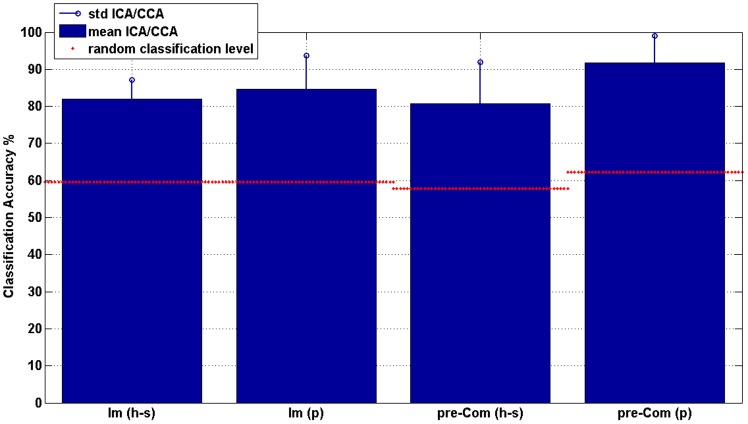
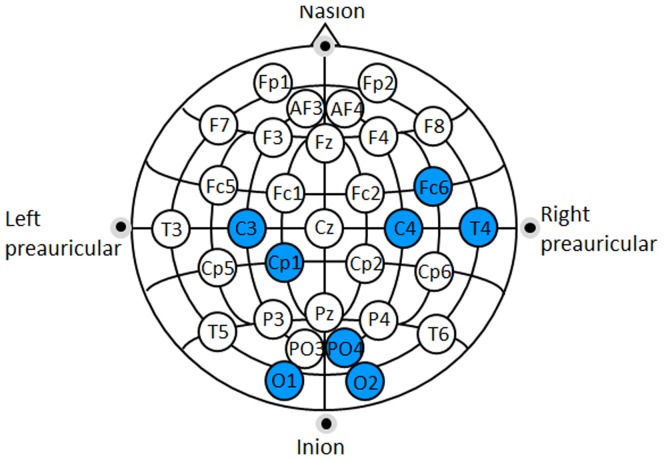
One of the major concerns of recent studies is the correct discrimination between vegetative and minimally conscious state as the distinction between these two conditions has major implications for subsequent patient rehabilitation. In particular, it would be advantageous to establish communication with these patients. This work describes a procedure using EEG to detect brain responses to imagery instruction in patients with disorders of consciousness. Five healthy subjects and five patients with different disorders of consciousness took part in the study. A support vector machine classifier applied to EEG data was used to distinguish two mental tasks (Imagery Trial) and to detect answers to simple yes or no questions (pre-Communication Trial). The proposed procedure uses feature selection based on a nested-leave-one-out algorithm to reduce the number of electrodes required. We obtained a mean classification accuracy of 82.0% (SD 5.1%) for healthy subjects and 84.6% (SD 9.1%) for patients in the Imagery Trial, and a mean classification accuracy of 80.7% (SD 11.5%) for healthy subjects and 91.7% (SD 7.4%) for patients in the pre-Communication Trial. The subset of electrodes selected was subject and session dependent.
近期研究的主要关注点之一是正确区分植物状态和微意识状态,因为这两种状态的区分对后续患者康复具有重大影响。特别是,与这些患者建立沟通将是有益的。这项工作描述了一种使用脑电图(EEG)来检测意识障碍患者对想象指令的大脑反应的程序。五名健康受试者和五名患有不同意识障碍的患者参与了该研究。应用于EEG数据的支持向量机分类器用于区分两项心理任务(想象试验)并检测对简单是或否问题的回答(预沟通试验)。所提出的程序使用基于嵌套留一法算法的特征选择来减少所需电极的数量。在想象试验中,我们获得的健康受试者平均分类准确率为82.0%(标准差5.1%),患者为84.6%(标准差9.1%);在预沟通试验中,健康受试者平均分类准确率为80.7%(标准差11.5%),患者为91.7%(标准差7.4%)。所选电极子集因受试者和实验环节而异。