Department of Production Engineering, Universidade Federal de Minas Gerais, Belo Horizonte, Brazil.
Int J Health Geogr. 2014 Jun 10;13:20. doi: 10.1186/1476-072X-13-20.
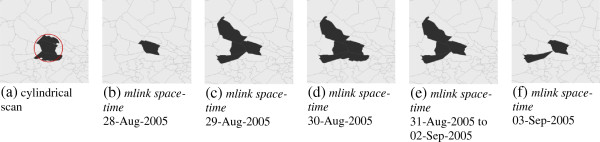
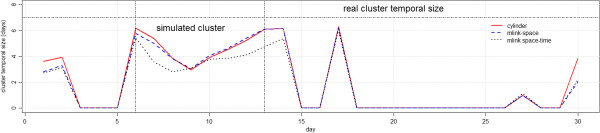
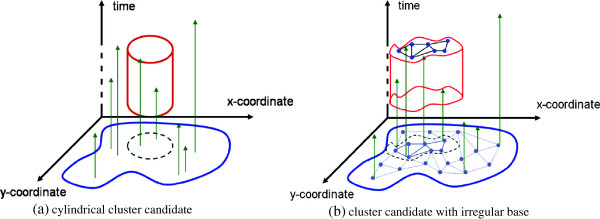
In disease surveillance, the prospective space-time permutation scan statistic is commonly used for the early detection of disease outbreaks. The scanning window that defines potential clusters of diseases is cylindrical in shape, which does not allow incorporating into the cluster shape potential factors that can contribute to the spread of the disease, such as information about roads, landscape, among others. Furthermore, the cylinder scanning window assumes that the spatial extent of the cluster does not change in time. Alternatively, a dynamic space-time cluster may indicate the potential spread of the disease through time. For instance, the cluster may decrease over time indicating that the spread of the disease is vanishing.
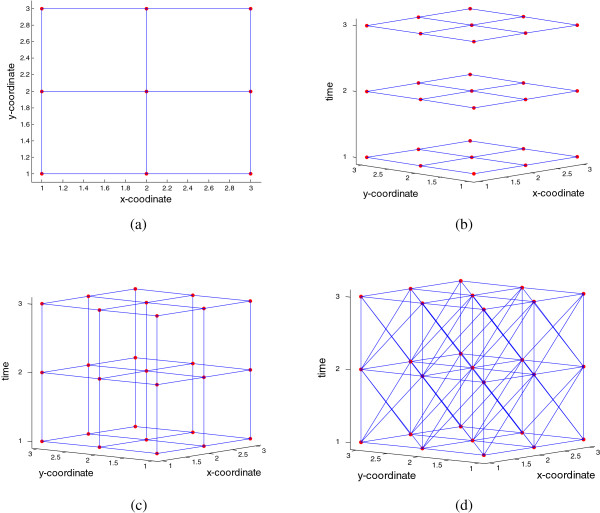
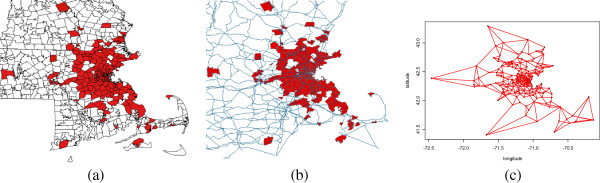
This paper proposes two irregularly shaped space-time permutation scan statistics. The cluster geometry is dynamically created using a graph structure. The graph can be created to include nearest-neighbor structures, geographical adjacency information or any relevant prior information regarding the contagious behavior of the event under surveillance.
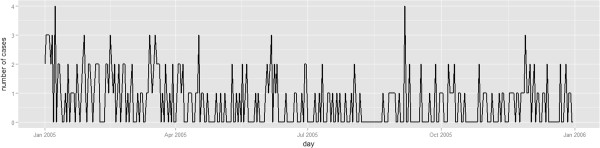
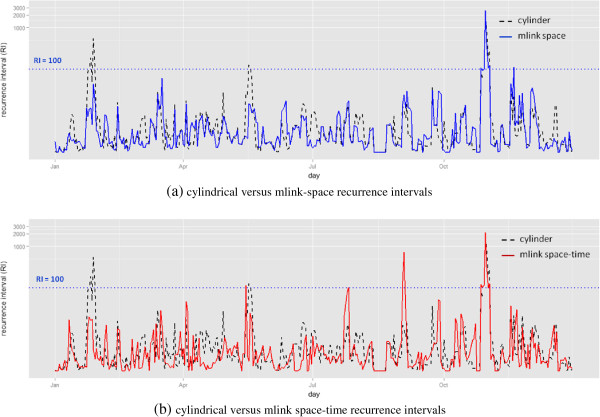
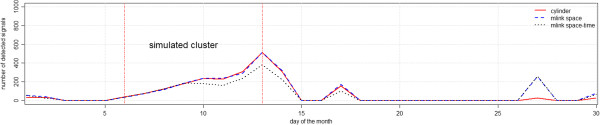
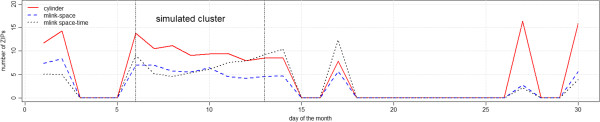
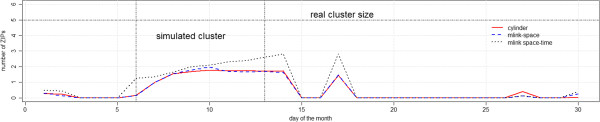
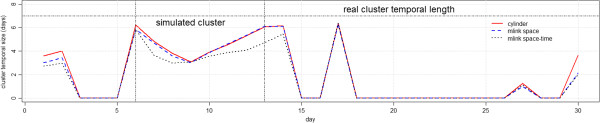
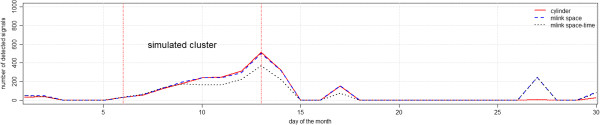
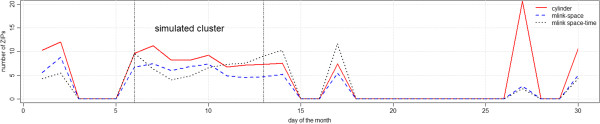
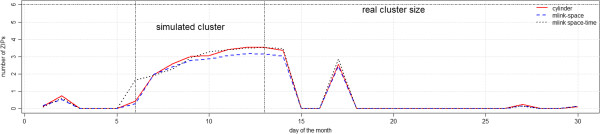
The new methods are illustrated using influenza cases in three New England states, and compared with the cylindrical version. A simulation study is provided to investigate some properties of the proposed arbitrary cluster detection techniques.
We have successfully developed two new space-time permutation scan statistics methods with irregular shapes and improved computational performance. The results demonstrate the potential of these methods to quickly detect disease outbreaks with irregular geometries. Future work aims at performing intensive simulation studies to evaluate the proposed methods using different scenarios, number of cases, and graph structures.
在疾病监测中,前瞻性时空排列扫描统计量常用于疾病暴发的早期检测。定义疾病潜在聚集的扫描窗口呈圆柱形,无法将可能有助于疾病传播的潜在因素(如道路、景观等信息)纳入到聚类形状中。此外,圆柱形扫描窗口假设聚类的空间范围不会随时间变化。相反,动态时空聚类可能表明疾病随着时间的推移有潜在的传播趋势。例如,随着时间的推移,聚类可能会减少,表明疾病的传播正在消失。
本文提出了两种不规则形状的时空排列扫描统计量。使用图结构动态创建聚类几何形状。可以创建图来包含最近邻结构、地理邻接信息或有关监视事件传染性行为的任何相关先验信息。
使用新英格兰三个州的流感病例说明了新方法,并与圆柱形版本进行了比较。提供了一项模拟研究来研究所提出的任意聚类检测技术的一些特性。
我们成功开发了两种具有不规则形状和改进计算性能的新时空排列扫描统计量方法。结果表明,这些方法具有快速检测具有不规则形状的疾病暴发的潜力。未来的工作旨在进行密集的模拟研究,使用不同的场景、病例数量和图结构来评估所提出的方法。