Healey Patrick G T, Purver Matthew, Howes Christine
Cognitive Science Research Group, School of Electronic Engineering and Computer Science, Queen Mary University of London, London, United Kingdom.
PLoS One. 2014 Jun 11;9(2):e98598. doi: 10.1371/journal.pone.0098598. eCollection 2014.
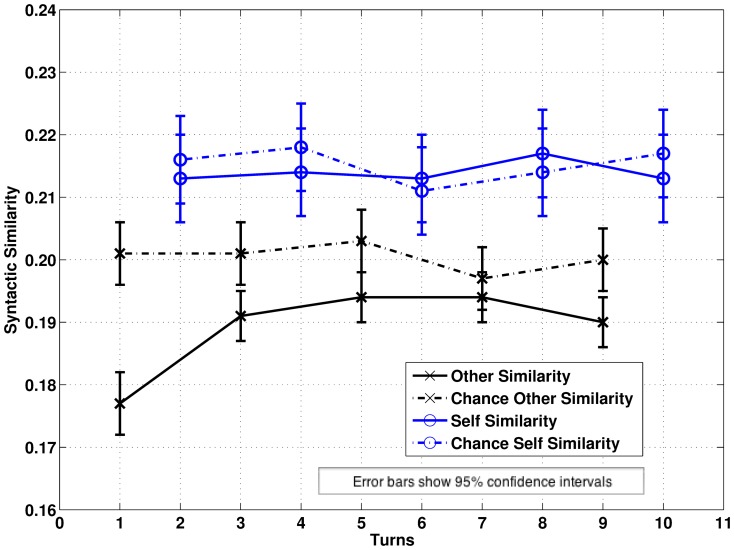
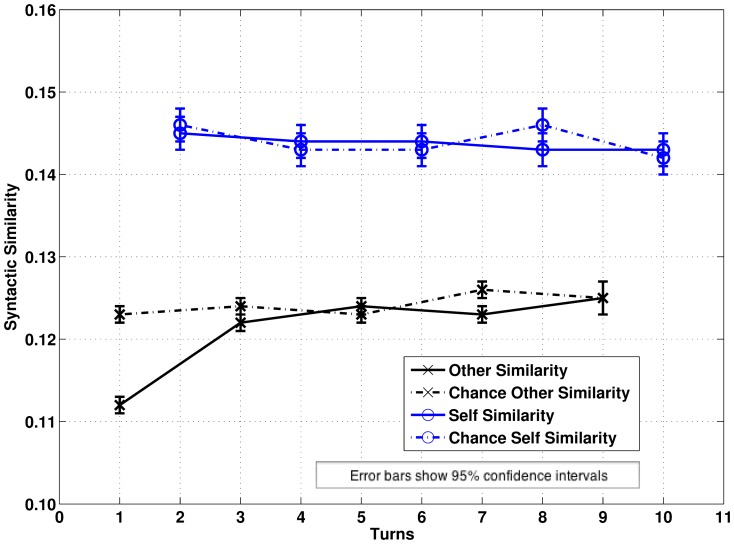
One of the best known claims about human communication is that people's behaviour and language use converge during conversation. It has been proposed that these patterns can be explained by automatic, cross-person priming. A key test case is structural priming: does exposure to one syntactic structure, in production or comprehension, make reuse of that structure (by the same or another speaker) more likely? It has been claimed that syntactic repetition caused by structural priming is ubiquitous in conversation. However, previous work has not tested for general syntactic repetition effects in ordinary conversation independently of lexical repetition. Here we analyse patterns of syntactic repetition in two large corpora of unscripted everyday conversations. Our results show that when lexical repetition is taken into account there is no general tendency for people to repeat their own syntactic constructions. More importantly, people repeat each other's syntactic constructions less than would be expected by chance; i.e., people systematically diverge from one another in their use of syntactic constructions. We conclude that in ordinary conversation the structural priming effects described in the literature are overwhelmed by the need to actively engage with our conversational partners and respond productively to what they say.
关于人类交流,最广为人知的观点之一是,人们的行为和语言使用在对话过程中会趋同。有人提出,这些模式可以通过自动的、跨人的启动效应来解释。一个关键的测试案例是结构启动效应:在产出或理解过程中接触一种句法结构,是否会使(同一说话者或另一说话者)再次使用该结构的可能性更大?有人声称,结构启动效应导致的句法重复在对话中无处不在。然而,以往的研究并没有独立于词汇重复来测试日常对话中的一般句法重复效应。在这里,我们分析了两个大型的无脚本日常对话语料库中的句法重复模式。我们的结果表明,当考虑到词汇重复时,人们并没有普遍倾向于重复自己的句法结构。更重要的是,人们相互重复对方句法结构的次数低于随机预期;也就是说,人们在句法结构的使用上系统性地存在差异。我们得出结论,在日常对话中,文献中描述的结构启动效应被与对话伙伴积极互动并对他们所说的话做出有效回应的需求所掩盖。