Holler Judith, Alday Phillip M, Decuyper Caitlin, Geiger Mareike, Kendrick Kobin H, Meyer Antje S
Max Planck Institute for Psycholinguistics, Nijmegen, Netherlands.
Donders Institute for Brain, Cognition, and Behavior, Radboud University, Nijmegen, Netherlands.
Front Psychol. 2021 Sep 16;12:693124. doi: 10.3389/fpsyg.2021.693124. eCollection 2021.
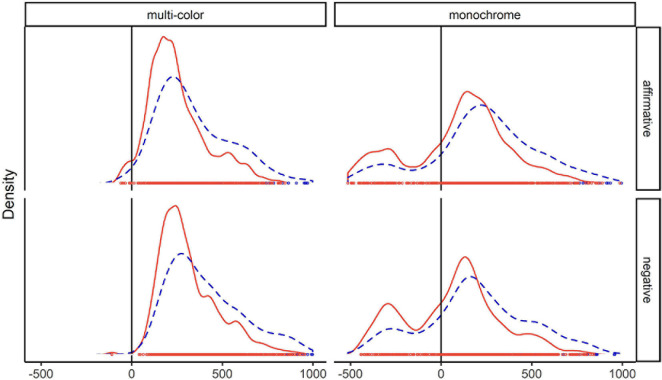
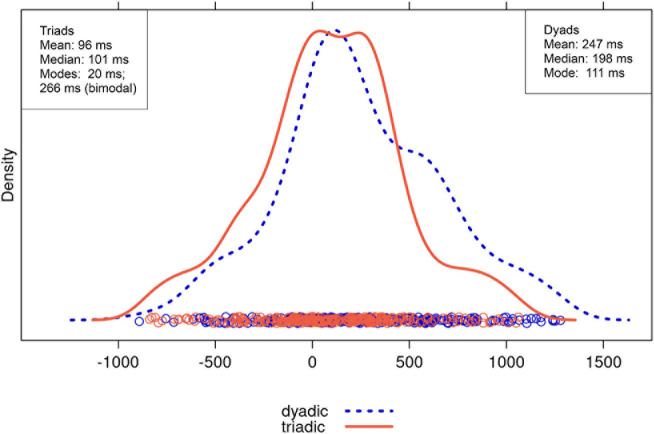
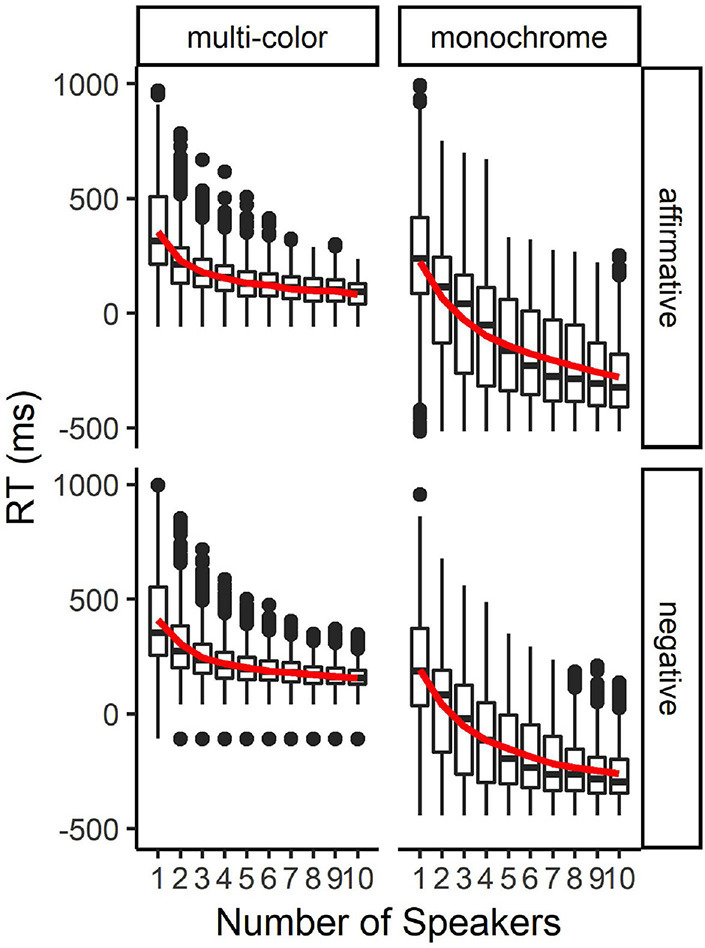
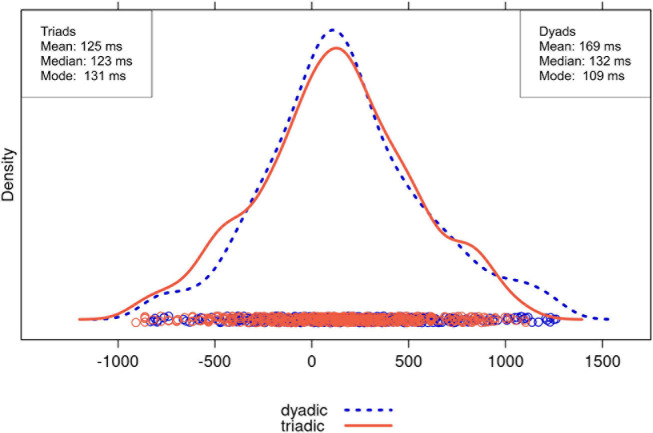
Natural conversations are characterized by short transition times between turns. This holds in particular for multi-party conversations. The short turn transitions in everyday conversations contrast sharply with the much longer speech onset latencies observed in laboratory studies where speakers respond to spoken utterances. There are many factors that facilitate speech production in conversational compared to laboratory settings. Here we highlight one of them, the impact of competition for turns. In multi-party conversations, speakers often compete for turns. In quantitative corpus analyses of multi-party conversation, the fastest response determines the recorded turn transition time. In contrast, in dyadic conversations such competition for turns is much less likely to arise, and in laboratory experiments with individual participants it does not arise at all. Therefore, all responses tend to be recorded. Thus, competition for turns may reduce the recorded mean turn transition times in multi-party conversations for a simple statistical reason: slow responses are not included in the means. We report two studies illustrating this point. We first report the results of simulations showing how much the response times in a laboratory experiment would be reduced if, for each trial, instead of recording all responses, only the fastest responses of several participants responding independently on the trial were recorded. We then present results from a quantitative corpus analysis comparing turn transition times in dyadic and triadic conversations. There was no significant group size effect in question-response transition times, where the present speaker often selects the next one, thus reducing competition between speakers. But, as predicted, triads showed shorter turn transition times than dyads for the remaining turn transitions, where competition for the floor was more likely to arise. Together, these data show that turn transition times in conversation should be interpreted in the context of group size, turn transition type, and social setting.
自然对话的特点是轮流发言之间的过渡时间较短。这在多方对话中尤为明显。日常对话中短暂的轮流过渡与实验室研究中观察到的说话者对口头话语做出回应时长得多的言语起始延迟形成鲜明对比。与实验室环境相比,有许多因素促进了对话中的言语产生。在这里,我们强调其中一个因素,即轮流竞争的影响。在多方对话中,说话者经常竞争轮流发言的机会。在多方对话的定量语料库分析中,最快的回应决定了记录的轮流过渡时间。相比之下,在二元对话中,这种轮流竞争不太可能出现,而在针对个体参与者的实验室实验中则根本不会出现。因此,所有回应往往都会被记录下来。因此,出于一个简单的统计原因,轮流竞争可能会减少多方对话中记录的平均轮流过渡时间:较慢的回应不包括在平均值中。我们报告两项研究来说明这一点。我们首先报告模拟结果,展示在实验室实验中,如果每次试验不是记录所有回应,而是只记录几个独立回应试验的参与者中最快的回应,回应时间会减少多少。然后,我们展示定量语料库分析的结果,比较二元和三元对话中的轮流过渡时间。在问答过渡时间方面没有显著的群体规模效应,在这种情况下,当前发言者通常会选择下一个发言者,从而减少了说话者之间的竞争。但是,正如预测的那样,对于其余更有可能出现抢占发言权竞争的轮流过渡,三人组的轮流过渡时间比二人组短。总之,这些数据表明,对话中的轮流过渡时间应在群体规模、轮流过渡类型和社会环境的背景下进行解释。