Cadet Jean Lud, Brannock Christie, Jayanthi Subramaniam, Krasnova Irina N
Molecular Neuropsychiatry Research Branch, Intramural Research Program, National Institute on Drug Abuse, NIH, DHHS, 251 Bayview Boulevard, Baltimore, MD, 21224, USA,
Mol Neurobiol. 2015 Apr;51(2):696-717. doi: 10.1007/s12035-014-8776-8. Epub 2014 Jun 18.
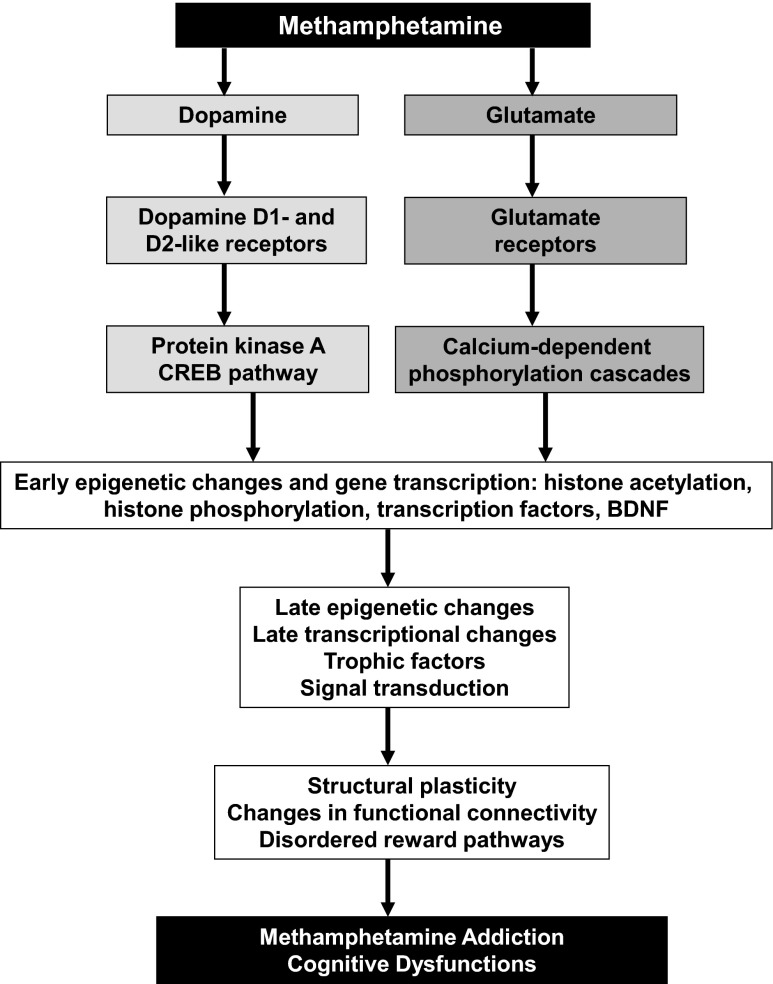
Methamphetamine use disorder is a chronic neuropsychiatric disorder characterized by recurrent binge episodes, intervals of abstinence, and relapses to drug use. Humans addicted to methamphetamine experience various degrees of cognitive deficits and other neurological abnormalities that complicate their activities of daily living and their participation in treatment programs. Importantly, models of methamphetamine addiction in rodents have shown that animals will readily learn to give themselves methamphetamine. Rats also accelerate their intake over time. Microarray studies have also shown that methamphetamine taking is associated with major transcriptional changes in the striatum measured within a short or longer time after cessation of drug taking. After a 2-h withdrawal time, there was increased expression of genes that participate in transcription regulation. These included cyclic AMP response element binding (CREB), ETS domain-containing protein (ELK1), and members of the FOS family of transcription factors. Other genes of interest include brain-derived neurotrophic factor (BDNF), tyrosine kinase receptor, type 2 (TrkB), and synaptophysin. Methamphetamine-induced transcription was found to be regulated via phosphorylated CREB-dependent events. After a 30-day withdrawal from methamphetamine self-administration, however, there was mostly decreased expression of transcription factors including junD. There was also downregulation of genes whose protein products are constituents of chromatin-remodeling complexes. Altogether, these genome-wide results show that methamphetamine abuse might be associated with altered regulation of a diversity of gene networks that impact cellular and synaptic functions. These transcriptional changes might serve as triggers for the neuropsychiatric presentations of humans who abuse this drug. Better understanding of the way that gene products interact to cause methamphetamine addiction will help to develop better pharmacological treatment of methamphetamine addicts.
甲基苯丙胺使用障碍是一种慢性神经精神障碍,其特征为反复出现的 binge 发作、禁欲期以及复吸。对甲基苯丙胺成瘾的人会经历不同程度的认知缺陷和其他神经异常,这使他们的日常生活活动以及参与治疗项目变得复杂。重要的是,啮齿动物的甲基苯丙胺成瘾模型表明,动物会很容易学会给自己注射甲基苯丙胺。随着时间的推移,大鼠的摄入量也会增加。微阵列研究还表明,在停止用药后的短时间或长时间内,服用甲基苯丙胺与纹状体中的主要转录变化有关。在停药 2 小时后,参与转录调控的基因表达增加。这些基因包括环磷腺苷反应元件结合蛋白(CREB)、含 ETS 结构域蛋白(ELK1)以及转录因子 FOS 家族的成员。其他感兴趣的基因包括脑源性神经营养因子(BDNF)、酪氨酸激酶受体 2 型(TrkB)和突触素。发现甲基苯丙胺诱导的转录是通过磷酸化的 CREB 依赖性事件来调节的。然而,在从甲基苯丙胺自我给药中停药 30 天后,包括 junD 在内的转录因子表达大多下降。其蛋白质产物是染色质重塑复合物组成成分的基因也出现下调。总之,这些全基因组结果表明,甲基苯丙胺滥用可能与影响细胞和突触功能的多种基因网络调节改变有关。这些转录变化可能是滥用这种药物的人出现神经精神症状的触发因素。更好地理解基因产物相互作用导致甲基苯丙胺成瘾的方式,将有助于开发出更好的甲基苯丙胺成瘾者药物治疗方法。