Culley Alexander I, Mueller Jaclyn A, Belcaid Madhi, Wood-Charlson Elisha M, Poisson Guylaine, Steward Grieg F
Department of Oceanography, Center for Microbial Oceanography: Research and Education, University of Hawai'i at Mānoa, Honolulu, Hawai'i, USA
Department of Oceanography, Center for Microbial Oceanography: Research and Education, University of Hawai'i at Mānoa, Honolulu, Hawai'i, USA.
mBio. 2014 Jun 17;5(3):e01210-14. doi: 10.1128/mBio.01210-14.
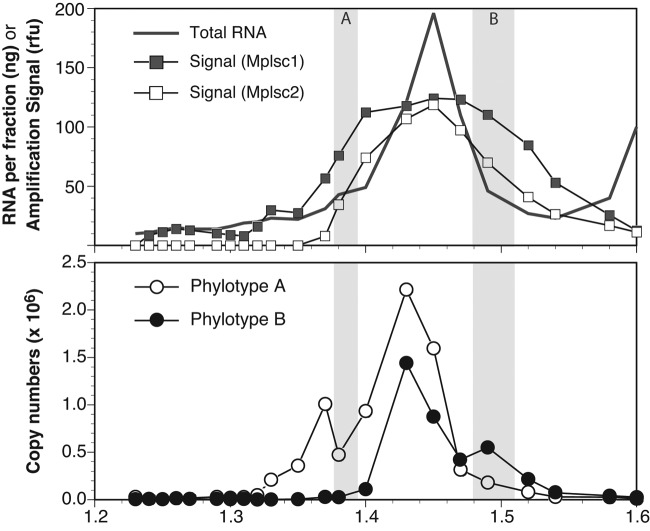
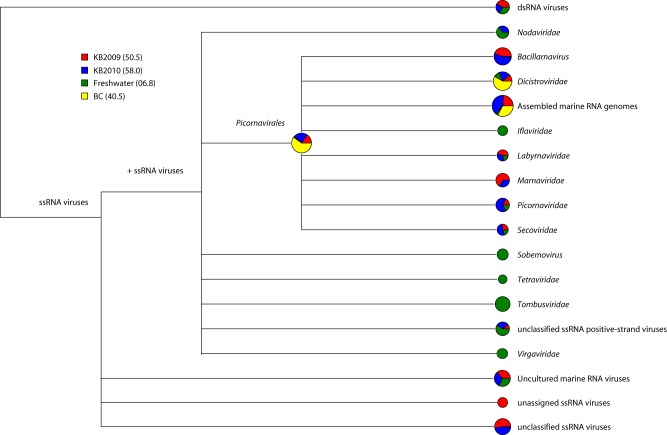
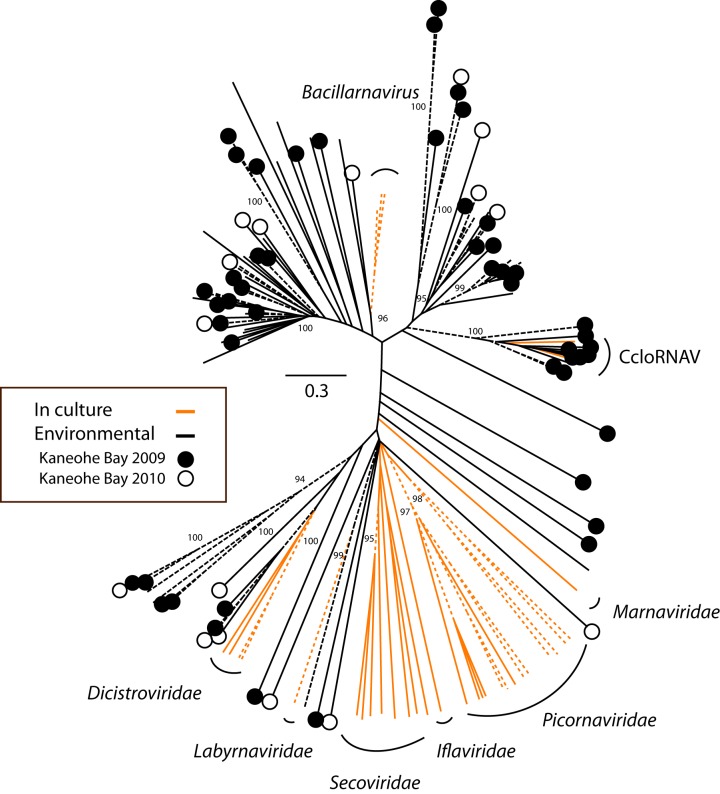
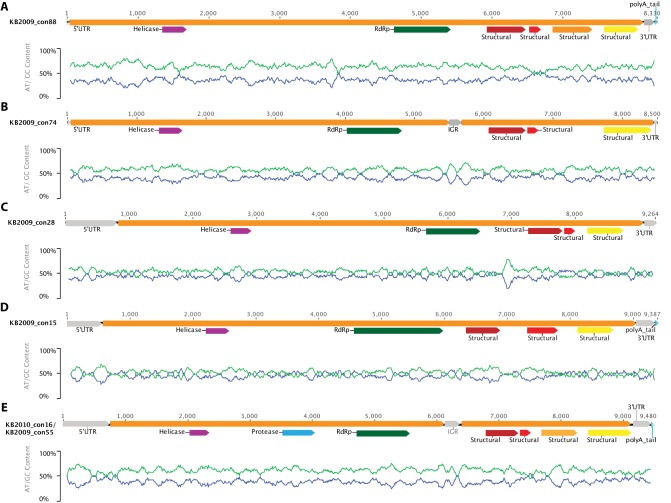
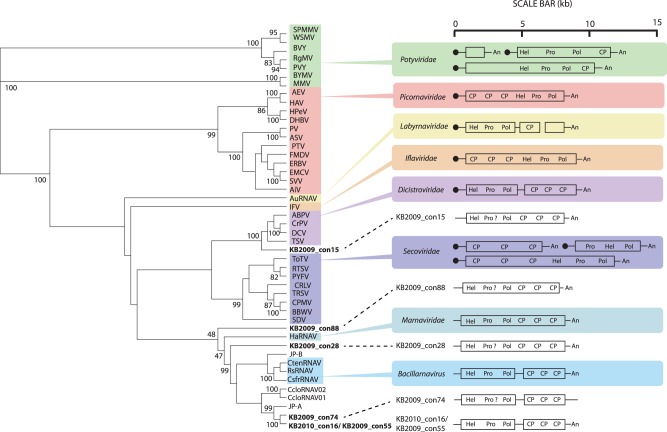
Viruses have a profound influence on the ecology and evolution of plankton, but our understanding of the composition of the aquatic viral communities is still rudimentary. This is especially true of those viruses having RNA genomes. The limited data that have been published suggest that the RNA virioplankton is dominated by viruses with positive-sense, single-stranded (+ss) genomes that have features in common with those of eukaryote-infecting viruses in the order Picornavirales (picornavirads). In this study, we investigated the diversity of the RNA virus assemblages in tropical coastal seawater samples using targeted PCR and metagenomics. Amplification of RNA-dependent RNA polymerase (RdRp) genes from fractions of a buoyant density gradient suggested that the distribution of two major subclades of the marine picornavirads was largely congruent with the distribution of total virus-like RNA, a finding consistent with their proposed dominance. Analyses of the RdRp sequences in the library revealed the presence of many diverse phylotypes, most of which were related only distantly to those of cultivated viruses. Phylogenetic analysis suggests that there were hundreds of unique picornavirad-like phylotypes in one 35-liter sample that differed from one another by at least as much as the differences among currently recognized species. Assembly of the sequences in the metagenome resulted in the reconstruction of six essentially complete viral genomes that had features similar to viruses in the families Bacillarna-, Dicistro-, and Marnaviridae. Comparison of the tropical seawater metagenomes with those from other habitats suggests that +ssRNA viruses are generally the most common types of RNA viruses in aquatic environments, but biases in library preparation remain a possible explanation for this observation.
Marine plankton account for much of the photosynthesis and respiration on our planet, and they influence the cycling of carbon and the distribution of nutrients on a global scale. Despite the fundamental importance of viruses to plankton ecology and evolution, most of the viruses in the sea, and the identities of their hosts, are unknown. This report is one of very few that delves into the genetic diversity within RNA-containing viruses in the ocean. The data expand the known range of viral diversity and shed new light on the physical properties and genetic composition of RNA viruses in the ocean.
病毒对浮游生物的生态和进化有着深远影响,但我们对水生病毒群落组成的了解仍很基础。对于那些具有RNA基因组的病毒来说尤其如此。已发表的有限数据表明,RNA病毒浮游生物主要由具有正义单链(+ss)基因组的病毒主导,这些病毒具有与微小核糖核酸病毒目(微小核糖核酸病毒)中感染真核生物的病毒共同的特征。在本研究中,我们使用靶向PCR和宏基因组学方法研究了热带沿海海水样本中RNA病毒组合的多样性。从浮力密度梯度分级中扩增RNA依赖的RNA聚合酶(RdRp)基因表明,海洋微小核糖核酸病毒的两个主要亚分支的分布与总病毒样RNA的分布基本一致,这一发现与它们被认为的主导地位相符。对文库中RdRp序列的分析揭示了许多不同的系统发育型,其中大多数与已培养病毒的序列关系仅很遥远。系统发育分析表明,在一个35升的样本中存在数百种独特的微小核糖核酸病毒样系统发育型,它们彼此之间的差异至少与目前公认的物种之间的差异一样大。宏基因组中的序列组装导致重建了六个基本完整的病毒基因组,这些基因组具有与芽孢病毒科、双顺反子病毒科和马尔纳病毒科病毒相似的特征。将热带海水宏基因组与其他栖息地的宏基因组进行比较表明,+ssRNA病毒通常是水生环境中最常见的RNA病毒类型,但文库制备中的偏差仍是对此观察结果的一个可能解释。
海洋浮游生物占地球光合作用和呼吸作用的很大一部分,它们在全球范围内影响碳循环和营养物质分布。尽管病毒对浮游生物生态和进化至关重要,但海洋中的大多数病毒及其宿主身份仍不为人知。本报告是极少数深入研究海洋中含RNA病毒遗传多样性的报告之一。这些数据扩展了已知的病毒多样性范围,并为海洋中RNA病毒的物理特性和遗传组成提供了新的线索。