Mirmiran Parvin, Bahadoran Zahra, Golzarand Mahdieh, Zojaji Homayoun, Azizi Fereidoun
Nutrition and Endocrine Research Center, and Obesity Research Center, Research Institute for Endocrine Sciences, Shahid Beheshti University of Medical Sciences, Tehran, Iran ; Department of Clinical Nutrition and Diet Therapy, Faculty of Nutrition Sciences and Food Technology, National Nutrition and Food Technology Research Institute, Shahid Beheshti University of Medical Sciences, Tehran, Iran.
Nutrition and Endocrine Research Center, and Obesity Research Center, Research Institute for Endocrine Sciences, Shahid Beheshti University of Medical Sciences, Tehran, Iran.
J Diabetes Metab Disord. 2014 May 28;13:64. doi: 10.1186/2251-6581-13-64. eCollection 2014.
In this clinical trial we compared the effects of broccoli sprouts powder, as an alternative and complementary treatment, to those of standard triple therapy, as a common medical treatment, on cardiovascular risk factors following the H.pylori eradication in patients with type 2 diabetes.
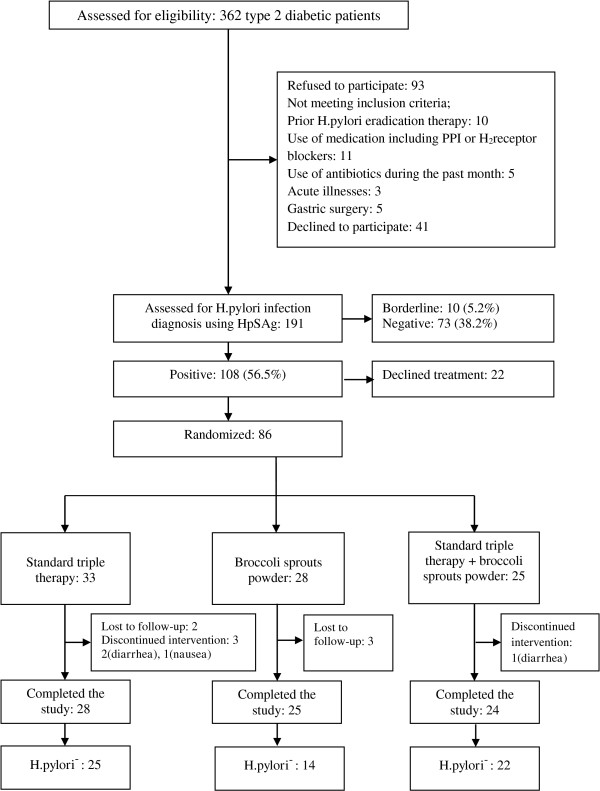
Eighty-six type 2 diabetic patients with positive H.pylori stool antigen test (HpSAg) were randomized to receive one of the three following regimens: STT) Standard triple therapy (omeprazole 20 mg, clarithromycin 500 mg, amoxicillin 1000 mg, twice a day for 14 days), BSP) 6 g/d broccoli sprouts powder for 28 days, and combination of these as STT + BSP. After 4 weeks of treatment, H.pylori eradication rates were assessed by HpSAg. Anthropometric measures, blood pressure, serum lipids and lipoproteins as well as serum high sensitive- C reactive protein were also assessed at baseline and at the second examination.
Seventy-seven participants completed the study [STT (n = 28), BSP (n = 25), STT + BSP (n = 24)]. The H.pylori eradication rates were 89.3%, 56.0% and 91.7% in STT, BSP and STT + BSP groups, respectively. After the treatment, both systolic and diastolic blood pressure significantly decreased in STT + BSP group (P < 0.05). Serum triglycerides and TG/HDL-C ratio increased in STT patients group (<0.05). Serum hs-CRP levels significantly decreased in the patients who were treated with BSP per se (3.0 ± 2.5 at baseline vs. 2.3 ± 2.1 after the treatment, P < 0.05).
Compared to standard triple therapy, BSP regimen in addition to considerable effects on H.pylori eradication had also favorable properties on cardiovascular risk factors following the H.pylori eradication.
在本临床试验中,我们比较了作为替代和补充治疗的西兰花芽粉与作为常规医学治疗的标准三联疗法,对2型糖尿病患者根除幽门螺杆菌后心血管危险因素的影响。
86例幽门螺杆菌粪便抗原检测(HpSAg)呈阳性的2型糖尿病患者被随机分为以下三种治疗方案之一:STT)标准三联疗法(奥美拉唑20毫克、克拉霉素500毫克、阿莫西林1000毫克,每日两次,共14天),BSP)每天6克西兰花芽粉,共28天,以及两者联合使用即STT + BSP。治疗4周后,通过HpSAg评估幽门螺杆菌根除率。在基线和第二次检查时还评估了人体测量指标、血压、血脂和脂蛋白以及血清高敏C反应蛋白。
77名参与者完成了研究[STT组(n = 28),BSP组(n = 25),STT + BSP组(n = 24)]。STT组、BSP组和STT + BSP组的幽门螺杆菌根除率分别为89.3%、56.0%和91.7%。治疗后,STT + BSP组的收缩压和舒张压均显著降低(P < 0.05)。STT患者组的血清甘油三酯和TG/HDL-C比值升高(<0.05)。单独接受BSP治疗的患者血清hs-CRP水平显著降低(基线时为3.0±2.5,治疗后为2.3±2.1,P < 0.05)。
与标准三联疗法相比,BSP方案除了对根除幽门螺杆菌有显著效果外,对根除幽门螺杆菌后的心血管危险因素也具有有利作用。