Richards Justin, Foster Charlie, Townsend Nick, Bauman Adrian
Nuffield Department of Population Health, British Heart Foundation Health Promotion Research Group, University of Oxford, Rosemary Rue Building, Old Road Campus, Roosevelt Drive, Headington, Oxford OX3 7LF, UK.
BMC Public Health. 2014 Jun 18;14:619. doi: 10.1186/1471-2458-14-619.
Physical inactivity contributes to poor fitness and mental health disorders. This is of concern in post-conflict low-income settings where non-communicable diseases are emerging and there is limited evidence for physical activity interventions. We examined the effects of a sport-for-development programme on adolescent physical fitness and mental health in Gulu, Uganda.
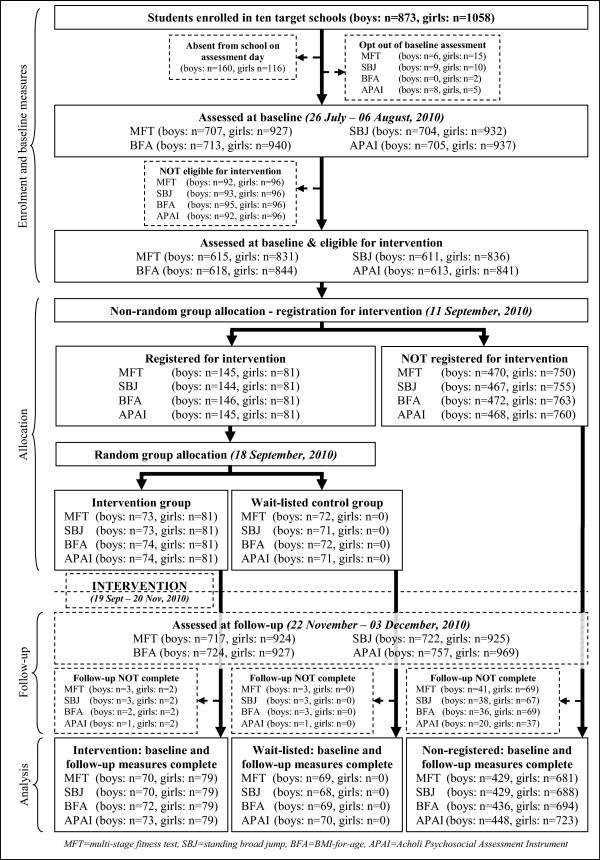
We conducted a single-blinded RCT nested within an observational study with three unbalanced parallel groups. Participants were able-bodied adolescents aged 11-14 years. The intervention comprised an 11-week voluntary competitive sport-for-development football league. Participants who did not subscribe for the intervention formed a non-registered comparison group. Boys who registered for the sport-for-development programme were randomly allocated to the intervention or wait-listed. The girls programme subscription was insufficient to form a wait-list and all registrants received the intervention. Physical fitness was assessed by cardiorespiratory fitness (multi-stage fitness test), muscular power (standing broad jump) and body composition (BMI-for-age). Mental health was measured using the Acholi Psychosocial Assessment Instrument for local depression-like (DLS) and anxiety-like (ALS) syndromes. All randomisation was computer generated and assessors were masked to group allocation. An intention-to-treat analysis of adjusted effect size (ES) was applied.
There were 1,462 adolescents in the study (intervention: boys = 74, girls = 81; wait-list: boys = 72; comparison: boys = 472, girls = 763). At four months follow-up there was no significant effect on the boys fitness when comparing intervention vs wait-listed and intervention vs non-registered groups. However, there was a negative effect on DLS when comparing boys intervention vs wait-listed (ES = 0.67 [0.33 to 1.00]) and intervention vs non-registered (ES = 0.25 [0.00 to 0.49]). Similar results were observed for ALS for boys intervention vs wait-listed (ES = 0.63 [0.30 to 0.96]) and intervention vs non-registered (ES = 0.26 [0.01 to 0.50]). There was no significant effect on the girls for any outcomes.
The sport-for-development league in this study had no impact on fitness and a negative effect on the mental health of participating boys. From this research, there is no evidence that voluntary competitive sport-for-development interventions improve physical fitness or mental health outcomes in post-conflict settings.
缺乏体育活动会导致身体素质差和心理健康问题。这在冲突后低收入地区令人担忧,因为这些地区非传染性疾病正在出现,而体育活动干预的证据有限。我们研究了一项体育促进发展项目对乌干达古卢青少年身体素质和心理健康的影响。
我们在一项观察性研究中进行了单盲随机对照试验,设有三个不平衡的平行组。参与者为11至14岁的健全青少年。干预措施包括为期11周的自愿性体育促进发展足球联赛。未报名参加干预的参与者组成一个未注册的对照组。报名参加体育促进发展项目的男孩被随机分配到干预组或等待名单组。女孩项目的报名人数不足以形成等待名单,所有登记者都接受了干预。通过心肺适能(多阶段适能测试)、肌肉力量(立定跳远)和身体成分(年龄别BMI)评估身体素质。使用阿乔利心理社会评估工具测量心理健康,评估当地类似抑郁(DLS)和类似焦虑(ALS)综合征。所有随机分组均由计算机生成,评估人员对分组情况不知情。应用意向性分析调整效应量(ES)。
本研究共有1462名青少年(干预组:男孩74名,女孩81名;等待名单组:男孩72名;对照组:男孩472名,女孩763名)。在四个月的随访中,比较干预组与等待名单组以及干预组与未注册组时,对男孩的身体素质没有显著影响。然而,比较男孩干预组与等待名单组(ES = 0.67 [0.33至1.00])以及干预组与未注册组(ES = 0.25 [0.00至0.49])时,对DLS有负面影响。在比较男孩干预组与等待名单组(ES = 0.63 [0.30至0.96])以及干预组与未注册组(ES = 0.26 [0.01至0.50])时,ALS也观察到类似结果。对女孩的任何结果均无显著影响。
本研究中的体育促进发展联赛对身体素质没有影响,对参与的男孩心理健康有负面影响。从这项研究来看,没有证据表明自愿性体育促进发展干预能改善冲突后环境中的身体素质或心理健康结果。