Zhuang Jiawei, Shan Zhonggui, Ma Teng, Li Chun, Qiu Shuiwei, Zhou Xiaobiao, Lin Lianfeng, Qi Zhongquan
Department of Cardiac Surgery, The First Affiliated Hospital, Xiamen University, Xiamen, Fujian 361003, P.R. China.
Organ Transplantation Institute, Medical College, Xiamen University, Xiamen, Fujian 361005, P.R. China.
Exp Ther Med. 2014 Jul;8(1):237-242. doi: 10.3892/etm.2014.1714. Epub 2014 May 14.
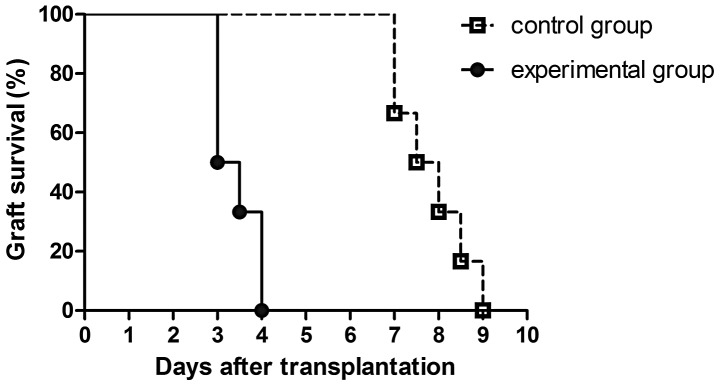
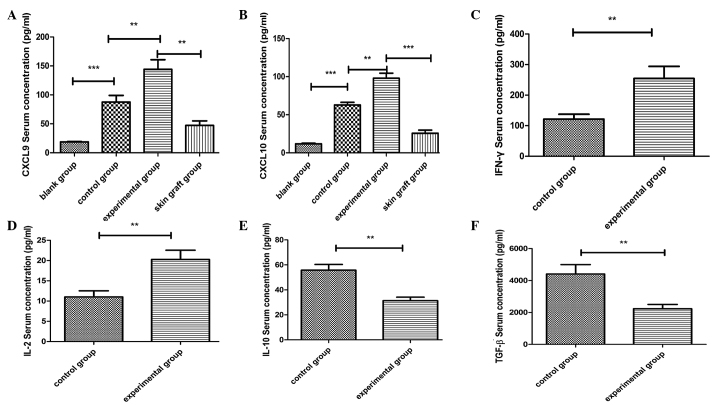
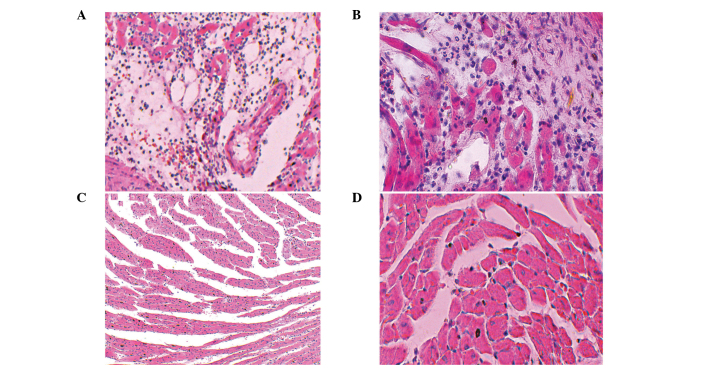
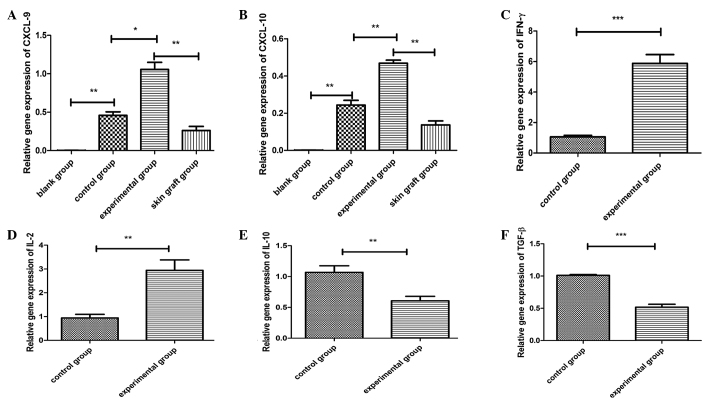
C-X-C motif chemokine ligand (CXCL) 9 and CXCL10 play key roles in the initiation and development of acute transplant rejection. Previously, higher levels of RANTES expression and secretion were demonstrated in retransplantation or T-cell memory-transfer models. In the present study, the effect of the chemokines, CXCL9 and CXCL10, were investigated in a mouse retransplantation model. BALB/c mice were used as donors, while C57BL/6 mice were used as recipients. In the experimental groups, a heterotopic heart transplantation was performed six weeks following skin grafting. In the control groups, a heterotopic heart transplantation was performed without skin grafting. Untreated mice served as blank controls. The mean graft survival time of the heterotopic heart transplantations was 7.7 days in the experimental group (n=6), as compared with 3.25 days in the control group (n=6; P<0.001). On day three following cardiac transplantation, histological evaluation of the grafts revealed a higher International Society for Heart & Lung Transplantation grade in the experimental group as compared with the control group. In addition, gene expression and serum concentrations of CXCL9, CXCL10, interferon-γ, and interleukin-2 were markedly higher in the experimental group when compared with the control group. Differences between the levels of CXCL9 and CXCL10 in the pre- and post-transplant mice indicated that the chemokines may serve as possible biomarkers to predict acute rejection. The results of the present study demonstrated that CXCL9 and CXCL10 play a critical role in transplantation and retransplantation. High levels of these cytokines during the pre-transplant period may lead to extensive acute rejection. Thus, the observations enhance the understanding of the mechanism underlying the increased expression and secretion of CXCL9 and CXCL10 by alloreactive memory T cells.
C-X-C基序趋化因子配体(CXCL)9和CXCL10在急性移植排斥反应的起始和发展中起关键作用。此前,在再次移植或T细胞记忆转移模型中已证实RANTES表达和分泌水平较高。在本研究中,在小鼠再次移植模型中研究了趋化因子CXCL9和CXCL10的作用。以BALB/c小鼠作为供体,C57BL/6小鼠作为受体。在实验组中,皮肤移植六周后进行异位心脏移植。在对照组中,未进行皮肤移植直接进行异位心脏移植。未处理的小鼠作为空白对照。实验组异位心脏移植的平均移植物存活时间为7.7天(n = 6),而对照组为3.25天(n = 6;P < 0.001)。心脏移植后第三天,对移植物进行组织学评估发现,实验组的国际心肺移植协会分级高于对照组。此外,与对照组相比,实验组中CXCL9、CXCL10、干扰素-γ和白细胞介素-2的基因表达和血清浓度明显更高。移植前和移植后小鼠体内CXCL9和CXCL10水平的差异表明,这些趋化因子可能作为预测急性排斥反应的潜在生物标志物。本研究结果表明,CXCL9和CXCL10在移植和再次移植中起关键作用。移植前期这些细胞因子的高水平可能导致广泛的急性排斥反应。因此,这些观察结果加深了对同种异体反应性记忆T细胞增加CXCL9和CXCL10表达和分泌机制的理解。