Zhao Xin Yan, Rakhda Mohmedmohsin Ismail Ahmed, Habib Sohail, Bihi Ali, Muhammad Abdullah, Wang Tai Ling, Jia Ji-Dong
Liver Research Center, Beijing Friendship Hospital, Capital Medical University, Beijing 100050, P.R. China.
International School of Capital Medical University, Beijing 100069, P.R. China.
Oncol Lett. 2014 Apr;7(4):977-983. doi: 10.3892/ol.2014.1847. Epub 2014 Feb 3.
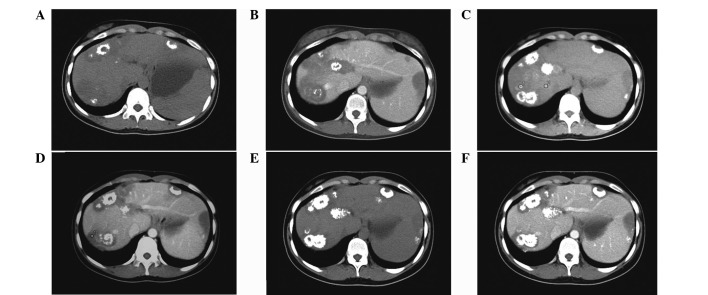
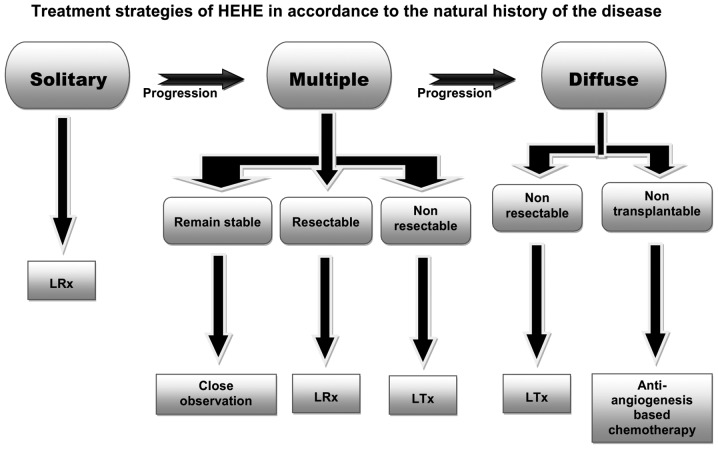
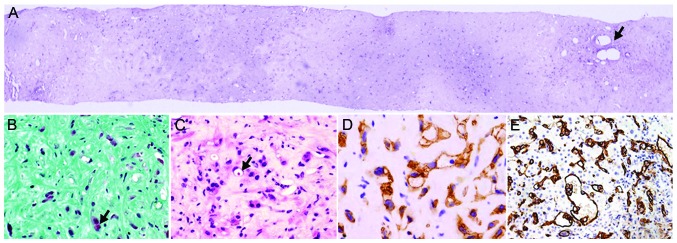
Hepatic epithelioid hemangioendothelioma (HEHE) is a rare tumor of vascular origin. Whether HEHE in Chinese patients exhibits similar characteristics compared with Western patients is not well known. The aim of the present study was to summarize the characteristics of HEHE in Chinese patients and identify its prognostic factors. In total, six patients diagnosed with HEHE at the Beijing Friendship Hospital between 2000 and 2012 were combined with 44 previously reported cases in China, retrieved from the literature between 1989 and mid-2012. These 50 cases from China were compared with 402 patients from Western populations. Prognostic factors were identified by the χ test and Cox regression analysis. The male to female ratio of the Chinese patients was 1:2.1 with the mean age of 44.2 years (range, 22-86 years). The percentage of asymptomatic Chinese patients was significantly higher than in the Western patients (40.0 vs. 24.8%; P=0.026), and that of extrahepatic metastasis (16.0 vs. 36.6%; P=0.005) was significantly lower in Chinese patients. On imaging study, capsular retraction (59.5%) and calcification (26.0%), as well as positivity of CD34 (93.5%) and CD31 (80.6%), were more frequently found in the Chinese patients. Management for the Chinese patients included liver resection (LRx; 45.7%), liver transplantation (LTx; 5.7%), trans-catheter arterial chemoembolization (14.3%) and palliative treatment (34.3%). Chinese patients with larger-sized tumor nodules [relative risk (RR), 1.58; 95% confidence interval (CI), 1.032-2.422; P=0.035) and diffuse type (RR, 12.17; 95% CI, 1.595-92.979; P=0.016) exhibited unfavorable outcomes. In contrast to Western patients with HEHE, a larger number of Chinese patients were asymptomatic with less extrahepatic metastasis. In China, LRx is widely adopted rather than LTx. Chinese patients with large tumor size or diffuse type may encounter a poorer prognosis.
肝上皮样血管内皮瘤(HEHE)是一种罕见的血管源性肿瘤。中国患者的HEHE与西方患者相比是否表现出相似的特征尚不清楚。本研究的目的是总结中国患者HEHE的特征并确定其预后因素。2000年至2012年在北京友谊医院诊断为HEHE的6例患者与1989年至2012年年中从文献中检索到的中国此前报道的44例病例合并。将这50例中国患者与402例西方患者进行比较。通过χ检验和Cox回归分析确定预后因素。中国患者的男女比例为1:2.1,平均年龄为44.2岁(范围22 - 86岁)。无症状中国患者的比例显著高于西方患者(40.0%对24.8%;P = 0.026),且中国患者肝外转移的比例(16.0%对36.6%;P = 0.005)显著更低。在影像学研究中,中国患者更常出现包膜回缩(59.5%)和钙化(26.0%),以及CD34(93.5%)和CD31(80.6%)阳性。中国患者的治疗方式包括肝切除术(LRx;45.7%)、肝移植术(LTx;5.7%)、经导管动脉化疗栓塞术(14.3%)和姑息治疗(34.3%)。肿瘤结节较大的中国患者[相对危险度(RR),1.58;95%置信区间(CI),1.032 - 2.422;P = 0.035]和弥漫型患者(RR,12.17;95% CI,1.595 - 92.979;P = 0.016)预后较差。与西方HEHE患者相比,中国有更多患者无症状且肝外转移较少。在中国,广泛采用的是肝切除术而非肝移植术。肿瘤体积大或为弥漫型的中国患者可能预后较差。