Rajput Rajesh, Rajput Meena, Bairwa Mohan, Singh Jasminder, Saini Ompal, Shankar Vijay
Department of Endocrinology and Medicine Unit VI, Pt. B.D.S. PGIMS, Rohtak, Haryana, India.
Department of Community Medicine, Pt. B.D.S. PGIMS, Rohtak, Haryana, India.
Indian J Endocrinol Metab. 2014 May;18(3):394-9. doi: 10.4103/2230-8210.131201.
To compare waist circumference (WC), body mass index (BMI), waist hip ratio (WHR), and waist-to-height ratio (WHtR) and define an appropriate cut-off, which is most closely predictive of the non-adipose components of the IDF metabolic syndrome (MetS) definition.
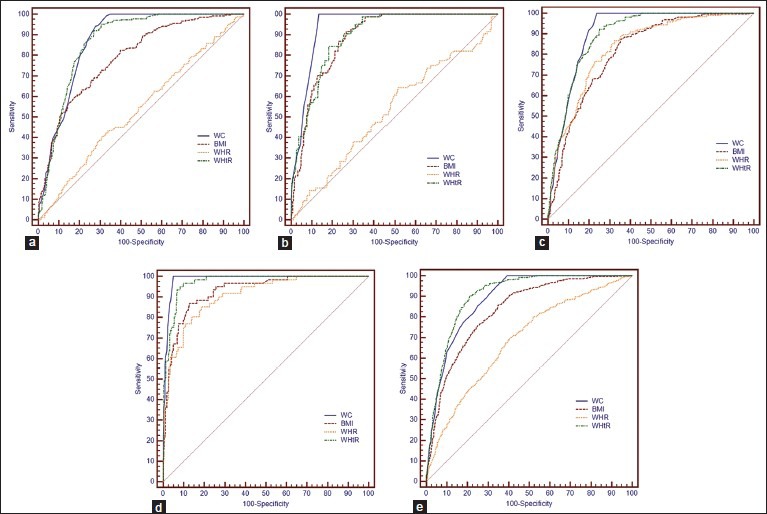
A total of 3,042 adults (1,693 in rural area and 1,349 in urban area) were screened for the presence of MetS according to the IDF definition. Among 3,042 adults selected as subjects, 1,518 were male and 1,524 were female. The receiver operating curve (ROC) analysis was done to determine the optimal cut-off value and the best discriminatory value of each of these anthropometric parameters to predict two or more non-obese components of metabolic syndrome. The area under ROC (AURC) for WC was superior to that for other anthropometric variables. The optimal cut-off value of WC in urban and rural males was >89 cm, which is higher than that in urban and rural females at 83 cm and 79 cm, respectively; the optimal cut-off for WHtR was >0.51 in rural females, 0.52 in rural males, and 0.53 in both urban males and females. Both parameters were found to be better than BMI and WHR. ROC and AURC values for WC were better than those for WHtR in men and women in both urban and rural areas (P = 0.0054); however, when the entire study cohort was analyzed together, irrespective of gender and place of residence, then at a value of 0.52, WHtR scored over WC as a predictor of metabolic syndrome (P = 0.001).
Although the predictive value of different gender-specific WC values is clearly superior to other anthropometric measures for predicting two or more non-adipose components of MetS, a single value of WHtR irrespective of gender and the area of residence can be used as a universal screening tool for the identification of individuals at high risk of development of metabolic complications.
比较腰围(WC)、体重指数(BMI)、腰臀比(WHR)和腰高比(WHtR),并确定一个合适的切点,该切点最能预测国际糖尿病联盟(IDF)代谢综合征(MetS)定义中的非脂肪成分。
根据IDF定义,对总共3042名成年人(农村地区1693名,城市地区1349名)进行了MetS筛查。在选定为研究对象的3042名成年人中,男性1518名,女性1524名。进行了受试者工作特征曲线(ROC)分析,以确定这些人体测量参数中每一个预测代谢综合征两个或更多非肥胖成分的最佳切点值和最佳鉴别值。WC的ROC曲线下面积(AURC)优于其他人体测量变量。城市和农村男性WC的最佳切点值>89cm,分别高于城市和农村女性的83cm和79cm;农村女性WHtR的最佳切点为>0.51,农村男性为0.52,城市男性和女性均为0.53。发现这两个参数均优于BMI和WHR。城市和农村男性及女性中,WC的ROC和AURC值均优于WHtR(P = 0.0054);然而,当对整个研究队列进行综合分析时,无论性别和居住地点如何,当WHtR值为0.52时,其作为代谢综合征预测指标的得分高于WC(P = 0.001)。
虽然不同性别特异性WC值在预测MetS的两个或更多非脂肪成分方面的预测价值明显优于其他人体测量指标,但无论性别和居住地区,单一的WHtR值可作为一种通用的筛查工具,用于识别发生代谢并发症高危个体。