Powney Matthew, Williamson Paula, Kirkham Jamie, Kolamunnage-Dona Ruwanthi
Institute of Translational Medicine, University of Liverpool, Crown Street, L69 3GS Liverpool, UK.
Trials. 2014 Jun 19;15:237. doi: 10.1186/1745-6215-15-237.
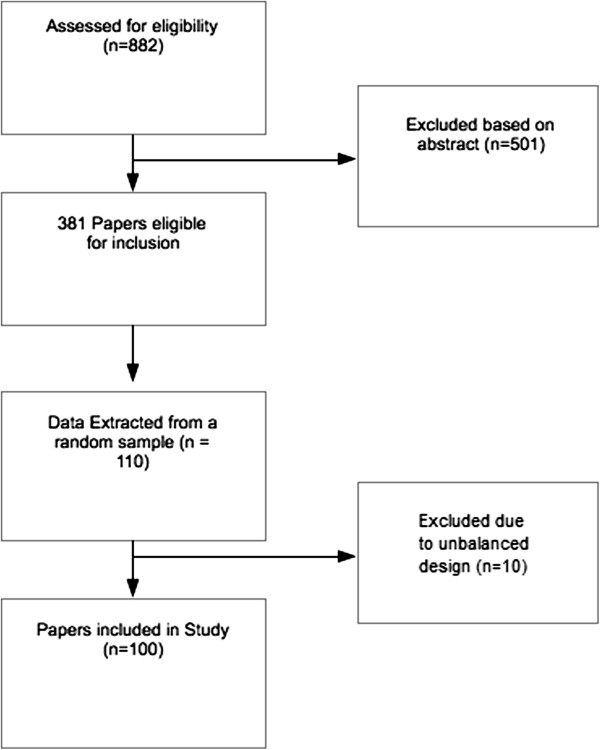
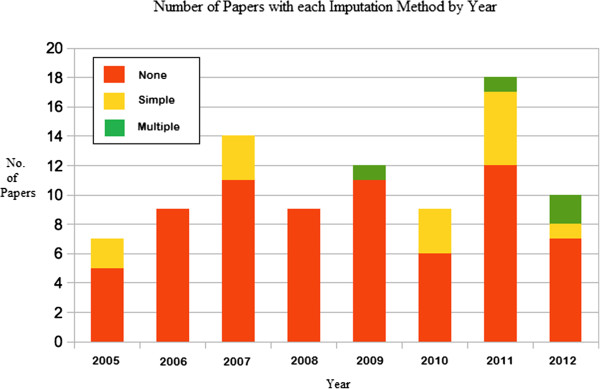
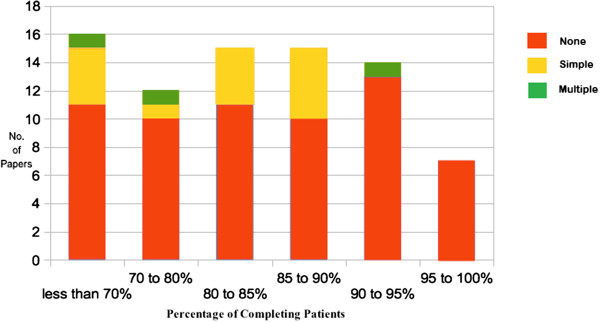
The aim of this review was to establish the frequency with which trials take into account missingness, and to discover what methods trialists use for adjustment in randomised controlled trials with longitudinal measurements. Failing to address the problems that can arise from missing outcome data can result in misleading conclusions. Missing data should be addressed as a means of a sensitivity analysis of the complete case analysis results. One hundred publications of randomised controlled trials with longitudinal measurements were selected randomly from trial publications from the years 2005 to 2012. Information was extracted from these trials, including whether reasons for dropout were reported, what methods were used for handing the missing data, whether there was any explanation of the methods for missing data handling, and whether a statistician was involved in the analysis. The main focus of the review was on missing data post dropout rather than missing interim data. Of all the papers in the study, 9 (9%) had no missing data. More than half of the papers included in the study failed to make any attempt to explain the reasons for their choice of missing data handling method. Of the papers with clear missing data handling methods, 44 papers (50%) used adequate methods of missing data handling, whereas 30 (34%) of the papers used missing data methods which may not have been appropriate. In the remaining 17 papers (19%), it was difficult to assess the validity of the methods used. An imputation method was used in 18 papers (20%). Multiple imputation methods were introduced in 1987 and are an efficient way of accounting for missing data in general, and yet only 4 papers used these methods. Out of the 18 papers which used imputation, only 7 displayed the results as a sensitivity analysis of the complete case analysis results. 61% of the papers that used an imputation explained the reasons for their chosen method. Just under a third of the papers made no reference to reasons for missing outcome data. There was little consistency in reporting of missing data within longitudinal trials.
本综述的目的是确定试验考虑缺失情况的频率,并了解试验者在具有纵向测量的随机对照试验中使用何种方法进行调整。未能解决因结局数据缺失而可能出现的问题可能会导致误导性结论。应将缺失数据作为对完全病例分析结果进行敏感性分析的一种手段来处理。从2005年至2012年的试验出版物中随机选取了100篇具有纵向测量的随机对照试验。从这些试验中提取信息,包括是否报告了退出试验的原因、使用了何种方法处理缺失数据、是否对缺失数据处理方法进行了解释,以及是否有统计学家参与分析。综述的主要重点是退出试验后的缺失数据,而非中期缺失数据。在该研究的所有论文中,9篇(9%)没有缺失数据。超过一半纳入研究的论文未对其选择缺失数据处理方法的原因做出任何解释。在具有明确缺失数据处理方法的论文中,44篇(50%)使用了适当的缺失数据处理方法,而30篇(34%)论文使用的缺失数据方法可能并不合适。在其余17篇论文(19%)中,难以评估所使用方法的有效性。18篇论文(20%)使用了插补法。多重插补法于1987年引入,总体而言是处理缺失数据的有效方法,但只有4篇论文使用了这些方法。在使用插补法的18篇论文中,只有7篇将结果作为对完全病例分析结果的敏感性分析呈现。61%使用插补法的论文解释了其选择该方法的原因。略少于三分之一的论文未提及结局数据缺失的原因。纵向试验中关于缺失数据的报告几乎没有一致性。