Brandt Diane E, Ho Pei-Shu, Chan Leighton, Rasch Elizabeth K
Rehabilitation Medicine Department, Clinical Center, National Institutes of Health, 6100 Executive Blvd. Rm. 3C01 MSC 7515, Bethesda, MD, 20892-7515, USA,
Qual Life Res. 2014 Dec;23(10):2663-71. doi: 10.1007/s11136-014-0740-6. Epub 2014 Jun 20.
Disability data inform resource allocation and utilization, characterize functioning and changes over time, and provide a mechanism to monitor progress toward promoting and protecting the rights of individuals with disability. Data collection efforts, however, define and measure disability in varied ways. Our objective was to see how the content of disability measures differed in five US national surveys and over time.
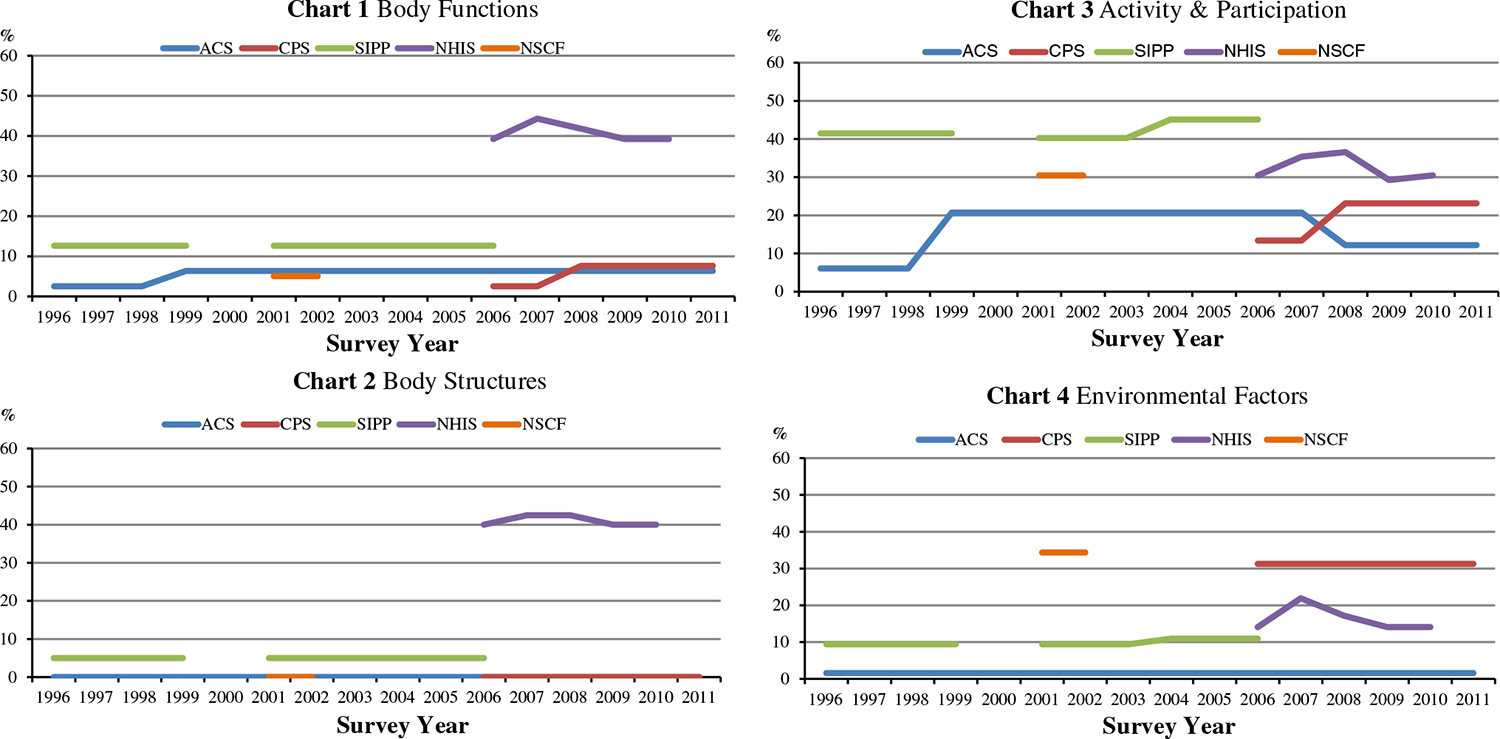
Using the WHO ICF as a conceptual framework for measuring disability, we assessed the National Health Interview Survey (NHIS), Current Population Survey (CPS), Survey of Income and Program Participation (SIPP), National Survey of SSI Children and Families (NSCF), and American Community Survey (ACS) for their content coverage of disability relative to each of the four ICF components (i.e., body functions, body structures, activities and participation, and environment). We used second-level ICF three-digit codes to classify question content into categories within each ICF component and computed the proportion of categories within each ICF component that was represented in the questions selected from these five surveys.
The disability measures varied across surveys and years. The NHIS captured a greater proportion of the ICF body functions and body structures components than did other surveys. The SIPP captured the most content of the ICF activities and participation component, and the NSCF contained the most content of the ICF environmental factors component.
This research successfully illustrated demonstrated the utility of the ICF in examining the content of disability measures in five national surveys and over time.
残疾数据为资源分配和利用提供信息,描述功能及随时间的变化情况,并提供一种机制来监测在促进和保护残疾人权利方面的进展。然而,数据收集工作对残疾的定义和衡量方式各不相同。我们的目标是了解美国五项全国性调查中残疾衡量指标的内容差异以及随时间的变化情况。
以世界卫生组织《国际功能、残疾和健康分类》(ICF)作为衡量残疾的概念框架,我们评估了国家健康访谈调查(NHIS)、当前人口调查(CPS)、收入与项目参与调查(SIPP)、补充保障收入儿童与家庭全国调查(NSCF)以及美国社区调查(ACS)在残疾内容覆盖方面相对于ICF的四个组成部分(即身体功能、身体结构、活动与参与以及环境)的情况。我们使用ICF二级三位数编码将问题内容分类到每个ICF组成部分的类别中,并计算从这五项调查中选取的问题所代表的每个ICF组成部分内类别的比例。
残疾衡量指标在不同调查和年份中存在差异。NHIS涵盖的ICF身体功能和身体结构组成部分的比例高于其他调查。SIPP涵盖的ICF活动与参与组成部分的内容最多,而NSCF包含的ICF环境因素组成部分的内容最多。
本研究成功说明了ICF在审视五项全国性调查中残疾衡量指标的内容以及随时间变化情况方面的效用。