Department of Otolaryngology, Medical University of Silesia, Zabrze, Poland.
Clin Interv Aging. 2014 Jun 10;9:901-14. doi: 10.2147/CIA.S61934. eCollection 2014.
There is still controversy regarding the influence of aging on medial olivocochlear (MOC) system function. The main objective of this study is to measure age-related changes of MOC system function in people with normal hearing thresholds.
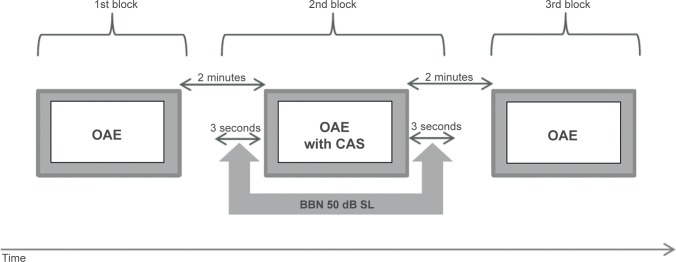
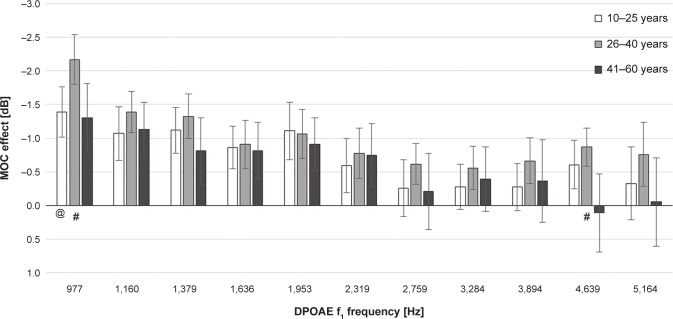
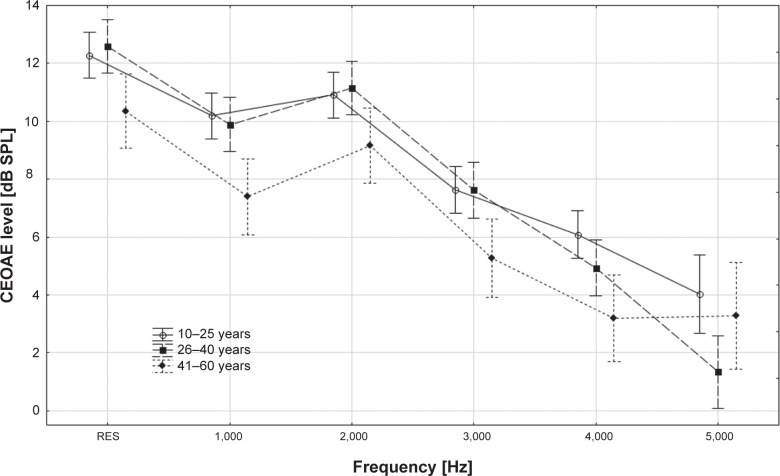
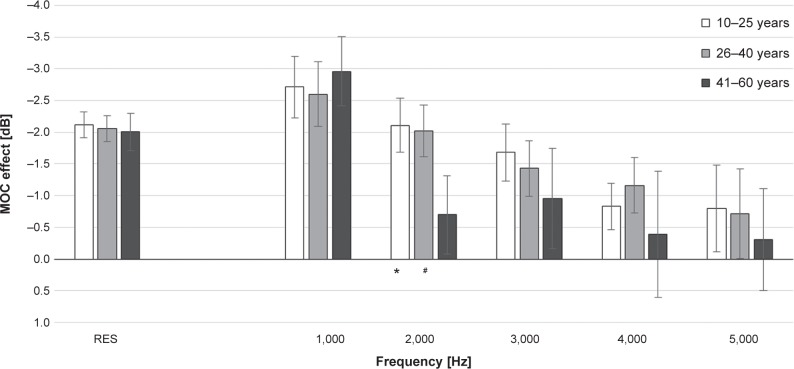
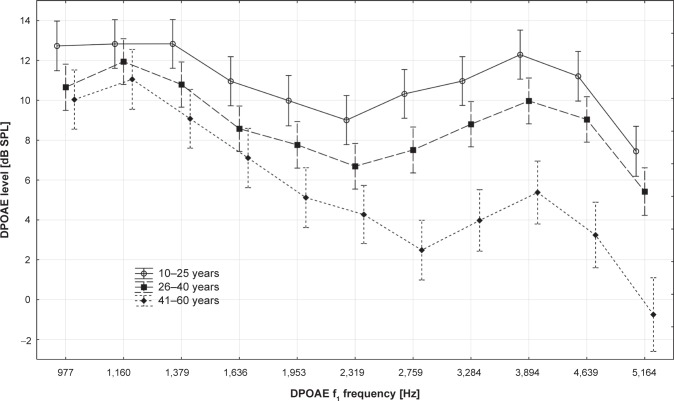
Bilateral assessment of the MOC effect for click-evoked otoacoustic emissions (CEOAEs; at 70±3 dB peak sound pressure level [pSPL], click at 50/second, 260 repeats, 2.5-20 millisecond window) and for distortion product otoacoustic emissions (DPOAEs; with [frequencies] f2/f1=1.22, [levels of primary tones] L1=65 dB SPL and L2=55 dB SPL; DP-grams for 2f1-f2 were collected for the f1 frequencies varying from 977 Hz to 5,164 kHz, with the resolution of four points per octave) was performed in a group of 146 (n=292 ears) healthy, right-handed subjects aged from 10-60 years with a bilateral hearing threshold from 0.25-4.0 kHz, not exceeding 20 dB hearing level; normal tympanograms; and a threshold of the contralateral stapedial reflex for broadband noise (BBN) of 75 dB SPL or higher. The MOC inhibition was assessed on the basis of changes in OAE level during BBN contralateral stimulation at 50 dB sensation level (mean, 65±3 dB SPL).
Comparative analysis of the MOC effect for CEOAE and DPOAE showed the weakest effect in the oldest age group (41-60 years) at almost all tested frequencies. Moreover, a weak, albeit significant, positive correlation between the level of OAE and the size of the MOC effect was documented.
On the basis of our study, we have found a decrease in the strength of the MOC system with increasing age in normally hearing subjects, as reflected by a decrease of the OAE suppression effects in older individuals and an increase of the number of CEOAE and DPOAE enhancements during contralateral acoustic stimulation in the elderly, especially in the high-frequency range.
衰老对内侧橄榄耳蜗(MOC)系统功能的影响仍存在争议。本研究的主要目的是测量正常听力阈值人群中与年龄相关的 MOC 系统功能变化。
对双侧 click-evoked otoacoustic emissions(CEOAEs;在 70±3 dB 峰值声压级[pSPL]、50/秒、260 次重复、2.5-20 毫秒窗口的 click 刺激下)和 distortion product otoacoustic emissions(DPOAEs;在 [频率] f2/f1=1.22、[初级音幅值] L1=65 dB SPL 和 L2=55 dB SPL;在 2f1-f2 的 DP-grams 中,f1 频率从 977 Hz 到 5,164 kHz 变化,每八度分辨率为四点)进行双侧评估,共有 146 名(n=292 耳)健康、右利手的受试者,年龄在 10-60 岁之间,双耳听力阈值在 0.25-4.0 kHz 之间,不超过 20 dB 听力级;正常鼓室图;以及宽带噪声(BBN)对侧镫骨肌反射的阈值为 75 dB SPL 或更高。MOC 抑制是基于 BBN 对侧刺激 50 dB 感觉级时 OAE 水平的变化来评估的(平均值,65±3 dB SPL)。
对 CEOAE 和 DPOAE 的 MOC 效应进行比较分析,结果表明在年龄最大的一组(41-60 岁)中,几乎在所有测试频率下,MOC 效应都最弱。此外,还记录到 OAE 水平与 MOC 效应大小之间存在微弱但显著的正相关。
基于我们的研究,我们发现正常听力受试者的 MOC 系统强度随着年龄的增长而降低,表现为在老年个体中 OAE 抑制效应降低,以及在老年人群中对侧声刺激时 CEOAE 和 DPOAE 增强的数量增加,尤其是在高频范围内。