Inoue Shigeaki, Suzuki Kodai, Komori Yukako, Morishita Yukiko, Suzuki-Utsunomiya Kyoko, Hozumi Katsuto, Inokuchi Sadaki, Sato Takehito
Crit Care. 2014 Jun 24;18(3):R130. doi: 10.1186/cc13941.
Sepsis is known as a complex immunological response with hyperinflammation in the acute phase followed by immunosuppression. Although aging is crucial in sepsis, the impact of aging on inflammation and immunosuppression is still unclear. The purpose of this study was to investigate the relationship between inflammation and immunosuppression in aged patients and mice after sepsis.
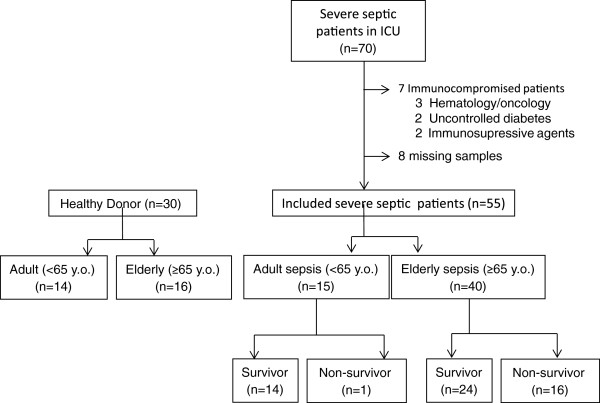
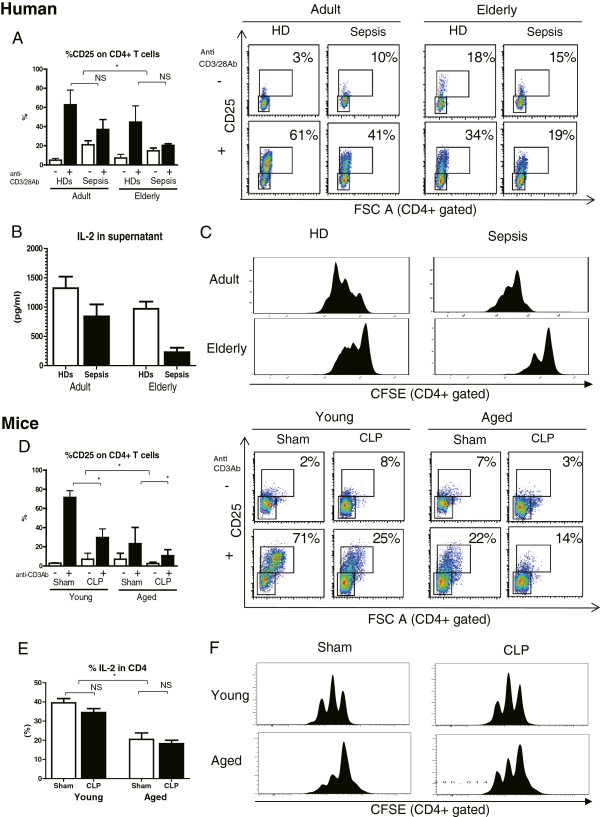
Fifty-five patients with severe sepsis and 30 healthy donors were prospectively enrolled, and 90-day survival was compared between elderly (≥ 65 years) and adult (18-64 years) septic patients with serial measurement of serum interleukin (IL)-6. Within 24 h after diagnosis of severe sepsis, peripheral blood mononuclear cells were stimulated ex vivo to measure expression of the activation maker CD25 in T cells, IL-2 levels in the supernatant, and proliferation. In the mouse study, young (6-8 weeks) and aged (20-22 months) C57/B6 mice were subjected to cecal ligation and puncture (CLP), and survival was compared after 7 days with serial measurement of serum IL-6. Expression of the negative co-stimulatory molecules, CD25, and IL-2 in CD4+ T cells was measured.
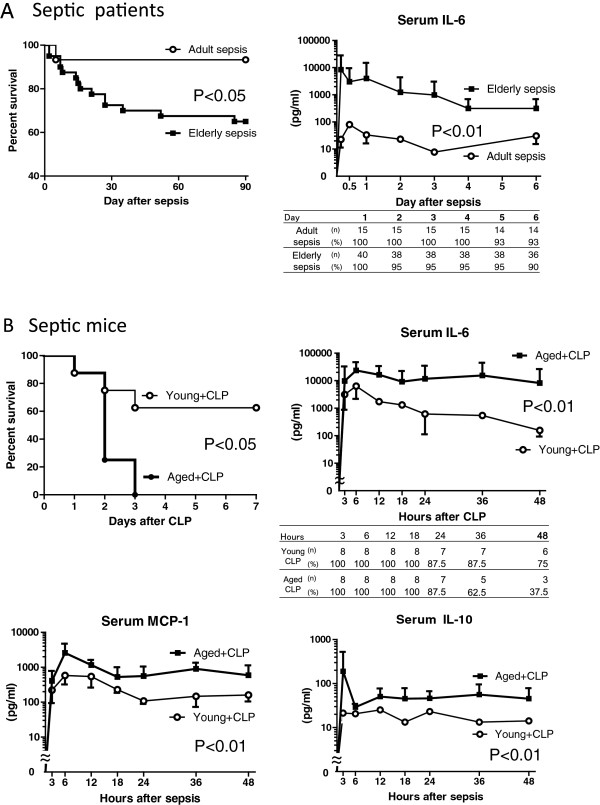
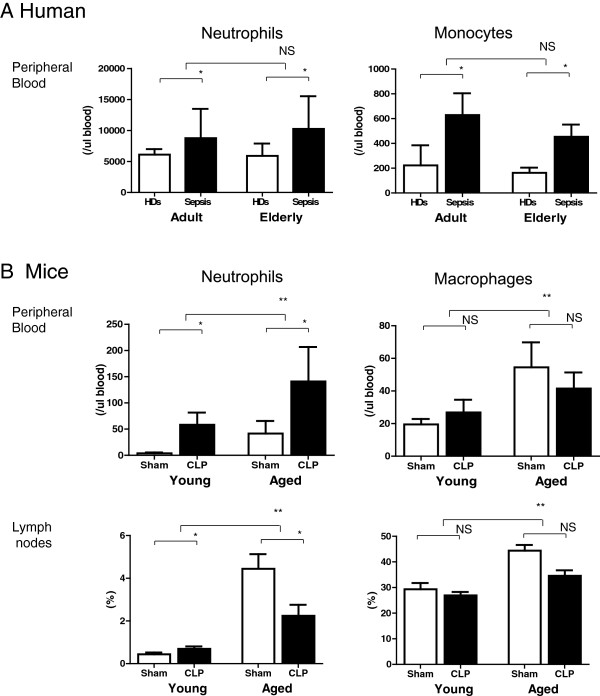
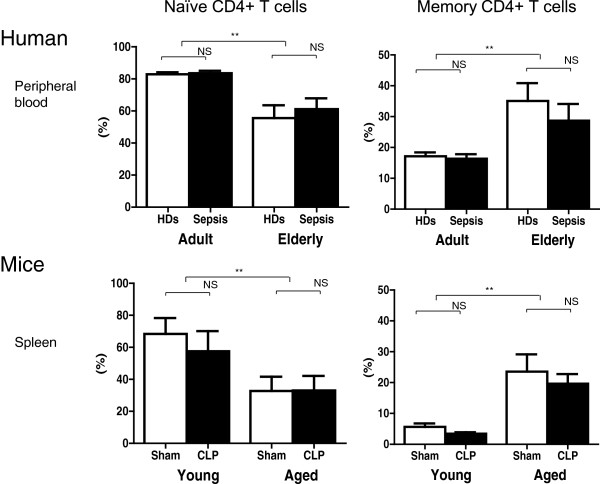
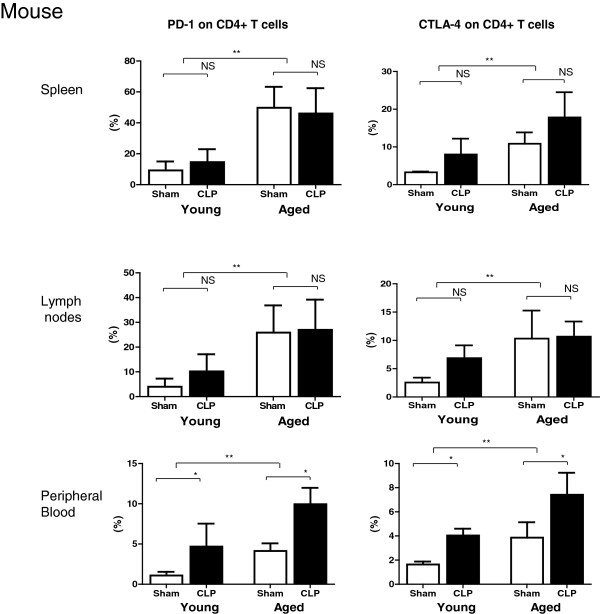
The survival rate in elderly sepsis patients and aged septic mice was significantly lower than that in adult patients and young septic mice (60% vs. 93% in septic patients, 0% vs. 63% in septic mice, P < 0.05). Serum IL-6 levels in elderly sepsis patients and aged septic mice were persistently higher than those in adult patients and young septic mice. Expression of negative co-stimulatory molecules in CD4+ T cells in the spleen, lymph nodes, and peripheral blood was significantly higher in aged mice than in young mice (P < 0.01). Ex vivo stimulation decreased CD25 expression, IL-2 production, and proliferation to a greater extent in CD4+ T cells from elderly patients and aged septic mice than in those from adult patients and young septic mice. Elderly patients demonstrated increased detection of gram-negative bacteria at days 14-16 and 28-32 after sepsis (P < 0.05).
Persistent inflammation and T cell exhaustion may be associated with decreased survival in elderly patients and mice after sepsis.
脓毒症是一种复杂的免疫反应,急性期表现为过度炎症反应,随后出现免疫抑制。尽管衰老在脓毒症中起着关键作用,但衰老对炎症和免疫抑制的影响仍不清楚。本研究的目的是探讨脓毒症后老年患者和小鼠炎症与免疫抑制之间的关系。
前瞻性纳入55例严重脓毒症患者和30例健康供体,比较老年(≥65岁)和成年(18 - 64岁)脓毒症患者的90天生存率,并连续测量血清白细胞介素(IL)-6。在诊断严重脓毒症后24小时内,体外刺激外周血单个核细胞,以测量T细胞中活化标志物CD25的表达、上清液中IL-2水平以及增殖情况。在小鼠研究中,对年轻(6 - 8周)和老年(20 - 22个月)的C57/B6小鼠进行盲肠结扎和穿刺(CLP),7天后比较生存率,并连续测量血清IL-6。检测CD4+T细胞中负性共刺激分子、CD25和IL-2的表达。
老年脓毒症患者和老年脓毒症小鼠的生存率显著低于成年患者和年轻脓毒症小鼠(脓毒症患者中分别为60%对93%,脓毒症小鼠中分别为0%对63%,P<0.05)。老年脓毒症患者和老年脓毒症小鼠的血清IL-6水平持续高于成年患者和年轻脓毒症小鼠。老年小鼠脾脏、淋巴结和外周血中CD4+T细胞的负性共刺激分子表达显著高于年轻小鼠(P<0.01)。与成年患者和年轻脓毒症小鼠的CD4+T细胞相比,体外刺激使老年患者和老年脓毒症小鼠的CD4+T细胞中CD25表达、IL-2产生和增殖的降低程度更大。老年患者在脓毒症后第14 - 16天和28 - 32天革兰氏阴性菌检测增加(P<0.05)。
持续炎症和T细胞耗竭可能与脓毒症后老年患者和小鼠生存率降低有关。