Johnson Joy, Sharman Zena, Vissandjée Bilkis, Stewart Donna E
CIHR Institute of Gender and Health, University of British Columbia, Vancouver, British Columbia, Canada.
Faculty of Nursing, Université de Montréal, Montreal, Quebec, Canada.
PLoS One. 2014 Jun 25;9(6):e99900. doi: 10.1371/journal.pone.0099900. eCollection 2014.
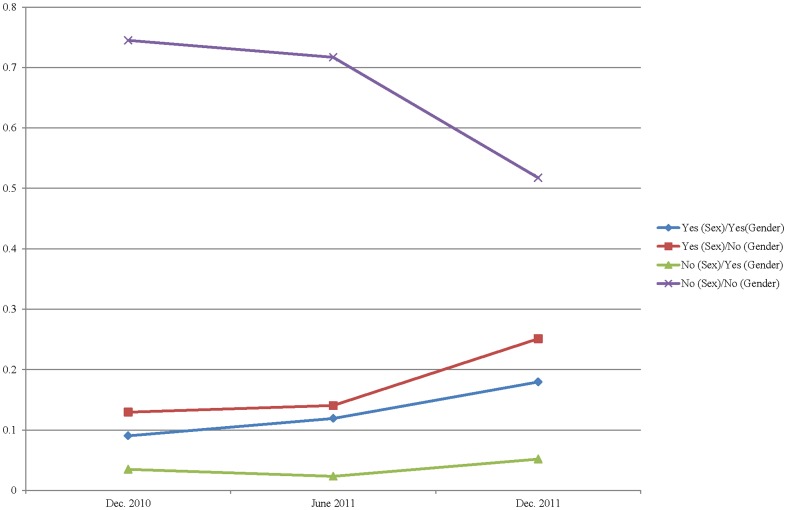
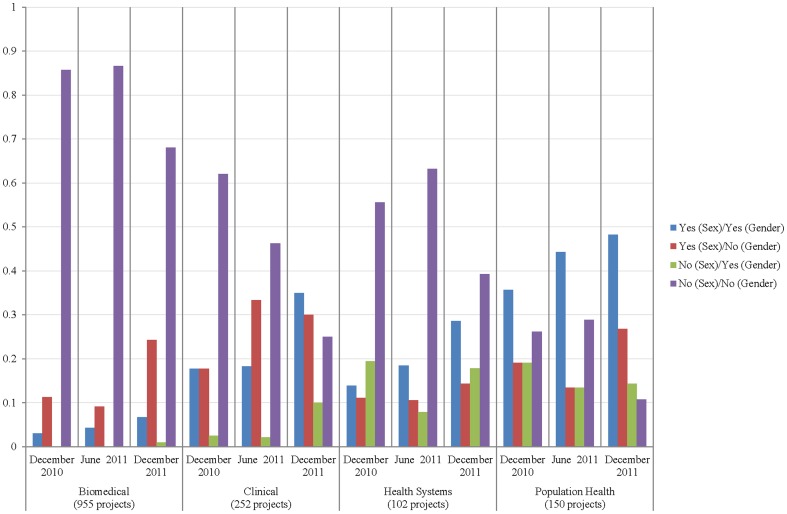
We analyzed the impact of a requirement introduced in December 2010 that all applicants to the Canadian Institutes of Health Research indicate whether their research designs accounted for sex or gender. We aimed to inform research policy by understanding the extent to which applicants across health research disciplines accounted for sex and gender. We conducted a descriptive statistical analysis to identify trends in application data from three research funding competitions (December 2010, June 2011, and December 2011) (N = 1459). We also conducted a qualitative thematic analysis of applicants' responses. Here we show that the proportion of applicants responding affirmatively to the questions on sex and gender increased over time (48% in December 2011, compared to 26% in December 2010). Biomedical researchers were least likely to report accounting for sex and gender. Analysis by discipline-specific peer review panel showed variation in the likelihood that a given panel will fund grants with a stated focus on sex or gender. These findings suggest that mandatory questions are one way of encouraging the uptake of sex and gender in health research, yet there remain persistent disparities across disciplines. These disparities represent opportunities for policy intervention by health research funders.
我们分析了2010年12月出台的一项要求的影响,该要求规定加拿大卫生研究院的所有申请者都要表明其研究设计是否考虑了性别因素。我们旨在通过了解健康研究各学科的申请者在多大程度上考虑了性别因素来为研究政策提供信息。我们进行了描述性统计分析,以确定来自三项研究资金竞争(2010年12月、2011年6月和2011年12月)(N = 1459)的申请数据中的趋势。我们还对申请者的回复进行了定性主题分析。我们在此表明,对关于性别问题给予肯定答复的申请者比例随时间增加(2011年12月为48%,而2010年12月为26%)。生物医学研究人员报告考虑性别因素的可能性最小。按特定学科同行评审小组进行的分析表明,给定小组资助明确关注性别问题的拨款的可能性存在差异。这些发现表明,强制性问题是鼓励在健康研究中考虑性别因素的一种方式,但各学科之间仍然存在持续的差异。这些差异为健康研究资助者进行政策干预提供了机会。