Institute of Neurology and Fondazione Alberto Sordi - Research Institute for Ageing, Campus Bio Medico University of Rome Rome, Italy ; Laboratory of Biomedical Robotics and Biomicrosystems CIR - Centre for Integrated Research, Campus Bio Medico University of Rome Rome, Italy.
Department of Psycology, Università di Milano-Bicocca Milano, Italy.
Front Syst Neurosci. 2014 Jun 11;8:109. doi: 10.3389/fnsys.2014.00109. eCollection 2014.
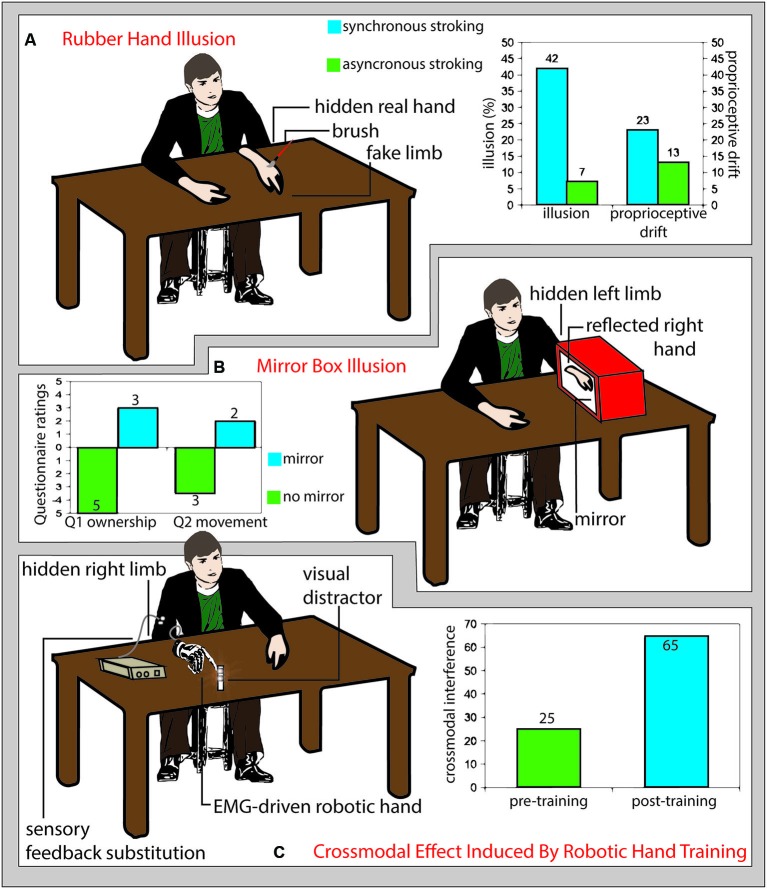
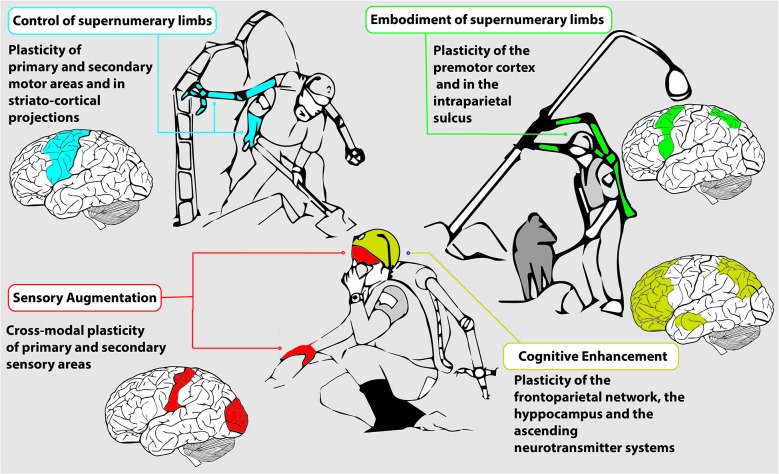
Today, the anthropomorphism of the tools and the development of neural interfaces require reconsidering the concept of human-tools interaction in the framework of human augmentation. This review analyses the plastic process that the brain undergoes when it comes into contact with augmenting artificial sensors and effectors and, on the other hand, the changes that the use of external augmenting devices produces in the brain. Hitherto, few studies investigated the neural correlates of augmentation, but clues on it can be borrowed from logically-related paradigms: sensorimotor training, cognitive enhancement, cross-modal plasticity, sensorimotor functional substitution, use and embodiment of tools. Augmentation modifies function and structure of a number of areas, i.e., primary sensory cortices shape their receptive fields to become sensitive to novel inputs. Motor areas adapt the neuroprosthesis representation firing-rate to refine kinematics. As for normal motor outputs, the learning process recruits motor and premotor cortices and the acquisition of proficiency decreases attentional recruitment, focuses the activity on sensorimotor areas and increases the basal ganglia drive on the cortex. Augmentation deeply relies on the frontoparietal network. In particular, premotor cortex is involved in learning the control of an external effector and owns the tool motor representation, while the intraparietal sulcus extracts its visual features. In these areas, multisensory integration neurons enlarge their receptive fields to embody supernumerary limbs. For operating an anthropomorphic neuroprosthesis, the mirror system is required to understand the meaning of the action, the cerebellum for the formation of its internal model and the insula for its interoception. In conclusion, anthropomorphic sensorized devices can provide the critical sensory afferences to evolve the exploitation of tools through their embodiment, reshaping the body representation and the sense of the self.
如今,工具的拟人化和神经接口的发展要求我们在人类增强的框架内重新考虑人机交互的概念。这篇综述分析了大脑在接触增强型人工传感器和效应器时所经历的可塑性过程,以及使用外部增强设备对大脑产生的变化。迄今为止,很少有研究调查增强的神经相关性,但可以从逻辑相关的范式中借鉴有关它的线索:感觉运动训练、认知增强、跨模态可塑性、感觉运动功能替代、工具的使用和体现。增强会改变许多区域的功能和结构,即初级感觉皮层塑造其感受野,使其对新的输入敏感。运动区域使神经假体的代表放电率适应以完善运动学。对于正常的运动输出,学习过程会募集运动和运动前皮层,并且熟练程度的提高会减少注意力的募集,将活动集中在感觉运动区域,并增加基底神经节对皮层的驱动。增强严重依赖于额顶网络。特别是,运动前皮层参与学习对外源性效应器的控制,并拥有工具运动代表,而内顶叶皮层提取其视觉特征。在这些区域中,多感觉整合神经元扩大其感受野,以体现多余的肢体。为了操作拟人化的神经假体,需要镜像系统来理解动作的意义,小脑来形成其内部模型,而脑岛来进行内部感知。总之,拟人化的传感器设备可以通过体现来提供关键的感觉输入,从而进化工具的利用,重塑身体的表现和自我意识。