Giustiniano Enrico, Meco Massimo, Morenghi Emanuela, Ruggieri Nadia, Cosseta Daniele, Cirri Silvia, Difrancesco Orazio, Zito Paola Cosma, Gollo Yari, Raimondi Ferdinando
Department of Anesthesia and Intensive Care Unit, Humanitas Research Hospital, Via Manzoni 56, 20089 Rozzano (Milano), Italy.
Cardiac Surgery Anesthesia Unit, Sant'Ambrogio Clinical Institute, Milano, Italy.
Biomed Res Int. 2014;2014:917985. doi: 10.1155/2014/917985. Epub 2014 May 20.
Patients who undergo high-risk surgery represent a large amount of post-operative ICU-admissions. These patients are at high risk of experiencing postoperative complications. Renal Resistive Index was found to be related with renal dysfunction, hypertension, and posttraumatic hemorrhagic shock, probably due to vasoconstriction. We explored whether Renal Resistive Index (RRI), measured after awakening from general anesthesia, could have any relationship with postoperative complications.
In our observational, stratified dual-center trial, we enrolled patients who underwent general anesthesia for high-risk major surgery. After awakening in recovery room (or during awakening period in subjects submitted to cardiac surgery) we measured RRI by echo-color-Doppler method. Primary endpoint was the association of altered RRI (>0.70) and outcome during the first postoperative week.
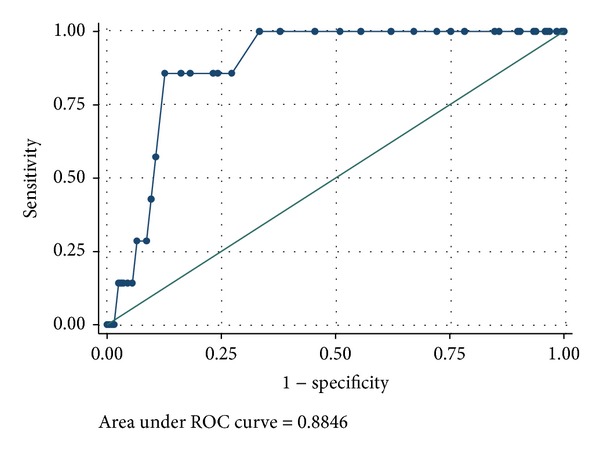
205 patients were enrolled: 60 (29.3%) showed RRI > 0.70. The total rate of adverse event was 27 (18.6%) in RRI ≤ 0.7 group and 19 (31.7%) in RRI > 0.7 group (P = 0.042). Significant correlation between RRI > 0.70 and complications resulted in pneumonia (P = 0.016), septic shock (P = 0.003), and acute renal failure (P = 0.001) subgroups. Patients with RRI > 0.7 showed longer ICU stay (P = 0.001) and lasting of mechanical ventilation (P = 0.004). These results were confirmed in cardiothoracic surgery subgroup. RRI > 0.7 duplicates triplicates the risk of complications, both in general (OR 2.03 93 95% CI 1.02-4.02, P = 0.044) and in cardiothoracic (OR 2.62 95% CI 1.11-6.16, P = 0.027) population. Furthermore, we found RRI > 0.70 was associated with a triplicate risk of postoperative septic shock (OR 3.04, CI 95% 1.5-7.01; P = 0.002).
接受高风险手术的患者占术后入住重症监护病房患者的很大一部分。这些患者术后发生并发症的风险很高。肾阻力指数被发现与肾功能不全、高血压和创伤后失血性休克有关,可能是由于血管收缩。我们探讨了全身麻醉苏醒后测量的肾阻力指数(RRI)是否与术后并发症存在任何关联。
在我们的观察性、分层双中心试验中,我们纳入了接受全身麻醉进行高风险大手术的患者。在恢复室苏醒后(或在接受心脏手术的患者的苏醒期间),我们通过超声彩色多普勒方法测量RRI。主要终点是术后第一周内RRI改变(>0.70)与结局的关联。
共纳入205例患者:60例(29.3%)的RRI>0.70。RRI≤0.7组的不良事件总发生率为27例(18.6%),RRI>0.7组为19例(31.7%)(P = 0.042)。RRI>0.70与并发症之间的显著相关性在肺炎(P = 0.016)、感染性休克(P = 0.003)和急性肾衰竭(P = 0.001)亚组中得到体现。RRI>0.7的患者在重症监护病房的住院时间更长(P = 0.001),机械通气持续时间更长(P = 0.004)。这些结果在心胸外科亚组中得到了证实。RRI>0.7使并发症风险增加两倍,在总体人群中(OR 2.03 93 95%CI 1.02 - 4.02,P = 0.044)以及心胸外科人群中(OR 2.62 95%CI 1.11 - 6.16,P = 0.027)均如此。此外,我们发现RRI>0.70与术后感染性休克风险增加两倍相关(OR 3.04,CI 95% 1.5 - 7.01;P = 0.002)。