Moore Hannah C, Jacoby Peter, Hogan Alexandra B, Blyth Christopher C, Mercer Geoffry N
Telethon Kids Institute, University of Western Australia, Perth, Australia.
National Centre for Epidemiology and Population Health, Australian National University, Canberra, Australia.
PLoS One. 2014 Jun 26;9(6):e100422. doi: 10.1371/journal.pone.0100422. eCollection 2014.
Respiratory syncytial virus (RSV) is a major cause of paediatric morbidity. Mathematical models can be used to characterise annual RSV seasonal epidemics and are a valuable tool to assess the impact of future vaccines.
Construct a mathematical model of seasonal epidemics of RSV and by fitting to a population-level RSV dataset, obtain a better understanding of RSV transmission dynamics.
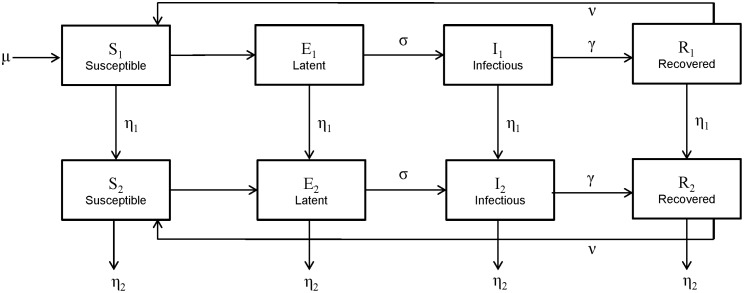
We obtained an extensive dataset of weekly RSV testing data in children aged less than 2 years, 2000-2005, for a birth cohort of 245,249 children through linkage of laboratory and birth record datasets. We constructed a seasonally forced compartmental age-structured Susceptible-Exposed-Infectious-Recovered-Susceptible (SEIRS) mathematical model to fit to the seasonal curves of positive RSV detections using the Nelder-Mead method.
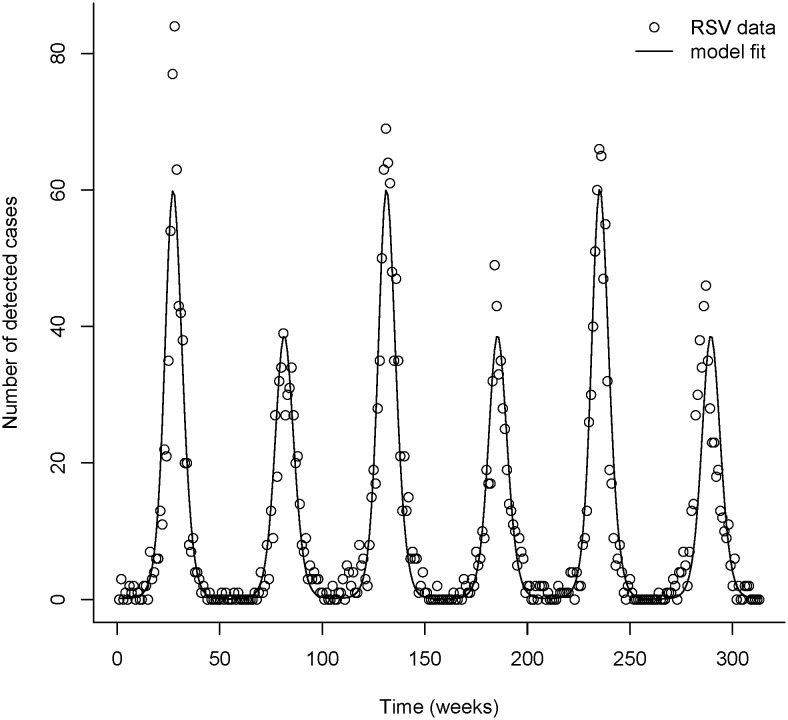
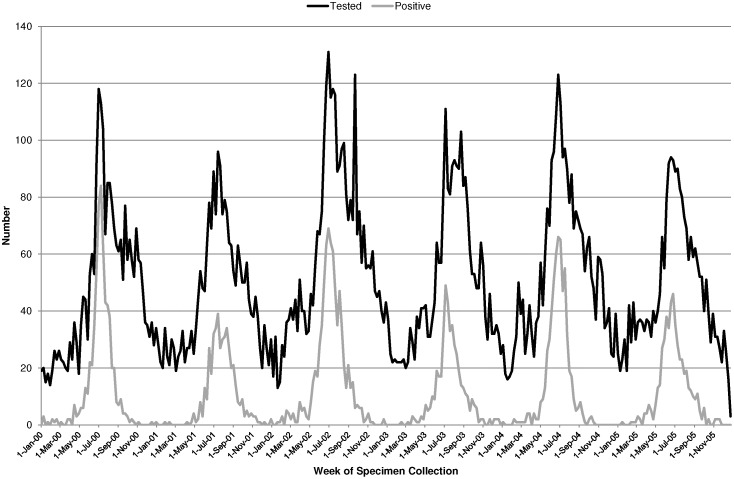
From 15,830 specimens, 3,394 were positive for RSV. RSV detections exhibited a distinct biennial seasonal pattern with alternating sized peaks in winter months. Our SEIRS model accurately mimicked the observed data with alternating sized peaks using disease parameter values that remained constant across the 6 years of data. Variations in the duration of immunity and recovery periods were explored. The best fit to the data minimising the residual sum of errors was a model using estimates based on previous models in the literature for the infectious period and a slightly lower estimate for the immunity period.
Our age-structured model based on routinely collected population laboratory data accurately captures the observed seasonal epidemic curves. The compartmental SEIRS model, based on several assumptions, now provides a validated base model. Ranges for the disease parameters in the model that could replicate the patterns in the data were identified. Areas for future model developments include fitting climatic variables to the seasonal parameter, allowing parameters to vary according to age and implementing a newborn vaccination program to predict the effect on RSV incidence.
呼吸道合胞病毒(RSV)是儿童发病的主要原因。数学模型可用于描述RSV的年度季节性流行特征,是评估未来疫苗影响的宝贵工具。
构建RSV季节性流行的数学模型,并通过拟合人群水平的RSV数据集,更好地理解RSV传播动态。
我们通过实验室和出生记录数据集的关联,获得了2000 - 2005年245,249名儿童出生队列中2岁以下儿童每周RSV检测数据的广泛数据集。我们构建了一个季节性强制的、按年龄分层的易感-暴露-感染-康复-易感(SEIRS)数学模型,使用Nelder-Mead方法拟合RSV阳性检测的季节性曲线。
从15,830份标本中,3394份RSV呈阳性。RSV检测呈现出明显的两年一次的季节性模式,冬季月份的峰值大小交替出现。我们的SEIRS模型使用在6年数据中保持恒定的疾病参数值,准确地模拟了观察到的大小交替的峰值数据。探讨了免疫期和恢复期的变化。使误差残差总和最小的数据最佳拟合模型是一个使用基于文献中先前模型对传染期的估计以及对免疫期略低估计的模型。
我们基于常规收集的人群实验室数据的年龄分层模型准确地捕捉到了观察到的季节性流行曲线。基于若干假设的SEIRS模型现在提供了一个经过验证的基础模型。确定了模型中能够复制数据模式的疾病参数范围。未来模型发展的领域包括将气候变量拟合到季节性参数、允许参数随年龄变化以及实施新生儿疫苗接种计划以预测对RSV发病率的影响。