HIV Drug Resistance Program, National Cancer Institute, Frederick, MD 21702, USA.
Leidos Biomedical Research, Frederick, MD 21702, USA.
Science. 2014 Jul 11;345(6193):179-83. doi: 10.1126/science.1254194. Epub 2014 Jun 26.
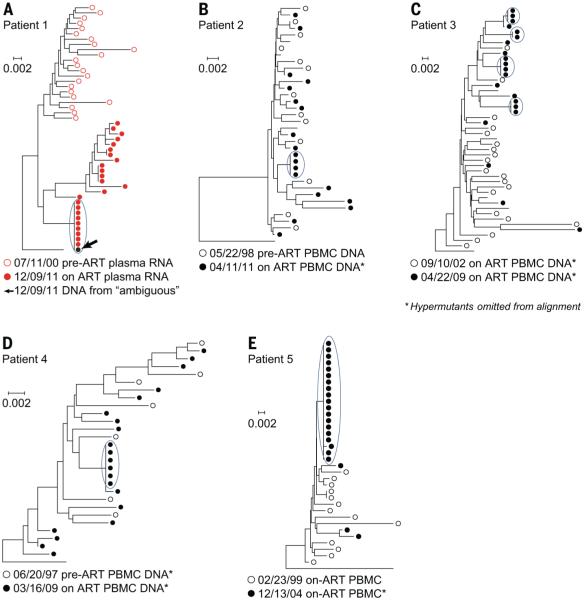
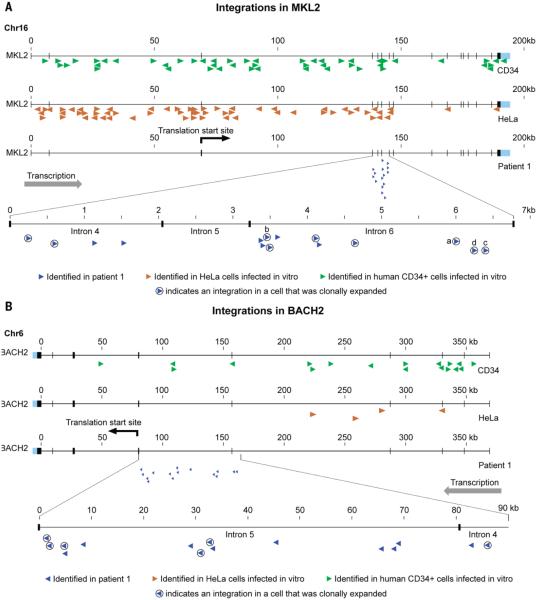
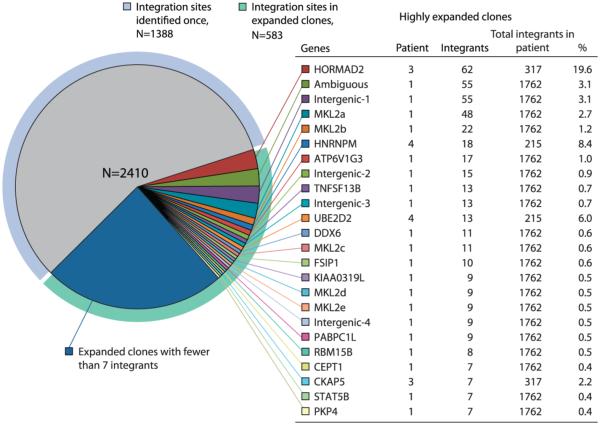
The persistence of HIV-infected cells in individuals on suppressive combination antiretroviral therapy (cART) presents a major barrier for curing HIV infections. HIV integrates its DNA into many sites in the host genome; we identified 2410 integration sites in peripheral blood lymphocytes of five infected individuals on cART. About 40% of the integrations were in clonally expanded cells. Approximately 50% of the infected cells in one patient were from a single clone, and some clones persisted for many years. There were multiple independent integrations in several genes, including MKL2 and BACH2; many of these integrations were in clonally expanded cells. Our findings show that HIV integration sites can play a critical role in expansion and persistence of HIV-infected cells.
在接受抑制性联合抗逆转录病毒疗法 (cART) 的个体中,HIV 感染细胞的持续存在是治愈 HIV 感染的主要障碍。HIV 将其 DNA 整合到宿主基因组的许多位点中;我们在五名接受 cART 的感染个体的外周血淋巴细胞中鉴定出 2410 个整合位点。大约 40%的整合发生在克隆扩增的细胞中。大约 50%的一个患者的感染细胞来自一个单一的克隆,一些克隆持续了很多年。在包括 MKL2 和 BACH2 在内的几个基因中存在多个独立的整合,其中许多整合发生在克隆扩增的细胞中。我们的研究结果表明,HIV 整合位点可能在 HIV 感染细胞的扩增和持续存在中发挥关键作用。