Barker Amy R, Renzaglia Karen S, Fry Kimberley, Dawe Helen R
Biosciences, College of Life and Environmental Sciences, University of Exeter, Exeter EX4 4QD, UK.
BMC Genomics. 2014 Jun 26;15(1):531. doi: 10.1186/1471-2164-15-531.
Cilia are critical for diverse functions, from motility to signal transduction, and ciliary dysfunction causes inherited diseases termed ciliopathies. Several ciliopathy proteins influence developmental signalling and aberrant signalling explains many ciliopathy phenotypes. Ciliary compartmentalisation is essential for function, and the transition zone (TZ), found at the proximal end of the cilium, has recently emerged as a key player in regulating this process. Ciliary compartmentalisation is linked to two protein complexes, the MKS and NPHP complexes, at the TZ that consist largely of ciliopathy proteins, leading to the hypothesis that ciliopathy proteins affect signalling by regulating ciliary content. However, there is no consensus on complex composition, formation, or the contribution of each component.
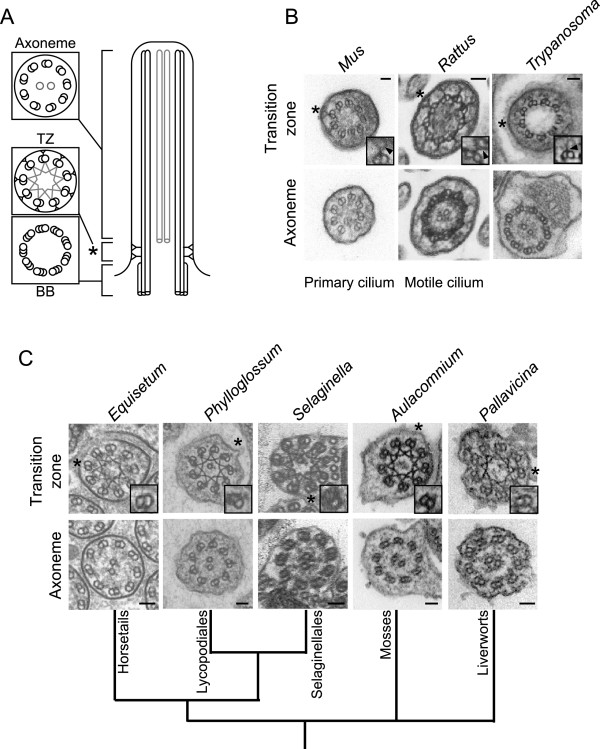
Using bioinformatics, we examined the evolutionary patterns of TZ complex proteins across the extant eukaryotic supergroups, in both ciliated and non-ciliated organisms. We show that TZ complex proteins are restricted to the proteomes of ciliated organisms and identify a core conserved group (TMEM67, CC2D2A, B9D1, B9D2, AHI1 and a single TCTN, plus perhaps MKS1) which are present in >50% of all ciliate/flagellate organisms analysed in each supergroup. The smaller NPHP complex apparently evolved later than the larger MKS complex; this result may explain why RPGRIP1L, which forms the linker between the two complexes, is not one of the core conserved proteins. We also uncovered a striking correlation between lack of TZ proteins in non-seed land plants and loss of TZ-specific ciliary Y-links that link microtubule doublets to the membrane, consistent with the interpretation that these proteins are structural components of Y-links, or regulators of their formation.
This bioinformatic analysis represents the first systematic analysis of the cohort of TZ complex proteins across eukaryotic evolution. Given the near-ubiquity of only 6 proteins across ciliated eukaryotes, we propose that the MKS complex represents a dynamic complex built around these 6 proteins and implicated in Y-link formation and ciliary permeability.
纤毛对于从运动到信号转导的多种功能至关重要,纤毛功能障碍会导致遗传性疾病,即纤毛病。几种纤毛病相关蛋白会影响发育信号传导,而异常信号传导解释了许多纤毛病的表型。纤毛的区室化对于其功能至关重要,位于纤毛近端的过渡区(TZ)最近已成为调节这一过程的关键因素。纤毛区室化与位于过渡区的两个蛋白质复合物,即MKS和NPHP复合物相关联,这两个复合物主要由纤毛病相关蛋白组成,由此产生了一个假说,即纤毛病相关蛋白通过调节纤毛成分来影响信号传导。然而,关于复合物的组成、形成或每个成分的作用尚无共识。
利用生物信息学,我们研究了现存真核生物超群中纤毛和非纤毛生物的过渡区复合物蛋白的进化模式。我们发现过渡区复合物蛋白仅限于纤毛生物的蛋白质组,并鉴定出一个核心保守组(跨膜蛋白67、CC2D2A、B9D1、B9D2、AHI1和单个TCTN,或许还有MKS1),在每个超群中分析的所有纤毛虫/鞭毛虫生物中,超过50%都存在这些蛋白。较小的NPHP复合物显然比较大的MKS复合物进化得更晚;这一结果可能解释了为何在两个复合物之间形成连接的RPGRIP1L不是核心保守蛋白之一。我们还发现非种子陆地植物中缺乏过渡区蛋白与过渡区特异性纤毛Y链(将微管双联体连接到膜上)的缺失之间存在显著相关性,这与这些蛋白是Y链的结构成分或其形成的调节因子的解释一致。
这项生物信息学分析代表了对真核生物进化过程中过渡区复合物蛋白群体的首次系统分析。鉴于在纤毛真核生物中仅有6种蛋白质几乎无处不在,我们提出MKS复合物是围绕这6种蛋白质构建的动态复合物,与Y链形成和纤毛通透性有关。