Ibhafidon Lawrence I, Obaseki Daniel O, Erhabor Gregory E, Akor Alexander A, Irabor Iziegbe, Obioh Ib
Environmental Management, Triple E Systems Associates Limited, Lagos, Nigeria.
Department of Medicine, Obafemi Awolowo University, Ile-Ife, Nigeria.
Niger Med J. 2014 Jan;55(1):48-53. doi: 10.4103/0300-1652.128164.
Particulate air pollution is associated with increased incidence of respiratory symptoms and decreased pulmonary, function but the relative impact of pollution from different domestic energy sources is not well-known or studied.
The study was aimed at assessing the association between particulate concentrations, respiratory symptoms and lung function.
It was a cross-sectional study comprised of randomly selected residents of three communities. These communities were selected according to the predominant type of fuel used for household cooking which were: firewood, kerosene and liquefied petroleum gas (LPG). Assessment of the indoor PM10 levels was done by filtration using the Gent stacked filter unit sampler for collection of atmospheric aerosol in two size fractions (PM2.5 and PM10). The Medical Research Council (MRC) questionnaire was administered followed by spirometry test.
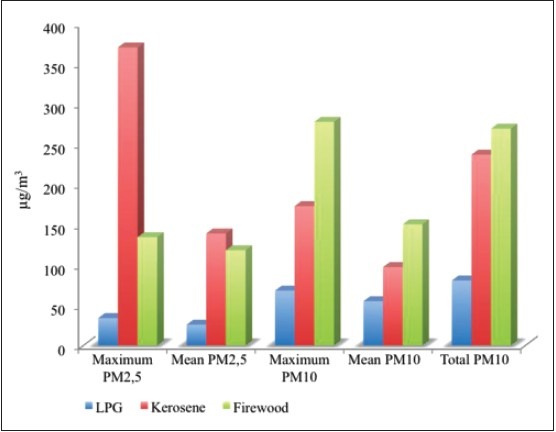
The mean PM10 concentration in participants using LPG, kerosene and firewood was 80.8 ± 9.52 μg/m(3), 236.9 ± 26.5 μg/m(3) and 269 ±93.7 μg/m(3), respectively. The mean age and height-adjusted percent predicted forced expiratory volumes in 1 s (FEV1) for men were 127 ± 7, 109 ± 40 and 91 ± 20 and for women were 129 ± 13, 115 ± 14, 100 ± 14 in users of LPG, kerosene and firewood, respectively. A similar trend was found in the forced vital capacity (FVCs). Users of firewood had significantly lower FEV1 and FVC compared with LPG users (P < 0.05). The participants using firewood had the highest prevalence of pulmonary and non-pulmonary symptoms (57.1%), whereas subjects using LPG had the lowest (23.8%).
There are high levels of particulate matter pollutions with respiratory effects in residential indoor environments in Ile-Ife, Nigeria.
颗粒物空气污染与呼吸道症状发生率增加及肺功能下降有关,但不同家庭能源产生的污染的相对影响尚不为人所知或得到充分研究。
本研究旨在评估颗粒物浓度、呼吸道症状与肺功能之间的关联。
这是一项横断面研究,由从三个社区随机选取的居民组成。这些社区是根据家庭烹饪所用的主要燃料类型来选择的,分别是:木柴、煤油和液化石油气(LPG)。使用Gent叠层过滤单元采样器通过过滤来评估室内PM10水平,以收集两个粒径级分(PM2.5和PM10)的大气气溶胶。先发放医学研究委员会(MRC)问卷,随后进行肺活量测定测试。
使用液化石油气、煤油和木柴的参与者的平均PM10浓度分别为80.8±9.52μg/m³、236.9±26.5μg/m³和269±93.7μg/m³。在液化石油气、煤油和木柴使用者中,男性1秒用力呼气量(FEV1)经年龄和身高调整后的预测百分比均值分别为127±7、109±40和91±20,女性分别为129±13、115±14、100±14。用力肺活量(FVC)也呈现类似趋势。与使用液化石油气的使用者相比,使用木柴的使用者的FEV1和FVC显著更低(P<0.05)。使用木柴的参与者肺部和非肺部症状的患病率最高(57.1%),而使用液化石油气的参与者患病率最低(23.8%)。
在尼日利亚伊费的住宅室内环境中,存在高水平的具有呼吸道影响的颗粒物污染。