Mesuraca Maria, Galasso Olimpio, Guido Leonardo, Chiarella Emanuela, Scicchitano Stefania, Vatrinet Renaud, Morrone Giovanni, Bond Heather M, Gasparini Giorgio
Laboratory of Molecular Haematopoiesis and Stem Cell Biology, Department of Experimental and Clinical Medicine, University of Catanzaro Magna Græcia, University Campus "Salvatore Venuta", Germaneto, 88100 Catanzaro, Italy.
Orthopedic and Trauma Surgery, Department of Medical and Surgical Sciences, University of Catanzaro Magna Græcia, University Campus "Salvatore Venuta", Germaneto, 88100 Catanzaro, Italy.
Mediators Inflamm. 2014;2014:318793. doi: 10.1155/2014/318793. Epub 2014 May 27.
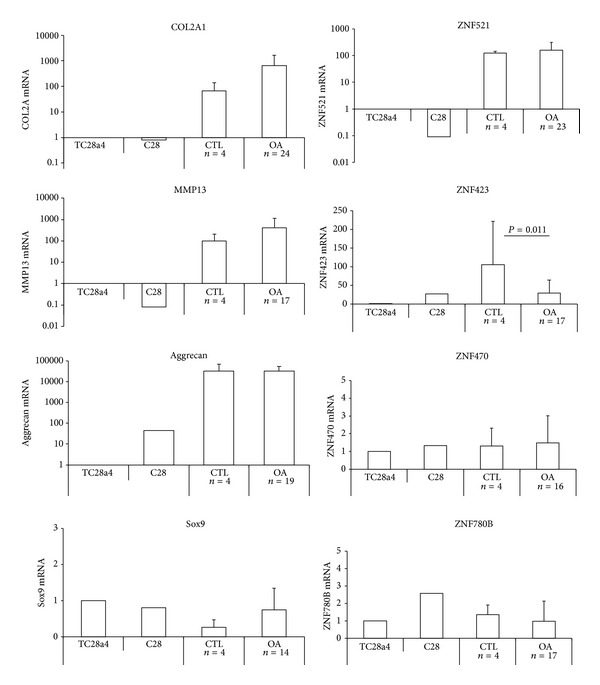
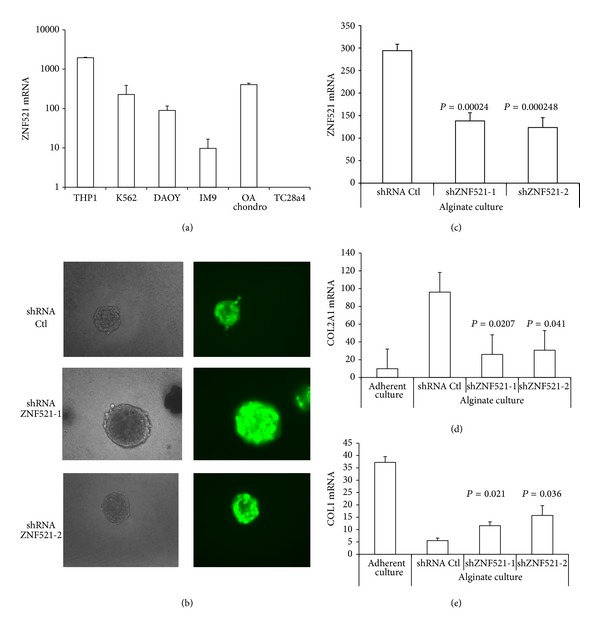
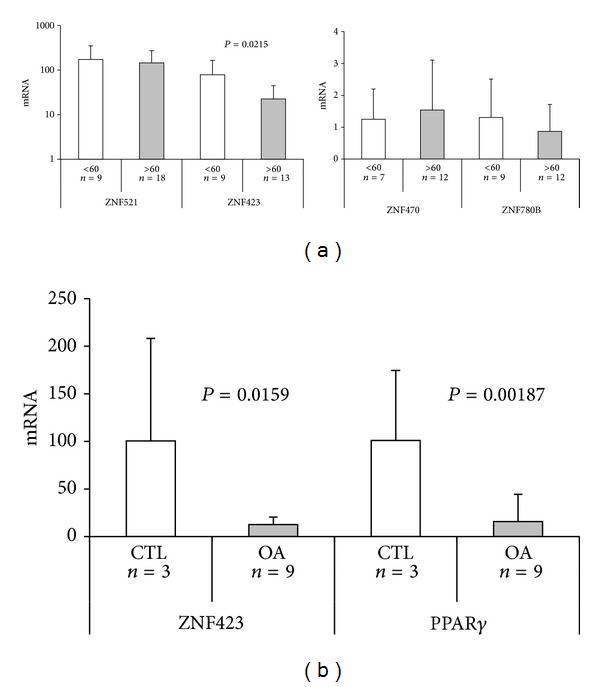
Articular chondrocytes are responsible for the maintenance of healthy articulations; indeed, dysregulation of their functions, including the production of matrix proteins and matrix-remodeling proteases, may result in fraying of the tissue and development of osteoarthritis (OA). To explore transcriptional mechanisms that contribute to the regulation of chondrocyte homeostasis and may be implicated in OA development, we compared the gene expression profile of a set of zinc finger proteins potentially linked to the control of chondrocyte differentiation and/or functions (ZNF423, ZNF470, ZNF521, and ZNF780B) in chondrocytes from patients affected by OA and from subjects not affected by OA. This analysis highlighted a significantly lower expression of the transcript encoding ZNF423 in chondrocytes from OA, particularly in elderly patients. Interestingly, this decrease was mirrored by the similarly reduced expression of PPARγ, a known target of ZNF423 with anti-inflammatory and chondroprotective properties. The ZNF521 mRNA instead was abundant in all primary chondrocytes studied; the RNAi-mediated silencing of this gene significantly altered the COL2A/COL1 expression ratio, associated with the maintenance of the differentiated phenotype, in chondrocytes cultivated in alginate beads. These results suggest a role for ZNF423 and ZNF521 in the regulation of chondrocyte homeostasis and warrant further investigations to elucidate their mechanism of action.
关节软骨细胞负责维持关节的健康;实际上,其功能失调,包括基质蛋白和基质重塑蛋白酶的产生,可能导致组织磨损和骨关节炎(OA)的发展。为了探索有助于调节软骨细胞稳态且可能与OA发展相关的转录机制,我们比较了一组可能与软骨细胞分化和/或功能控制相关的锌指蛋白(ZNF423、ZNF470、ZNF521和ZNF780B)在OA患者和未患OA受试者的软骨细胞中的基因表达谱。该分析突出显示,OA患者软骨细胞中编码ZNF423的转录本表达显著降低,尤其是在老年患者中。有趣的是,这种降低与PPARγ的表达降低相似,PPARγ是ZNF423的已知靶标,具有抗炎和软骨保护特性。相反,ZNF521 mRNA在所有研究的原代软骨细胞中都很丰富;在藻酸盐珠中培养的软骨细胞中,RNAi介导的该基因沉默显著改变了与维持分化表型相关的COL2A/COL1表达比率。这些结果表明ZNF423和ZNF521在调节软骨细胞稳态中发挥作用,值得进一步研究以阐明其作用机制。