Peng Nan, Meng Ning, Wang ShengQing, Zhao Fei, Zhao Jing, Su Le, Zhang ShangLi, Zhang Yun, Zhao BaoXiang, Miao JunYing
1] Shandong Provincial Key Laboratory of Animal Cells and Developmental Biology, School of Life Science, Shandong University, Jinan 250100, China [2].
1] School of Biological Science and Technology, University of Jinan, Jinan 250022, China [2] Institute of Organic Chemistry, School of Chemistry and Chemical Engineering, Shandong University, Jinan 250100, China [3].
Sci Rep. 2014 Jul 1;4:5519. doi: 10.1038/srep05519.
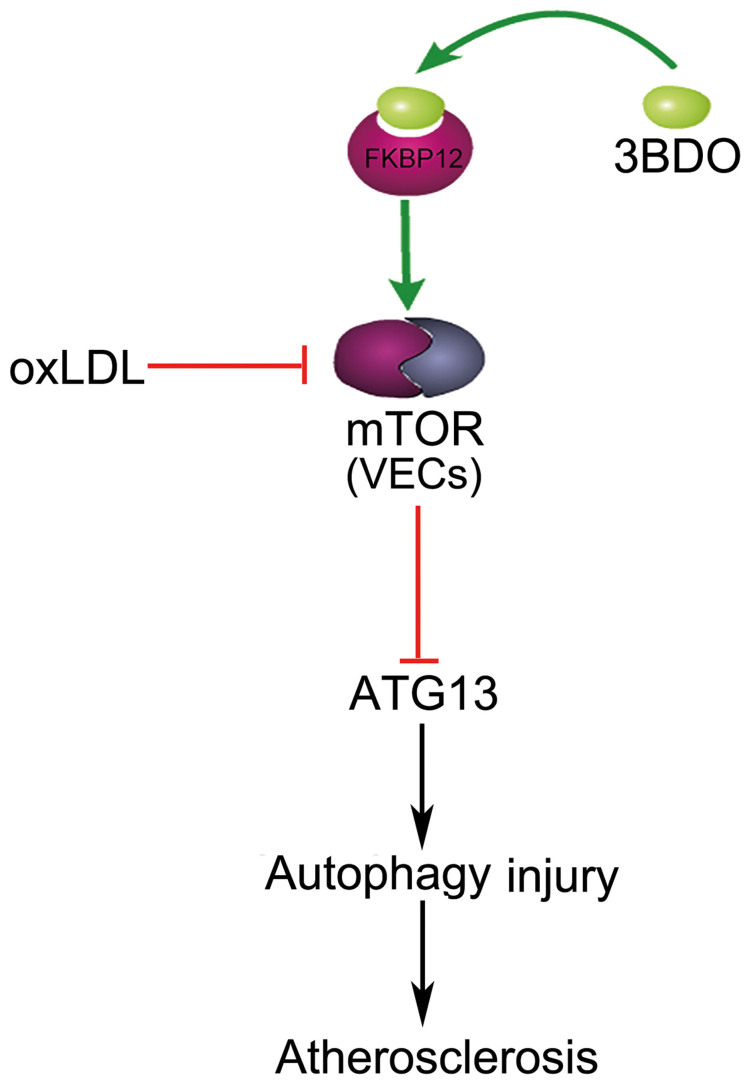
Oxidized low-density lipoprotein (oxLDL) inhibits mammalian target of rapamycin (mTOR) and induces autophagy and apoptosis in vascular endothelial cells (VECs) that play very critical roles for the cardiovascular homostasis. We recently defined 3-benzyl-5-((2-nitrophenoxy) methyl)-dihydrofuran-2(3H)-one (3BDO) as a new activator of mTOR. Therefore, we hypothesized that 3BDO had a protective role in VECs and thus stabilized atherosclerotic lesions in apolipoprotein E(-/-) (apoE(-/-)) mice. Our results showed that oxLDL inhibited the activity of mTOR and increased the protein level of autophagy-related 13 (ATG13) and its dephosphorylation, thus inducing autophagy in human umbilical vein endothelial cells (HUVECs). All of these effects were strongly inhibited by 3BDO. In vivo experiments confirmed that 3BDO activated mTOR and decreased the protein level of ATG13 in the plaque endothelium of apoE(-/-) mice. Importantly, 3BDO did not affect the activity of mTOR and autophagy in macrophage cell line RAW246.7 and vascular smooth muscle cells of apoE(-/-) mice, but suppressed plaque endothelial cell death and restricted atherosclerosis development in the mice. 3BDO protected VECs by activating mTOR and thus stabilized atherosclerotic lesions in apoE(-/-) mice.
氧化型低密度脂蛋白(oxLDL)抑制雷帕霉素哺乳动物靶点(mTOR),并在对心血管稳态起关键作用的血管内皮细胞(VECs)中诱导自噬和凋亡。我们最近将3-苄基-5-((2-硝基苯氧基)甲基)-二氢呋喃-2(3H)-酮(3BDO)定义为mTOR的一种新激活剂。因此,我们推测3BDO在VECs中具有保护作用,从而稳定载脂蛋白E基因敲除(apoE(-/-))小鼠的动脉粥样硬化病变。我们的结果表明,oxLDL抑制mTOR的活性,增加自噬相关蛋白13(ATG13)的蛋白水平及其去磷酸化,从而在人脐静脉内皮细胞(HUVECs)中诱导自噬。所有这些作用均被3BDO强烈抑制。体内实验证实,3BDO激活apoE(-/-)小鼠斑块内皮中的mTOR并降低ATG13的蛋白水平。重要的是,3BDO不影响巨噬细胞系RAW246.7和apoE(-/-)小鼠血管平滑肌细胞中mTOR的活性和自噬,但可抑制斑块内皮细胞死亡并限制小鼠动脉粥样硬化的发展。3BDO通过激活mTOR保护VECs,从而稳定apoE(-/-)小鼠的动脉粥样硬化病变。