Jacquet Gabrielle A, Obi Chioma C, Chang Mary P, Bayram Jamil D
Department of Emergency Medicine, Boston University School of Medicine, Boston, Massachusetts, USA; Center for Global Health and Development, Boston University, Boston, Massachusetts, USA.
Department of International Health, Johns Hopkins Bloomberg School of Public Health, Baltimore, Maryland, USA.
PLoS Curr. 2014 Jun 23;6:ecurrents.dis.626ae97e629eccd4756f20de04a20823. doi: 10.1371/currents.dis.626ae97e629eccd4756f20de04a20823.
Volunteers and members of relief organizations increasingly seek formal training prior to international field deployment. This paper identifies training programs for personnel responding to international disasters and complex humanitarian emergencies, and provides concise information - if available- regarding the founding organization, year established, location, cost, duration of training, participants targeted, and the content of each program.
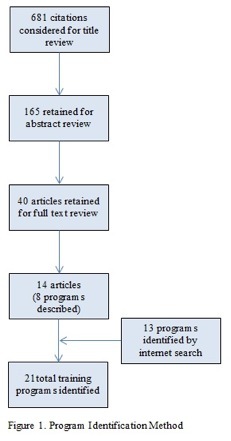
An environmental scan was conducted through a combination of a peer-reviewed literature search and an open Internet search for the training programs. Literature search engines included EMBASE, Cochrane, Scopus, PubMed, Web of Science databases using the search terms "international," "disaster," "complex humanitarian emergencies," "training," and "humanitarian response". Both searches were conducted between January 2, 2013 and September 12, 2013.
14 peer-reviewed articles mentioned or described eight training programs, while open Internet search revealed 13 additional programs. In total, twenty-one training programs were identified as currently available for responders to international disasters and CHE. Each of the programs identified has different goals and objectives, duration, expenses, targeted trainees and modules. Each of the programs identified has different goals and objectives, duration, expenses, targeted trainees and modules. Seven programs (33%) are free of charge and four programs (19%) focus on the mental aspects of disasters. The mean duration for each training program is 5 to 7 days. Fourteen of the trainings are conducted in multiple locations (66%), two in Cuba (9%) and two in Australia (9%). The cost-reported in US dollars- ranges from $100 to $2,400 with a mean cost of $480 and a median cost of $135. Most of the programs are open to the public, but some are only available by invitation only, such as the International Mobilization Preparation for Action (IMPACT) and the United Nations Humanitarian Civil-Military Coordination (UN-CMCoord) Field Course.
A variety of training programs are available for responders to disasters and complex humanitarian emergencies. These programs vary in their objectives, audiences, modules, geographical locations, eligibility and financial cost. This paper presents an overview of available programs and serves as a resource for potential responders interested in capacity-building training prior to deployment.
志愿者和救援组织成员在进行国际实地部署之前,越来越多地寻求接受正规培训。本文确定了针对应对国际灾难和复杂人道主义紧急情况的人员的培训项目,并提供了简明信息(如有),内容涉及创办组织、成立年份、地点、费用、培训时长、目标参与者以及每个项目的内容。
通过同行评审文献检索与公开网络搜索相结合的方式,对培训项目进行环境扫描。文献搜索引擎包括EMBASE、Cochrane、Scopus、PubMed、Web of Science数据库,使用的检索词为“国际”“灾难”“复杂人道主义紧急情况”“培训”和“人道主义应对”。两项搜索均在2013年1月2日至2013年9月12日期间进行。
14篇同行评审文章提及或描述了8个培训项目,而公开网络搜索又发现了另外13个项目。总共确定了21个培训项目,目前可供应对国际灾难和复杂人道主义紧急情况的人员使用。所确定的每个项目都有不同的目标、时长、费用、目标学员和模块。所确定的每个项目都有不同的目标、时长、费用、目标学员和模块。7个项目(33%)免费,4个项目(19%)关注灾难的心理方面。每个培训项目的平均时长为5至7天。14个培训在多个地点开展(66%),2个在古巴(9%),2个在澳大利亚(9%)。所报告的费用(以美元计)从100美元到2400美元不等,平均费用为480美元,中位数费用为135美元。大多数项目对公众开放,但有些项目仅通过邀请参与,例如国际行动动员准备(IMPACT)和联合国人道主义军民协调(UN-CMCoord)实地课程。
有多种培训项目可供应对灾难和复杂人道主义紧急情况的人员使用。这些项目在目标、受众、模块、地理位置、资格要求和财务成本方面各不相同。本文概述了可用项目,为有兴趣在部署前接受能力建设培训的潜在应对人员提供了参考资源。