Jin Yu, Díaz Begoña, Colomer Marc, Sebastián-Gallés Núria
Speech Acquisition and Perception Group, Center for Brain and Cognition, Department of Technology, Pompeu Fabra University, Barcelona, Spain.
PLoS One. 2014 Jul 3;9(7):e100901. doi: 10.1371/journal.pone.0100901. eCollection 2014.
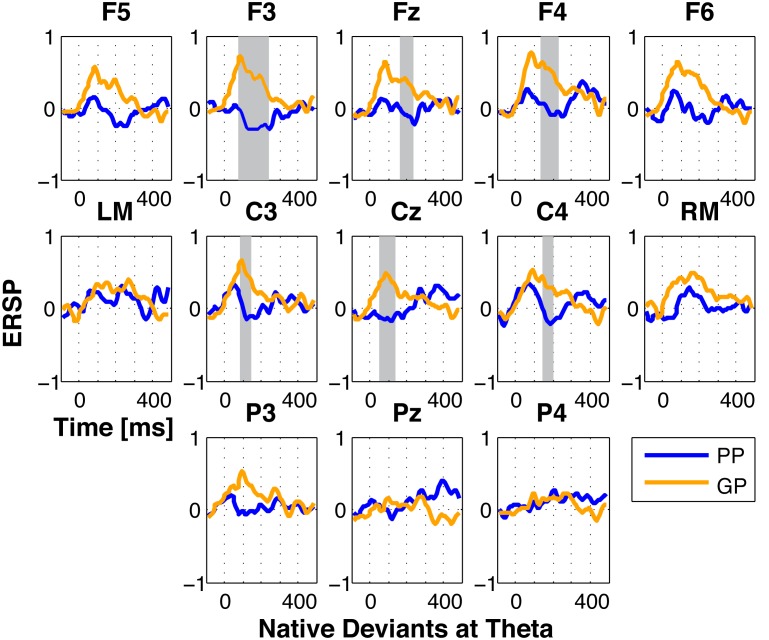
Individual differences in second language (L2) phoneme perception (within the normal population) have been related to speech perception abilities, also observed in the native language, in studies assessing the electrophysiological response mismatch negativity (MMN). Here, we investigate the brain oscillatory dynamics in the theta band, the spectral correlate of the MMN, that underpin success in phoneme learning. Using previous data obtained in an MMN paradigm, the dynamics of cortical oscillations while perceiving native and unknown phonemes and nonlinguistic stimuli were studied in two groups of participants classified as good and poor perceivers (GPs and PPs), according to their L2 phoneme discrimination abilities. The results showed that for GPs, as compared to PPs, processing of a native phoneme change produced a significant increase in theta power. Stimulus time-locked analysis event-related spectral perturbation (ERSP) showed differences for the theta band within the MMN time window (between 70 and 240 ms) for the native deviant phoneme. No other significant difference between the two groups was observed for the other phoneme or nonlinguistic stimuli. The dynamic patterns in the theta-band may reflect early automatic change detection for familiar speech sounds in the brain. The behavioral differences between the two groups may reflect individual variations in activating brain circuits at a perceptual level.
在评估电生理反应失配负波(MMN)的研究中,第二语言(L2)音素感知(在正常人群范围内)的个体差异与母语中观察到的语音感知能力有关。在此,我们研究了θ波段的脑振荡动力学,即MMN的频谱相关物,其是音素学习成功的基础。利用先前在MMN范式中获得的数据,根据两组参与者的L2音素辨别能力,将其分为优秀感知者(GPs)和较差感知者(PPs),研究了他们在感知母语和未知音素以及非语言刺激时皮质振荡的动力学。结果表明,与PPs相比,对于GPs而言,处理母语音素变化会使θ功率显著增加。刺激时间锁定分析事件相关频谱扰动(ERSP)显示,在MMN时间窗口(70至240毫秒之间)内,对于母语异常音素,θ波段存在差异。对于其他音素或非语言刺激,两组之间未观察到其他显著差异。θ波段的动态模式可能反映了大脑中对熟悉语音的早期自动变化检测。两组之间的行为差异可能反映了在感知水平上激活脑回路的个体差异。