Weisman Ronit, Cohen Adiel, Gasser Susan M
Department of Natural and Life Sciences, The Open University of Israel, Raanana, Israel
Department of Natural and Life Sciences, The Open University of Israel, Raanana, Israel.
EMBO Mol Med. 2014 Aug;6(8):995-1002. doi: 10.15252/emmm.201403959.
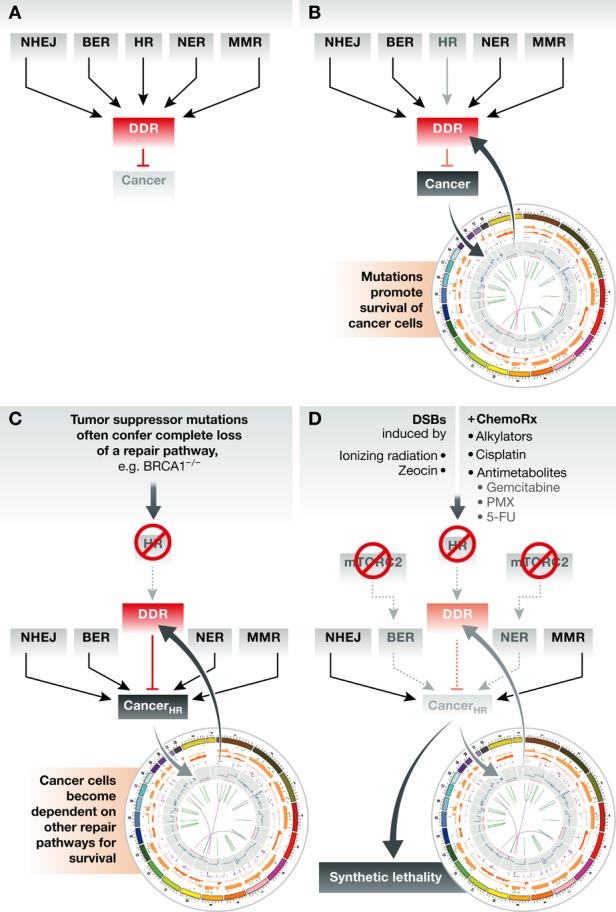
The inhibition of the central growth regulatory kinase TOR, which participates in two complexes, TORC1 and TORC2, has been a focus of metabolic and cancer studies for many years. Most studies have dealt with TORC1, the canonical target of rapamycin, and the role of this complex in autophagy, protein synthesis, and cell growth control. Recent work on TORC2 in budding and fission yeast species points to a conserved role of this lesser-known TOR complex in the survival of DNA damage. In budding yeast, TORC2 controls lipid biosynthesis and actin cytoskeleton through downstream AGC kinases, which are now, surprisingly, implicated in the survival of oxidative DNA damage. Preliminary data from mTORC2 modulation in cancer cells suggest that an extension to human chemotherapy is worth exploring.
参与TORC1和TORC2两种复合物的中枢生长调节激酶TOR的抑制作用,多年来一直是代谢和癌症研究的重点。大多数研究都围绕雷帕霉素的典型靶点TORC1以及该复合物在自噬、蛋白质合成和细胞生长控制中的作用展开。近期针对芽殖酵母和裂殖酵母中TORC2的研究表明,这个鲜为人知的TOR复合物在DNA损伤存活方面具有保守作用。在芽殖酵母中,TORC2通过下游AGC激酶控制脂质生物合成和肌动蛋白细胞骨架,令人惊讶的是,这些激酶现在与氧化性DNA损伤的存活有关。癌细胞中mTORC2调节的初步数据表明,将其扩展应用于人类化疗值得探索。