Kobayashi Hiromitsu, Kakihana Wataru, Kimura Tasuku
Department of Nursing, Ishikawa Prefectural Nursing University, 1-1 Gakuendai, Kahoku, Ishikawa 929-1212, Japan.
J Neuroeng Rehabil. 2014 Jul 4;11:109. doi: 10.1186/1743-0003-11-109.
The gait of a healthy person is believed to be more regular and symmetrical than those of an individual with a disease. Thus, symmetry and regularity are important indicators of human gait.
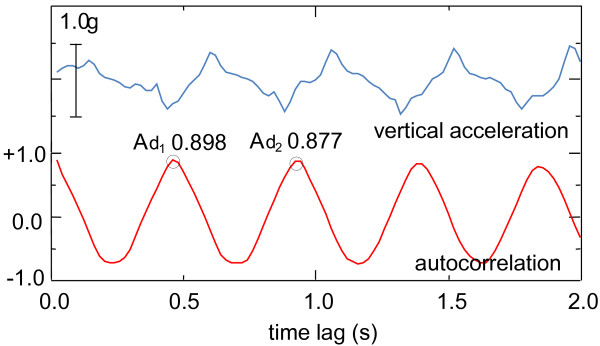
The effects of age and gender on gait symmetry and regularity were investigated in 87 Japanese participants by measuring trunk accelerometry during a 7-m walk. The younger group included 26 female and 21 male students, and the elderly group included 24 females and 16 males. Average age for each group was 20 and 70 years, respectively. Gait symmetry and regularity were evaluated on the basis of autocorrelation functions of trunk accelerations of vertical and anteroposterior axes.
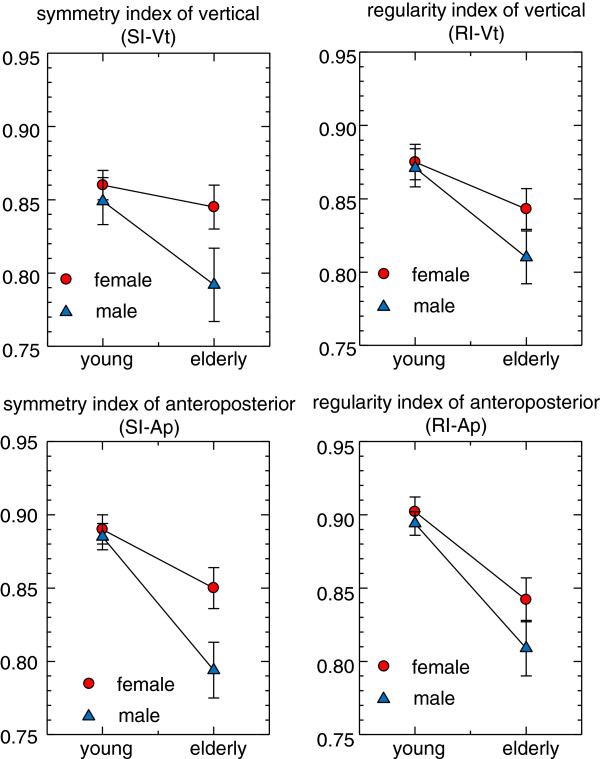
The relationship between age and gait symmetry and regularity was statistically significant for both vertical and anteroposterior axes. Elderly participants showed lower symmetry and regularity in their gait than young participants. A significant gender effect was observed for the symmetry index of both axes but not for the regularity index. Male participants showed lower gait symmetry than females. An interaction effect between age and gender was significant in the symmetry index of anteroposterior acceleration. Gender effect was appeared more clearly in elderly than young participants.
Elderly participants showed a more asymmetrical and irregular gait than young participants. In addition to age, a significant gender effect was observed on gait symmetry. However, the effect size of gender was smaller than that of age, and it was not significant for gait regularity. The gait indices obtained by autocorrelation of trunk acceleration can be considered useful to evaluate aging effect on gait.
一般认为,健康人的步态比患病个体的步态更规律、更对称。因此,对称性和规律性是人类步态的重要指标。
通过测量87名日本参与者在7米步行过程中的躯干加速度,研究年龄和性别对步态对称性和规律性的影响。年轻组包括26名女学生和21名男学生,老年组包括24名女性和16名男性。每组的平均年龄分别为20岁和70岁。基于垂直轴和前后轴的躯干加速度自相关函数评估步态对称性和规律性。
年龄与步态对称性和规律性之间的关系在垂直轴和前后轴上均具有统计学意义。老年参与者的步态对称性和规律性低于年轻参与者。在两个轴的对称性指数上观察到显著的性别效应,但在规律性指数上未观察到。男性参与者的步态对称性低于女性。年龄和性别之间的交互作用在前后加速度的对称性指数上具有统计学意义。性别效应在老年参与者中比在年轻参与者中表现得更明显。
老年参与者的步态比年轻参与者更不对称、更不规律。除年龄外,在步态对称性上还观察到显著的性别效应。然而,性别的效应量小于年龄的效应量,并且对步态规律性不显著。通过躯干加速度自相关获得的步态指数可被认为有助于评估衰老对步态的影响。