Gordon Anthony C, Mason Alexina J, Perkins Gavin D, Ashby Deborah, Brett Stephen J
Section of Anaesthetics, Pain Medicine and Intensive Care, Department of Surgery and Cancer, Imperial College London, London, UK Centre for Perioperative Medicine and Critical Care Research, Imperial College Healthcare NHS Trust, London, UK.
Imperial Clinical Trials Unit, School of Public Health, Faculty of Medicine, Imperial College London, London, UK.
BMJ Open. 2014 Jul 3;4(7):e005866. doi: 10.1136/bmjopen-2014-005866.
Vasopressin is an alternative vasopressor in the management of septic shock. It spares catecholamine use but whether it improves outcome remains uncertain. Current evidence suggests that it may be most effective if used early and possibly in conjunction with corticosteroids. This trial will compare vasopressin to noradrenaline as initial vasopressor in the management of adult septic shock and investigate whether there is an interaction of vasopressin with corticosteroids.
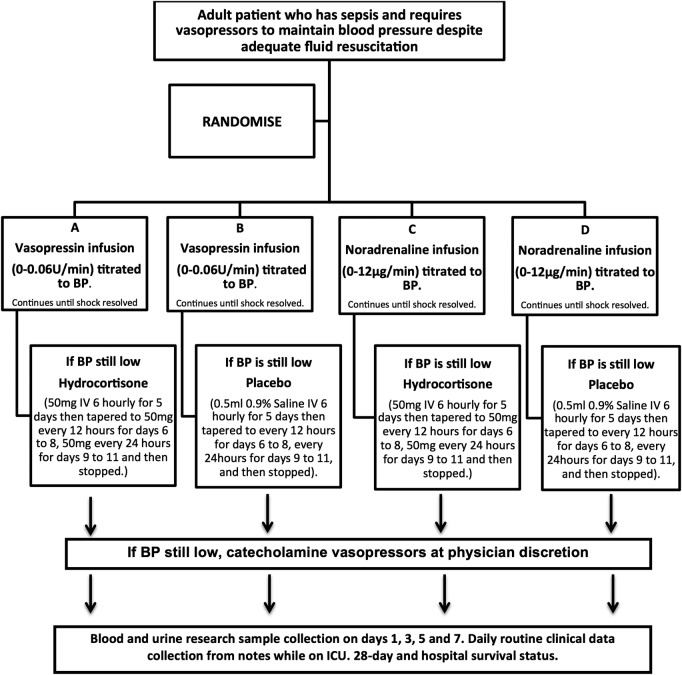
This is a multicentre, factorial (2×2), randomised, double-blind, placebo-controlled trial. 412 patients will be recruited from multiple UK intensive care units and randomised to receive vasopressin (0-0.06 U/min) or noradrenaline (0-12 µg/min) as a continuous intravenous infusion as initial vasopressor therapy. If maximum infusion rates of this first study drug are reached, the patient will be treated with either hydrocortisone (initially 50 mg intravenous bolus six-hourly) or placebo, before additional open-label catecholamine vasopressors are prescribed. The primary outcome of the trial will be the difference in renal failure-free days between treatment groups. Secondary outcomes include need for renal replacement therapy, survival rates, other organ failures and resource utilisation.
The trial protocol and information sheets have received a favourable opinion from the Oxford A Research Ethics Committee (12/SC/0014). There is an independent Data Monitoring and Ethics Committee and independent membership of the Trial Steering Committee including patient and public involvement. The trial results will be published in peer-reviewed journals and presented at national and international scientific meetings.
ISRCTN 20769191 and EudraCT 2011-005363-24.
血管加压素是治疗感染性休克的一种替代性血管活性药物。它可减少儿茶酚胺的使用,但能否改善预后仍不确定。目前的证据表明,如果早期使用,可能与皮质类固醇联合使用时最为有效。本试验将比较血管加压素与去甲肾上腺素作为成人感染性休克初始血管活性药物的疗效,并研究血管加压素与皮质类固醇之间是否存在相互作用。
这是一项多中心、析因(2×2)、随机、双盲、安慰剂对照试验。将从英国多个重症监护病房招募412名患者,随机接受血管加压素(0 - 0.06 U/分钟)或去甲肾上腺素(0 - 12 μg/分钟)持续静脉输注作为初始血管活性药物治疗。如果达到第一种研究药物的最大输注速率,在开具额外的开放标签儿茶酚胺类血管活性药物之前,患者将接受氢化可的松(初始剂量为50 mg静脉推注,每6小时一次)或安慰剂治疗。试验的主要结局将是治疗组之间无肾衰竭天数的差异。次要结局包括肾脏替代治疗的需求、生存率、其他器官功能衰竭和资源利用情况。
试验方案和信息表已获得牛津A研究伦理委员会的批准(12/SC/0014)。有一个独立的数据监测和伦理委员会,试验指导委员会有独立成员,包括患者和公众参与。试验结果将在同行评审期刊上发表,并在国内和国际科学会议上展示。
ISRCTN 20769191和EudraCT 2011 - 005363 - 24。