Soil and Water Science Department, University of Florida-IFAS, Gainesville, FL, USA.
Microbiology and Cell Science Department, University of Florida-IFAS, Gainesville, FL, USA.
AMB Express. 2014 Jun 5;4:42. doi: 10.1186/s13568-014-0042-y. eCollection 2014.
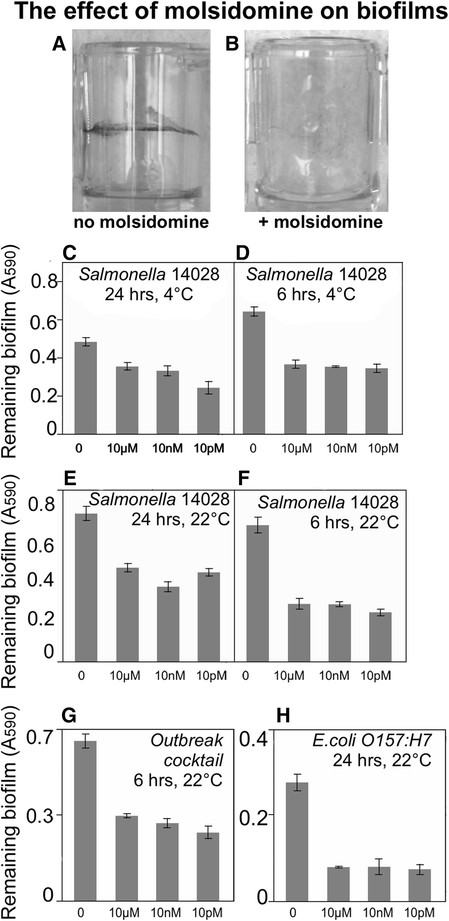
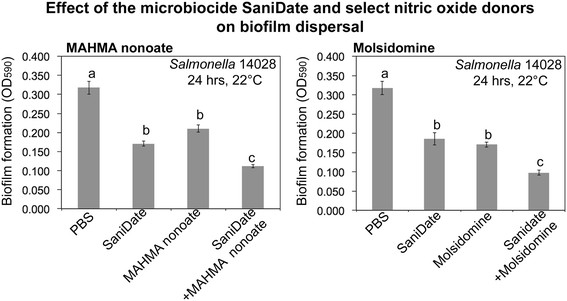
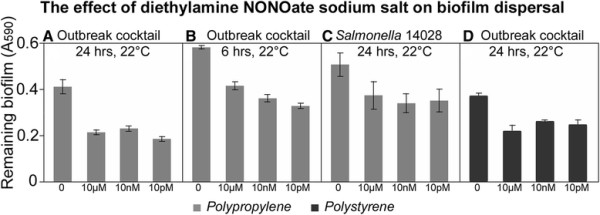
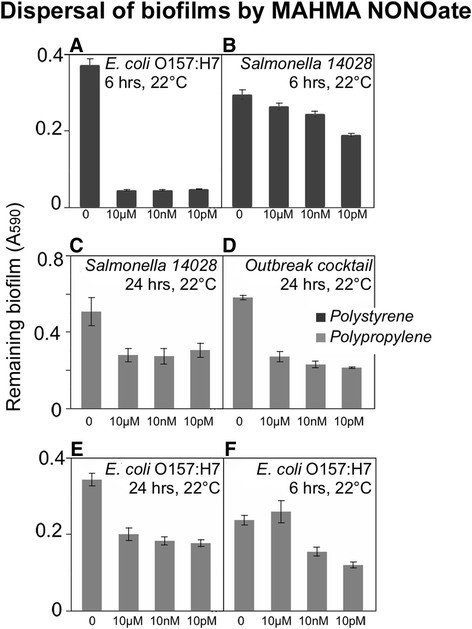
Biofilms in the industrial environment could be problematic. Encased in extracellular polymeric substances, pathogens within biofilms are significantly more resistant to chlorine and other disinfectants. Recent studies suggest that compounds capable of manipulating nitric oxide-mediated signaling in bacteria could induce dispersal of sessile bacteria and provide a foundation for novel approaches to controlling biofilms formed by some microorganisms. In this work, we compared the ability of five nitric oxide donors (molsidomine, MAHMA NONOate, diethylamine NONOate, diethylamine NONOate diethylammonium salt, spermine NONOate) to dislodge biofilms formed by non-typhoidal Salmonella enterica and pathogenic E. coli on plastic and stainless steel surfaces at different temperatures. All five nitric oxide donors induced significant (35-80%) dispersal of biofilms, however, the degree of dispersal and the optimal dispersal conditions varied. MAHMA NONOate and molsidomine were strong dispersants of the Salmonella biofilms formed on polystyrene. Importantly, molsidomine induced dispersal of up to 50% of the pre-formed Salmonella biofilm at 4°C, suggesting that it could be effective even under refrigerated conditions. Biofilms formed by E. coli O157:H7 were also significantly dispersed. Nitric oxide donor molecules were highly active within 6 hours of application. To better understand mode of action of these compounds, we identified Salmonella genomic region recA-hydN, deletion of which led to an insensitivity to the nitric oxide donors.
工业环境中的生物膜可能会造成问题。生物膜中的病原体被包裹在细胞外聚合物中,对氯和其他消毒剂的抵抗力显著增强。最近的研究表明,能够操纵细菌中一氧化氮介导的信号转导的化合物可以诱导固定细菌的分散,并为控制某些微生物形成的生物膜提供新的方法奠定基础。在这项工作中,我们比较了五种一氧化氮供体(molsidomine、MAHMA NONOate、二乙胺 NONOate、二乙胺 NONOate 二乙铵盐、亚精胺 NONOate)在不同温度下在塑料和不锈钢表面上分散非伤寒沙门氏菌和致病性大肠杆菌形成的生物膜的能力。所有五种一氧化氮供体都能显著(35-80%)分散生物膜,但分散程度和最佳分散条件有所不同。MAHMA NONOate 和 molsidomine 是聚苯乙烯上形成的沙门氏菌生物膜的强分散剂。重要的是,molsidomine 可诱导高达 50%的预形成沙门氏菌生物膜在 4°C 下分散,表明即使在冷藏条件下也可能有效。大肠杆菌 O157:H7 形成的生物膜也被显著分散。一氧化氮供体分子在应用后 6 小时内高度活跃。为了更好地了解这些化合物的作用机制,我们鉴定了沙门氏菌基因组区域 recA-hydN,该区域的缺失导致对一氧化氮供体不敏感。